
A price rise is going out to thousands of customers, and a letter or SMS gets ignored. A rushed human call can start a fight. AI voice calls can notify customers about price changes, check they understood, and record each answer.
Set the rules before you dial
Check the law for every region you call into, because the script has to carry the rules. Four examples:
- US: AI-voice calls already need consent under the TCPA, following the FCC's 2024 ruling. The proposed "say it is AI at the start of the call" rule was still not final as of mid-2026. Open with the disclosure anyway.
- EU: Article 50 of the AI Act has applied since 2 Aug 2026. Any AI that talks to people, including automated phone systems, must say it is AI from the first interaction.
- Colorado: The Chatbot Safety Act takes effect on 1 Jan 2027. It requires any public-facing conversational AI to disclose that it is AI.
- Regulated sectors (banks, lenders, telecoms, insurers): Notice rules for fee and price changes, such as a minimum notice period or a written format, can apply. Ask your compliance lead which ones cover you and whether a call can serve as the notice.
Build the human route into the script from the start. Gartner found that 87% of 3,566 customers say a company using GenAI for service must offer a way to reach a human. Your agent should say how to reach a person in the first call.
Before launch, check that your tool has consent marking, calling hours, retry rules, a do-not-contact list, a test call and a browser test of the agent.
Write a short, plain notice script
Keep the call under a minute, and put the facts in a fixed order. Customers remember the first and last things they hear, so make those the amount and the next step.
- Opener: Say who is calling, that it is an AI assistant, and why. Say how to reach a person.
- The change: State the new amount, then the start date, then the reason in one sentence.
- The options: Name what the customer can do, such as keep the plan, change plan or talk to a person.
- The check: Ask them to say the change back (next step below).
Use plain words and short sentences. Say "your monthly bill goes from 20 to 24 dollars on 1 March" and avoid "adjustment to your fee schedule." Say each number once, slowly, and repeat only the amount at the end. Leave out anything the agent was not given. A sample opener: "Hello, this is an AI assistant calling for Northside Mobile. I'm calling about a change to your monthly price. You can ask for a person at any time."
Ask them to say it back
Ask the customer to repeat the change, because "Do you understand?" only earns a polite yes. Use teach-back instead. Ask "Can you tell me your new monthly amount?" or a closed question such as "Will you be on the new plan from 1 March?" A wrong amount or date shows you a gap right away.
Define three outcomes before launch, and give the agent one move for each:
- Understood and accepted: Restate the figure once, thank them, and end the call. Send an SMS with the same numbers.
- Understood but disputes it: Acknowledge the concern and tag the objection type. Then offer a person or an approved option.
- Did not understand, or not reached: Say it again in simpler words, once. Then offer a callback or schedule a repeat call.
Count "reached" strictly. A call where only the AI spoke is not a reached call, so a voicemail or a silent line never counts as a customer who was told. A carrier's temporary refusal should not use up one of the customer's retries either. Set retry rules and calling hours per campaign (check the detail in the app), and test the window. Mornings and evenings can answer better than midday, so try more than one start time.
A notice call can work in two steps: confirm first, then follow up on anyone who disputed or did not pick up. Some customers prefer a message to a call. So send the SMS after the call, with the same figures.
Plan for objections and handoffs
Give the agent a short answer for each common objection, and keep every answer inside what the business has approved. Each answer follows four moves: acknowledge, give the reason in one sentence, state the options, then stop.
- "Why?" Name the reason once, in plain words, such as higher supplier costs or a new service. Don't add detail the agent was not given.
- "That's too much." Acknowledge it, restate the exact new amount, and offer only the approved options.
- "I'll cancel." Don't argue or bargain. Offer a person, and tag the call as a cancellation risk.
- "I never agreed to this." Treat it as a dispute. Don't debate the contract. Hand over to a person.
- "Let me talk to a person." Say yes at once.
Set the allowed offers before launch, such as a fee waiver for a set period, a payment delay, or a move to a cheaper plan. The agent may offer only items on that list. Regulated buyers, banks first, name an AI that "goes rogue" as their main blocker. Hard limits on what the agent may say answer that fear.
Design the handoff as carefully as the script. Buyers ask whether it is polite, what happens to a disputed amount, and whether anyone chases a handover nobody picked up. Transfer on a cancellation threat, a dispute, a complaint or a vulnerable customer. The agent should say a named team will call back. The handover should carry the transcript and outcome tag, so the customer never repeats the story.
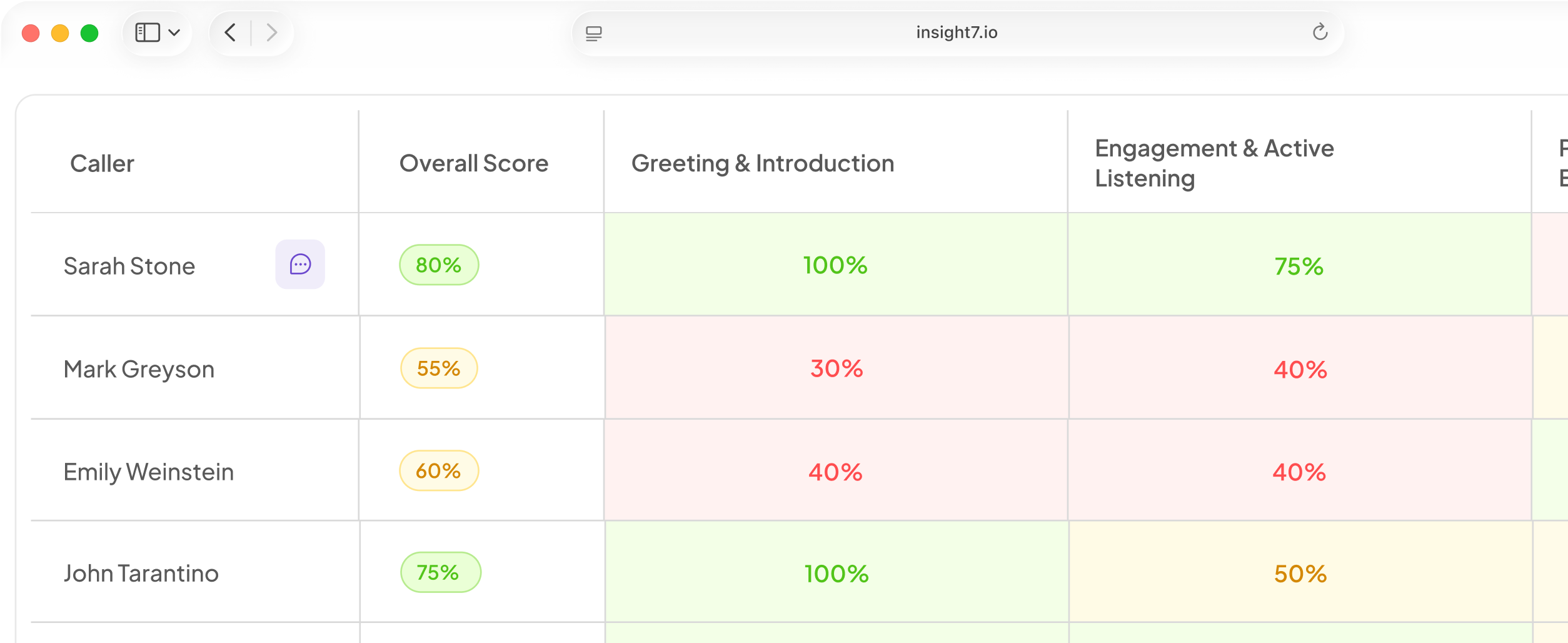
Insight7's voice campaigns are in beta. A campaign has consent marking, calling hours, retry rules and a do-not-call list, though you should check the detail in the app first. You can test the agent by talking to it in the browser, with no phone number needed. After launch, score every call against a weighted scorecard your team owns. QA leaders say one critical error should fail the whole call. So weight a "no unapproved offers" criterion heavily, and one wrong promise sinks the score.
Log every answer and read the drop-off
Log five fields for every call: the outcome (understood, disputed, no answer, asked for a human), the objection type, the customer's exact words, the follow-up owner and a timestamp. Choose a tool whose dashboard shows calls in progress and a transcript after each call. It should also pull yes/no answers and outcomes from that transcript. Spot-check that each outcome matches the transcript. An "understood" tag on a mumbled reply can hide a dispute.
Drop-off happens at four points. Fix them in this order:
- Not reached: Track answer rate by hour and by number. Change the call time or use a local number first.
- Hung up early: Track the share of calls that end in the first seconds. Rewrite the opener.
- Understood, then churned: Track cancellations in the weeks after the call. Review your list of allowed offers.
- Disputed and escalated: Track how many there are and how fast someone follows up. Review the handoff.
Score a sample of calls against your rubric. Alerts can be set on low scores and on words like "cancel" or "complaint" (check this in the app first). Sync outcomes to your CRM and share the call link with whoever follows up.
To prove the campaign worked, compare churn, complaint rate and support contacts before and after. Gartner reviewed 432 AI customer-service use cases. Only a quarter showed positive ROI, and 42% could not be measured (Customer Experience Dive).
Start small. Banks want a short, low-risk pilot before they pay for anything.
Related reading: How to Recover Failed Payments and Expired Cards With AI Outbound Calls, AI Voice Agent Use Cases for Customer Onboarding, Activation and Retention With Examples and How to Increase Account Funding Rates for Fintech and Investment Apps With AI Outbound Calls.
Questions people also ask
Do I need consent to send price change notices by AI voice call?
Treat consent as required. In the US, AI-voice calls already need consent under the TCPA. Rules differ by region and call type, so ask your legal team and mark consent on every contact.
Does an AI voice agent have to say it is an AI?
In the EU, yes, since 2 Aug 2026. Colorado adds the same duty from 1 Jan 2027. Where no rule applies yet, say it anyway. A plain opener also sounds less like a scam.
Can a phone call count as the official notice of a price or fee change?
It depends on your regulator and sector. Some set notice periods or written formats. Check with your compliance lead, send the written notice if required, and keep the call transcript as proof.
How many times should I retry a customer who does not pick up?
Start with 3 to 4 attempts, because many customers answer on the second or third try. Spread them across different hours. A carrier refusal should not use up an attempt.
What should an AI agent say when a customer says they will cancel?
It should acknowledge the concern, restate the new amount once, and offer only pre-approved options, such as a waiver, a delay or a cheaper plan. Then it offers a person and tags the call as a cancellation risk.
When should an AI voice call hand over to a human?
Hand over on a cancellation threat, a dispute, a complaint or a vulnerable customer. Hand over at once if asked, because 87% of customers expect that route. Also hand over after two failed teach-back checks.
How do I know customers understood the price change?
Ask them to say the new amount or date back, then check the transcript. Outcomes can be pulled from it. The share of wrong restatements shows which script part confuses people.
Say it back, then hand it over
A notice call works when the customer can say the change back and a person can take any dispute. Before you start, check one thing: that your compliance lead has confirmed whether the call counts as the official notice.