
You must decide which AI call center vendors to shortlist, and whether to buy QA, coaching, live assist or voice agents first. That depends on how clearly your RFP for AI call center software states the problem, data rules, stack and success measure.
Copy this RFP template
Paste this into your own document. Ask vendors to answer in your numbered format.
1. Background and goal
- Company, team size, monthly call volume, channels and current tools.
- The one job to be done: QA, coaching, live assist or voice agents.
- Baseline number, target number and review date.
2. Functional requirements
- Score every call against a weighted scorecard we own.
- Critical-error rules that fail a whole call.
- Calibration: reviewers can override and tune AI scores.
- Coaching tasks created from weak calls.
3. AI accuracy testing
- Vendor scores our 20 recordings. We compare to a human answer key.
- Languages, accents and noisy audio supported.
4. Integrations and stack
- Telephony, meeting tools, CRM and helpdesk we use.
- Write-back to CRM, API access and export formats.
- Replace or plug into our stack: state which.
5. Security and data
- Where recordings live, which AI models touch them, who owns them.
- Retention, deletion, redaction of personal data.
- Security reports held, such as SOC 2.
6. Compliance and AI disclosure
- Consent, calling hours, retry rules and recording rules by region.
- Disclosure that callers are speaking to AI.
- Audit trail and model validation.
7. Human handover (voice agents)
- Triggers, tone, sensitive issues, disputed amounts.
- Who chases a handover nobody picked up.
8. Pilot and success measure
- Small-sample pilot, one success measure, payment after measured lift.
9. Pricing
- One sheet: platform, per-seat or per-minute, integration, support, overage.
- Total cost at current volume and at double.
10. References and support
- Two references from similar sectors, onboarding plan, support hours.
11. Scoring table
| Section | Weight |
|---|---|
| Functional fit | 30% |
| Accuracy on our calls | 20% |
| Integrations | 15% |
| Security and compliance | 20% |
| Price | 15% |
How to use the template and score replies
Start by defining the problem. Pick one job to be done and put it in the first line of your RFP. If you ask for all four jobs at once, vendors answer a vague brief, and you can't compare vague answers.
Next, record one baseline number to beat. Manual QA is traditionally a 2 to 5% sample of calls, while AI call scoring is built to evaluate 100% of conversations, so check your own sample rate. Coverage makes a good baseline because you can count it today.
Put measurement in from the start. In a Gartner analysis of 432 AI customer-service use cases, only a quarter produced a positive return, and 42% had unclear ROI because leaders could not say what value they got. Write down the metric, the baseline and a review date. A QA lead might ask for "100% of calls scored, and a coaching task created within two days."
Then gather your stakeholders. Name the people who must sign off before you write the RFP: ops, QA, IT or security, compliance, finance and the budget holder. Deals stall when the person in the room is not the user or the budget holder. Ask finance to set the cost to beat, because champions need numbers they can carry upstairs.
Agree the timeline and the score sheet before vendors reply. Give each section a weight. Changing weights after you see the answers invites arguments. Build in a short pilot too. Banks ask for a small-sample pilot, with payment only after a measured lift, and we advise any buyer to do the same. Write the order of demo, pilot and commercial terms into the RFP.
Send the RFP to four to six vendors with the same deadline. Fewer than four gives you little contrast. More than six buries your team in reading. Ask each vendor for pricing in writing, and ask for a range early. Buyers want prices on paper so they can compare vendors and brief their own teams.
Score every reply on the weighted sheet you fixed with your stakeholders. Read answers for evidence. Good replies name a method, a number and a customer. Weak replies use words like "high accuracy" with no test behind them.
Then run the demo on your own calls. Give each shortlisted vendor the same 20 recordings, and keep a human-scored answer key. Compare each tool's scores to the key. Vendor demo audio is clean. Your accents, noise and call types will show the real gaps. Before any payment, ask for a written pilot plan with one success measure.
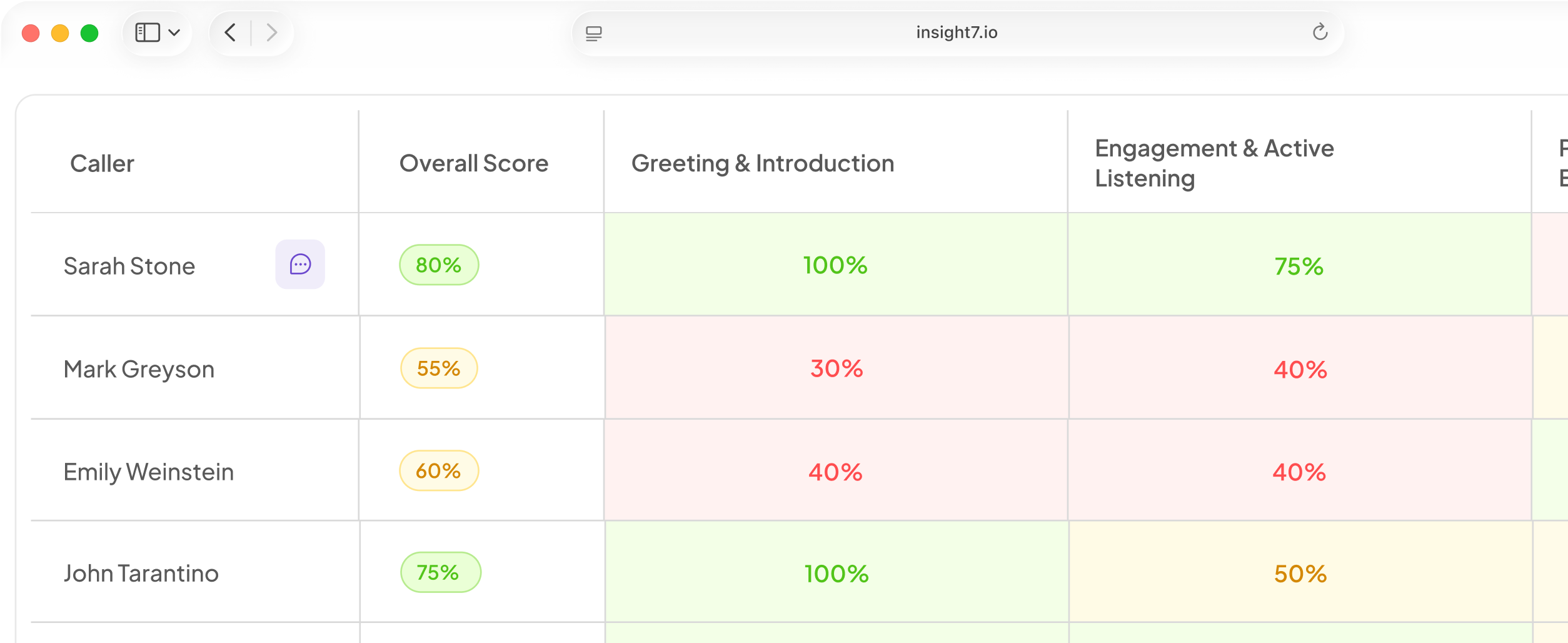
Insight7 is one option to put through this test. It scores every call against a weighted scorecard your team owns, and starter rubrics give you a scorecard to begin from. It connects with Zoom, Teams, Google Meet, Dialpad, Aircall and RingCentral. Live Assist coaches an agent during a live call from a playbook the manager sets. Outbound voice campaigns are in beta. You can try the free Call Quality Monitor on your own recordings first.
How to adapt the template to your use case
Weight up the sections that match your job, and cut the rest. A QA-only buyer can drop the voice agent and telephony rows. Put the weight on scorecard design and on matching the human auditor. One critical error should fail the whole call.
A voice-agent buyer adds consent marking, calling hours, retry rules, language coverage, a test call and the handover design. Buyers often ask whether the handover is polite, and who chases one nobody picked up.
A regulated buyer adds model validation and an audit trail. Regulators in several regions are moving this way. Nigeria's central bank, for one, now expects transparency, governance and independent model validation at least yearly. Ask for proof from real deployments, not a better demo.
Keep the RFP under about 15 pages. Watch for vague accuracy claims, no test on your audio, and integration fees that appear only in the fine print.
Related reading: Build vs Buy AI Voice Agents Decision Framework for Engineering and CX Leaders and AI Voice Agent Reliability Checklist for Carrier Failover, Uptime Monitoring and Concurrency Limits.
Questions people also ask
What is an RFP for AI call center software?
It is a written request that asks vendors to propose a solution for your calls. It states your problem, requirements, data rules and success measure. Vendors reply with answers, a test plan and itemised pricing.
What should be included in an AI call center software RFP?
Cover the problem, functional needs, AI testing, integrations, security, compliance, handover, pilot terms, pricing and references. Add a scoring table. Numbered answers let you line up replies row by row.
How long should an RFP for call center software be?
Use tables with one answer cell per row, so replies stay short. Attach your scorecard and test recordings as appendices instead of pasting them into the body.
How many vendors should I send an AI call center RFP to?
After scoring, cut the list to two or three finalists. Only finalists get your recordings and a pilot, because each test costs real review time.
What is the difference between an RFP, RFI and RFQ for call center software?
An RFI gathers general information about vendors. An RFP asks for a full proposal with approach, testing and price. An RFQ asks only for a price against a fixed specification.
What questions should I ask AI call center software vendors?
Ask for accuracy on your own audio, and how scores are checked against human reviewers. Ask where recordings live, which AI models touch them, and who owns them. Ask what a human handover looks like.
How do I compare AI call center software pricing in an RFP?
Give every vendor one price sheet listing each fee: platform, per-minute or per-seat, integration, support and overage. Per-minute pricing can climb with volume, so ask for the total at double your volume.
Test vendors on your own calls
A good RFP states one measurable problem and tests every vendor on your own calls. The scorecard, the answer key and the pilot measure keep the choice fair. This week, pick 20 real recordings, have a human score them, and attach them as the test set.