
Caller authentication methods for AI phone agents are the checks an agent uses to prove a caller owns the account before sharing data or acting. Cloned voices and spoofed caller ID now defeat single checks, so layer methods by request risk.
Four methods trade security for effort
Each method proves a different thing, and each fails in a different way. I score them on two axes. Security is what an attacker needs to beat the check. Customer effort is the steps, time and device the caller needs.
| Method | What it proves | Main attack | Customer effort | Cost and integration | Best use |
|---|---|---|---|---|---|
| Knowledge questions | Caller knows a fact | Leaked or guessable answers | Medium. Caller must recall and speak answers, no device | Low. Needs answers stored in the CRM | Low-risk lookups |
| OTP (SMS, voice call, app push) | Caller holds a registered phone or app | SIM swap, phishing, social engineering | Medium. Wait, read digits aloud, may need a second device | Medium. Needs an SMS or push gateway | Medium-risk changes |
| Caller ID or registered number match | Call came from a known number | Spoofing | None | Lowest. One field match | A background signal |
| Voice biometrics | Voice matches an enrolled print | Cloned or replayed voice | Low after enrolment, which needs consent | Highest. Needs enrolment, consent and a vendor engine | One signal in a stack |
Effort levels are relative. Time each method on your own line before you set policy.
One-line verdicts
- Knowledge questions: easy to ship, easiest to beat.
- OTP: the strongest everyday check, but it only proves the phone, not the person.
- Caller ID: free and silent, so use it to raise or lower suspicion, never to grant access.
- Voice biometrics: smooth for the caller, with the most setup for you.
The record sets the ceiling
Every method checks the caller against something stored. If the stored phone number is old or the security answers are stale, a strong method still passes the wrong person or blocks the right one. Clean the record first.
OTP by app push resists attackers best
Rank each method by what an attacker must get or control. From strongest to weakest: OTP by app push, OTP by SMS or voice call, voice biometrics used with other signals, knowledge questions, then caller ID. Caller ID ranks last because it is the cheapest to fake, which is why it is only a background signal.
Knowledge questions are weak. Birth dates, addresses and mothers' maiden names are easy for an attacker to find or buy, because people share them widely and old breaches spread them. The attacker needs only research.
OTP is stronger because the attacker must control the registered phone or number. They can get there through a SIM swap. They can also phish the caller into reading the code aloud. SMS and voice delivery are the weaker forms, so offer alternatives. An app push to an enrolled device is harder to beat, because the attacker must hold the device.
Caller ID proves little, because spoofing lets anyone show any number. A matching number can lower suspicion. It is a signal, not proof of who is speaking.
Voice biometrics can be attacked with cloning. Anyone who holds a recording of the caller's voice, such as a public video or a recorded call, may be able to feed it to a cloning tool. Liveness and anti-spoofing detection raise the cost of an attack but do not remove it.
Why a bot is a bigger target
A human agent tires and gets suspicious. A bot does neither. An attacker can call it unlimited times and test one guess per call. Its error replies can also leak which answer was right, such as "that date of birth does not match".
Three design rules shut this down:
- Cap failed attempts per account and per number.
- Use identical wording for every failure.
- Never say which field failed.
Phone callers pay in time and steps
Effort on a phone line is higher than on a screen, because the caller has only voice and one device. Count steps, time, and what can go wrong.
- Knowledge questions: The caller must remember the answer and say it clearly. They fail when people forget a security answer or when speech recognition mishears a name or a date. Let the caller retry once, then move on.
- OTP: The caller waits for a text, reads six digits aloud and hopes the call holds. Weak signal delays the SMS. A caller who is driving cannot check a phone. Push approval needs a second device. Allow a resend.
- Caller ID: There is no effort at all. It fails for anyone on a new, borrowed or shared phone, so a miss must never end the call. It should only trigger the next check.
- Voice biometrics: The check is passive after enrolment, so it is the smoothest. Enrolment needs the caller's consent. Noise, a bad line or a head cold can lower the match score.
Match the effort to the risk. A balance check can take one question. Changing a payout account deserves the full OTP step, even if it adds delay.
Always keep a path to a person. In a Gartner survey of 3,566 customers, 87% said companies using GenAI for service must offer a human option. Make a failed check route to a human agent, not a dead end.
Verify first, disclose AI, protect voiceprints
Build the agent so it verifies first and releases data only after a pass. Keep the logic plain. Match the caller to a record, run the method that fits the request's risk tier, then answer.
Many regions treat biometric data as sensitive, so ask your privacy counsel how voiceprints are classed where you operate. Get explicit consent at enrolment, set a retention period, and offer a non-biometric option for callers who decline.
Tell callers they are talking to AI. EU AI Act Article 50 has applied since 2 Aug 2026: any AI that talks to people, including automated phone systems, must say so from the first interaction. Put the disclosure in the greeting, before any check.
Write down three answers for your security review. Where do recordings live? Which models touch them? Who owns them? Buyers ask all three. Regulated buyers also worry about a rogue agent. The design answer is a fixed order: verify, release data, then log every attempt, pass or fail.
Layer methods by request risk
Match the method to what the caller is asking for. Here is a starting set of tiers.
- Low risk (balance, order status): Use caller ID as a background signal, plus one knowledge question.
- Medium risk (address change): Send an OTP to the registered device. Prefer an app push over SMS.
- High risk (money movement, credential reset): Require an OTP plus a second factor, then hand the call to a human.
Voice biometrics belongs in the stack as one signal that raises or lowers confidence. It never grants access alone.
Add fail-safe rules to every tier:
- Lock the account after a few failed tries.
- Give no hints.
- Use the same wording for every failure.
- Escalate to a person.
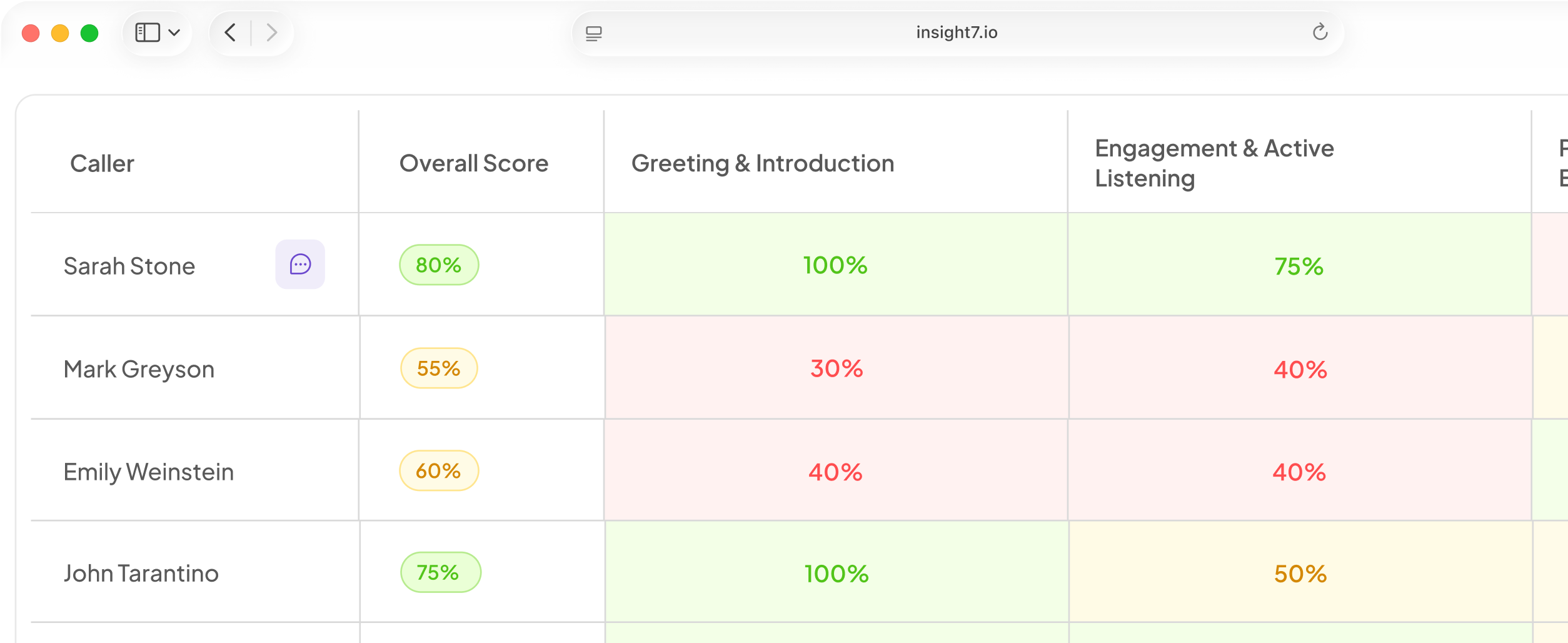
Check that agents follow the tiers. Insight7's inbound voice line is a number people ring, answered by an AI agent that can look the caller up, and it is in beta. Insight7 also scores every call against a weighted scorecard your team owns, so you are not relying on the 2% manual sample. Insight7 does not replace your authentication step. It helps you review whether the step happened. As general advice, treat "skipped verification" as a critical error, because a checklist score can hide what matters and one critical error should fail the whole call.
To find out where you stand, pull a sample of recent calls. Count how many sensitive disclosures happened without a passed check.
Pick the method that fits the risk
- Knowledge questions: low-risk lookups, paired with one other signal.
- OTP: any change to account details or contact data; prefer app push.
- Caller ID: a background signal that adds or removes a step.
- Voice biometrics: high-volume lines where callers will consent to enrol.
Related reading: How AI Voice Agents Verify Caller Identity Before Sharing Account Information, Knowledge Base Readiness Checklist for AI Customer Service Agents and 15 Inbound Call Types AI Voice Agents Can Resolve Without a Human.
Questions people also ask
What is voice biometrics?
It matches a caller's voice to a stored voiceprint. It can be active, using a set phrase, or passive, running during normal speech. The system returns a match score, and you choose the threshold that triggers extra checks.
How secure is voice biometrics?
Secure enough to be one signal, not the only one. Cloned or replayed voices can pass a basic voiceprint. Add liveness checks, a random phrase for each call, and a device-bound factor for money movement.
Can caller ID be spoofed?
Yes. Anyone can make a call display a number that is not theirs. Treat a match as a small drop in suspicion and a mismatch as a reason to add a step.
How do you detect caller ID spoofing?
Look for mismatches between the number shown and the account's usual device, location or call pattern. Repeated calls from one origin using many different numbers are also a flag. Combine these with a second factor.
How do you prevent caller ID spoofing from unlocking accounts?
Never let the number grant access. Use it only to rank risk, then require a check the attacker cannot fake by display alone, such as an app push to an enrolled device.
Is voice authentication safe for callers' privacy?
It is safe when handled well. Store voiceprints encrypted, separate from the call recording, keep them only as long as needed, and let callers delete them or choose another method.
Is biometric authentication secure enough for high-risk requests?
Not by itself. Biometrics can fail for real callers with noise or illness, and can be spoofed. For high-risk requests, pair it with a possession factor and a human handoff.
Layer first, then test
Layer the checks by request risk, and never let one method guard money movement. This week, list your agent's five most sensitive requests, give each a method tier, then score sample calls against that list with Insight7.