
A finance lead has a budget meeting on Friday and a vendor deck promising big savings. Nobody can say what a call costs today. This AI voice agent ROI calculator gives you one formula, eight inputs and two worked examples.
Start with one net-savings formula
Use this formula: ROI = (value created + cost avoided − AI cost) ÷ AI cost, over a fixed period such as one month or one collection cycle.
Be strict, because the evidence on AI service spending is weak. Gartner reviewed 432 AI customer-service use cases. Only a quarter showed positive ROI, a quarter showed negative ROI, and 42% could not be measured. Meanwhile, AI spending by service leaders rose 38% while overall service budgets rose 2%. Your CFO will expect proof.
Here is what each term means:
- Cost avoided: the human handling cost you skip on calls the AI finishes alone.
- Value created: money or outcomes the AI adds, such as a payment recovered or a repeat call avoided.
- AI cost: usage fees, platform fees, setup spread over the period, and human minutes on escalated calls.
Count every term per finished call, never per call placed. A dialed number that rings out saves nothing.
Banks want a small pilot and payment only after a measured lift. Champions need a number they can carry upstairs.
Gather eight inputs before you calculate
Fill in one table before you open a spreadsheet. Every input needs a source you can point to.
| Input | Where to find it | Common trap |
|---|---|---|
| 1. Call volume | Telephony logs: calls and contact attempts per month | Counting attempts as conversations |
| 2. Cost per handled call | Agent pay and benefits, QA, tools, divided by calls handled | Using agent salary alone |
| 3. Containment rate | Share of calls the AI finishes with no human | Counting hang-ups as wins |
| 4. Handover cost | Human minutes on escalated calls, plus AI minutes before handoff | Treating escalations as free |
| 5. AI cost | Vendor quote: per-minute or per-call fee, setup, platform fee | Guessing from a list price |
| 6. Reach rate (outbound) | Answered calls that became a real two-way conversation | Counting voicemail as reached |
| 7. Outcome value | Payment recovered, contact saved, repeat call avoided | Valuing outcomes you never measured |
| 8. Quality guardrail | Complaint rate, error rate, share of customers asking for a human | Skipping it, then paying in churn |
Set a strict rule for reach. In Insight7's voice campaign beta, a call is not counted as reached when only the AI spoke, and a carrier's temporary refusal does not use up a retry.
Budget for handover from day one. Gartner found that 87% of 3,566 customers say a company using GenAI for service must offer a way to reach a human. That path is a cost line.
Plan where the data will come from. In the beta, a dashboard shows calls in progress and the transcript when each call ends. Yes/no answers and call outcomes are pulled from the transcript. Start with a small pilot of a few hundred numbers to fill the table with real figures.
Worked example one: customer service inbound
These figures are illustrative assumptions for a made-up contact centre. Replace every one with your own. They are not a benchmark.
| Input | Assumed value |
|---|---|
| Inbound calls per month | 20,000 |
| Human cost per handled call | $6.00 |
| Containment rate | 35% |
| AI cost per contained call | $1.20 |
| AI cost before handoff, per escalated call | $0.40 |
| Extra human time on handover, per escalated call | $0.50 |
| Platform fee per month | $2,000 |
| Setup, spread over 12 months | $15,000 |
The arithmetic
- Baseline: 20,000 × $6.00 = $120,000 a month.
- Contained calls: 20,000 × 35% = 7,000. Cost avoided: 7,000 × $6.00 = $42,000.
- Usage: 7,000 × $1.20 = $8,400. Escalated calls: 13,000 × $0.40 = $5,200.
- Handover: 13,000 × $0.50 = $6,500.
- Run cost: $8,400 + $5,200 + $6,500 + $2,000 = $22,100. Add $1,250 of setup for $23,350.
- Net saving: $42,000 − $23,350 = $18,650 a month.
- ROI: $18,650 ÷ $23,350 = about 80%.
- Payback on setup: $15,000 ÷ ($42,000 − $22,100) = about 0.75 months, using run cost only.
I counted no value created. Repeat calls avoided would add to it.
Sensitivity: containment moves the result most.
| Containment | Net monthly saving | ROI |
|---|---|---|
| 35% | $18,650 | 80% |
| 20% | $1,550 | 7% |
| 15% | −$4,150 | −19% |
Escalated calls still cost AI minutes and extra human time, so a drop to 20% wipes out most of the saving.
Growth leaders worry about serving far more customers without hiring in step.
Gartner found 42% of AI service use cases could not be measured. Your containment, handover and cost lines come from call records, so you can measure them.
Worked example two: collections and reminders
These figures are illustrative assumptions for a made-up lender. Replace them with your own. The baseline is agents working the same early-stage list by phone.
| Input (assumed) | Agents only (assumed) | AI voice agent (assumed) |
|---|---|---|
| Accounts per cycle | 10,000 | 10,000 |
| Reach rate | 35% | 40% |
| Commit to pay (of reached) | 35% | 35% |
| Paid (of commitments) | 65% | 65% |
| Value per paid account | $40 | $40 |
| Cost per account worked | $2.50 | $0.50 |
| Handover | n/a | 10% of reached, $4 each |
| Platform + setup (12 months) | n/a | $1,500 + $667 a month |
The arithmetic
- Agents: 10,000 × 35% × 35% × 65% = about 796 paid. Value is $31,850. Cost is $25,000. Net is $6,850.
- AI: 10,000 × 40% = 4,000 reached, giving 910 paid. Value is $36,400.
- AI cost: $5,000 usage + $1,600 handover + $1,500 platform + $667 setup = $8,767.
- AI net: $36,400 − $8,767 = $27,633. Gain over agents: $20,783 a cycle.
- ROI: $20,783 ÷ $8,767 = about 237%.
Reach drives the result. Usage stays at $5,000 because every account is still dialed, while handover scales with reached accounts.
- At 30% reach: 683 paid, value $27,300. Cost is $5,000 + $1,200 + $1,500 + $667 = $8,367. The gain is $12,083 and ROI is 144%.
- At 20% reach: 455 paid, value $18,200. Cost is $5,000 + $800 + $1,500 + $667 = $7,967. The gain is $3,383 and ROI is 42%.
A consumer lender's outbound pilot showed the funnel shape. About half of answered calls became real conversations, and under half of those showed interest. Three to four attempts worked best. Retry rules are a reach input.
Reminders are not collections, and a happy customer pays. A call before the due date can stop a failed debit, so model it as a separate list.
Handover is the cost of risk. Buyers ask what happens with a disputed amount or a sensitive case.
Start small. Test a few hundred numbers in your next collection cycle.
Track results with call data, then rerun
Rerun the calculator every month with measured inputs. Reach rate, containment and handover share move the result most. Call length and value per outcome also matter, because a longer call raises usage cost on every contained call.
Subtract the cost of staying compliant. Disclosure rules differ by region, so check each market you call:
- EU: Article 50 of the AI Act has applied since 2 August 2026. Any AI that talks to people, including automated phone systems, must say it is AI from the first interaction.
- US: The FCC's 2024 ruling means AI-voice calls already need consent under the TCPA. A proposed rule to say it is AI at the start of the call was still not final in mid-2026.
Add consent lists, disclosure scripts and legal review as cost lines.
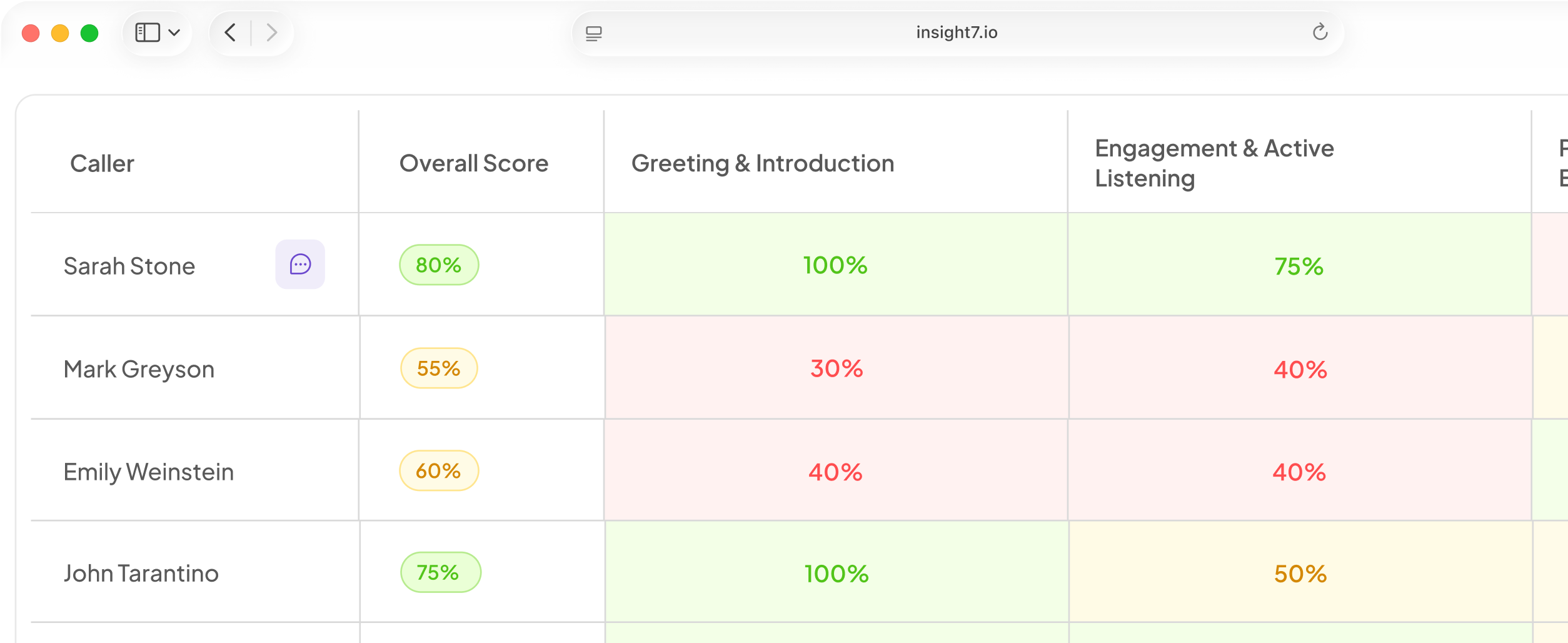
Review quality two ways: read a sample of transcripts, and score every call. Calls can be scored against a weighted scorecard your team owns. That replaces the usual 2% manual sample with 100% coverage. Set one critical error to fail a whole call, because a checklist score can look perfect while the customer leaves angry.
For a pilot, call a test group and keep a control group that humans call. Compare paid accounts, complaints and handovers, then replace your assumptions with those results.
A free Call Quality Monitor can score uploaded recordings or transcripts for a first look.
Related reading: AI Voice Calls vs SMS vs Email for Customer Reactivation Campaigns Compared by Response and Conversion and AI Voice Agent Pilot Plan Template for a Two-Week Proof of Concept.
Questions people also ask
How do you calculate ROI for an AI voice agent?
Subtract the AI cost from the cost avoided plus the value created, then divide by the AI cost. Use one fixed period. Count only calls the AI finished.
What is a good ROI for an AI voice agent?
A positive number after handover, compliance and quality costs is the bar. Compare it with the human-handled baseline for the same call type. An ROI that depends on one optimistic input is weak.
How much does an AI voice agent cost per call?
Add usage fees, platform fees, setup spread over the period and handover minutes. Divide by finished calls, not calls placed. Get the rate in writing, because call length changes the answer.
How long does it take for an AI voice agent to pay back?
Divide setup cost by the monthly saving after run costs. If that saving is zero or negative, payback never comes. Low containment or low reach stretches it fastest.
Can AI voice agents be used for debt collections?
Yes, and early-stage reminders are a sensible start, because a happy customer pays. Hand disputes to a person. Check consent rules for AI-voice calls in each market.
What containment rate should I assume for an AI voice agent?
Assume a low number, then replace it with pilot data. Measure containment by intent, since status checks and reminders contain better than disputes.
How do you measure the ROI of an AI voice agent in a pilot?
Run a few hundred numbers through one cycle with a matched control group that humans call. Compare reach, paid accounts or resolved calls, handovers and complaints, then use the formula.
Count only what you can measure
Run a pilot, put real reach, containment and handover numbers into the formula, then rerun it monthly. Insight7 scores every call against a scorecard your team owns. If you cannot measure the call, you cannot count the saving.