
If you train agents, interviewers, or reps for a living, custom roleplay only earns its name once it is built from your own call or interview history, scored against the rubric you already use to grade live performance, and designed around the real variety of counterparts, formats, and tool use your team actually faces. A scenario library pulled from a demo deck or built around one example customer teaches reps to handle a conversation that does not exist on their queue, no matter how polished the AI sounds. None of that comes down to a smarter model. It comes down to what you hand over before anyone starts building. After this, you will know exactly what belongs in that handover, whether you are briefing a vendor or an internal team.
Write the Scenario Brief First
Fill out this brief about your own operation before you ask anyone, a vendor or an internal team, to build custom roleplay. Every row below surfaced as a real gap in a real build, not a hypothetical, and skipping one gets you a scenario that matches your industry but not your actual calls.
| Requirement | What you need to specify | Your answer |
|---|---|---|
| Source material | Which real call or interview recordings and transcripts will seed the scenario, not marketing copy or a product description | |
| Evaluation criteria | The exact rubric already used to grade live performance | |
| Persona list | Every distinct counterpart type staff actually encounter, including the hard ones, with a target count | |
| Format | Whether the call is one-to-one, one-to-many, or another shape, specified separately from persona | |
| Tool-use requirement | The internal system the trainee must search mid-conversation, and whether the scenario withholds information to force that | |
| Variety and scale | How many accounts or cases the scenario pool draws from, and what access permissions gate it | |
| Structure | Whether sessions are grouped by situation or by skill category, with a statement of what good looks like up front | |
| Scoring scale | Confirmation that the training score sits on the same scale as the live-call score |
An incomplete brief does not fail loudly. It produces a scenario that sounds right for your industry, gets built, gets assigned, and still does not touch the actual gap on the floor.
Source Scenarios from Real Transcripts
Build scenario content from your own call or interview transcripts, never from a product description or a generic category list. Standard template categories like customer service, sales, and leadership conversations do not carry the structure of a conversation that looks nothing like those three. A hiring interview is one of them. Anything drafted from secondary material instead of your own records will miss the texture that only exists in your own calls, because that texture was never written down anywhere else.
A company whose team conducts structured hiring interviews ran into this directly. An early batch of scenarios covered customer service, sales, and leadership conversations, which did not match this team's actual workflow of structured candidate interviews. The team's recruiting lead pointed out that better source material was already sitting in her own records: hundreds of transcripts of past interviews, covering effectively every question and answer pattern an interviewer would face.
If your workflow is not a standard sales or support call, a generic library will not carry its structure. Only your own transcripts will.
Match Personas to Real Counterparts
List every distinct counterpart type your staff actually face, including the hard ones, and set a target count before anyone starts building. One persona is rarely enough once a team takes roleplay seriously. The range needed should mirror the real range of counterparts staff meet on live calls, not the range a demo library happened to ship with.
That apparel company's recruiting lead tested the first two custom scenarios built for her team and came back with a specific number: she wanted the library expanded to at least four or five. Separately, the lead for the team that coaches new hires asked for a persona to be added that a lot of trainers deal with in practice: a shy, timid trainee, to help trainers learn how to draw them out in coaching conversations. Neither gap showed up until the team actually used the tool for its own work.
A persona list copied from a demo library teaches reps to handle a counterpart who doesn't exist on their queue.
Score Against Your Live Rubric
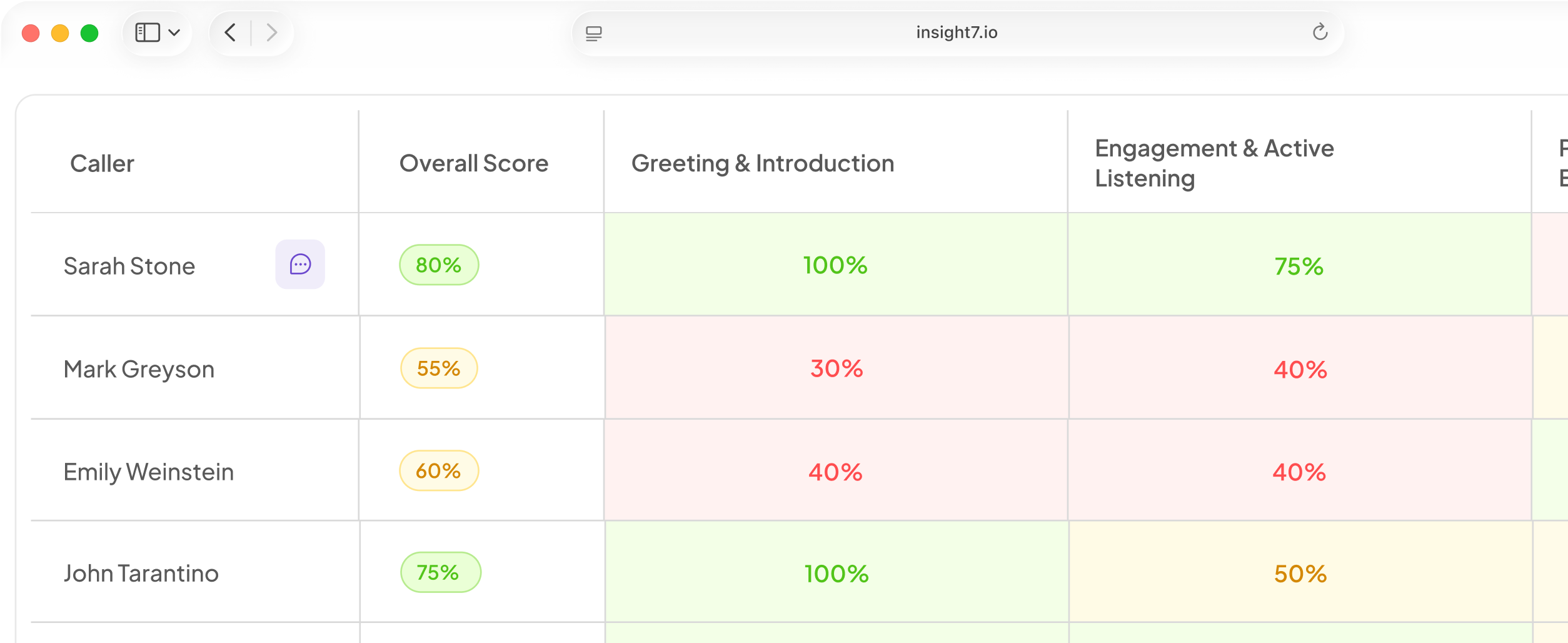
Use the exact rubric your team already uses to grade live performance, not whatever scoring template ships with the tool. A default template can be well designed and still grade on criteria nobody downstream recognizes, which means nobody downstream trusts the score it produces.
When the recruiting lead at that apparel company reviewed her team's first custom sessions, her first request after testing was to change the evaluation criteria to the ones already used to grade live interviews.
A team only trusts a training score once it is measuring the same things their live scorecard measures.
Vary the Pool, Not One Case
Build the scenario pool from many real accounts or cases, not one, and gate it with the same access permissions already used live. A single fixed example teaches reps to solve that one case, not the underlying skill.
A US waste management company with its own customer service call center had built a CRM lookup scenario around a single fixed test customer. The operations lead flagged that this would not scale. He wanted to upload a list of many customer accounts so reps would see real variety, and he wanted that content fenced by the same regional, team-specific data permissions already used on live calls, so a team only ever practiced on accounts it was actually allowed to see.
This is the same failure we see most often once a cohort gets large: live, instructor-led roleplay only reaches a handful of people in the room at a time, and the rest of a bigger team gets no hands-on practice at all. A pool built from one fixed case produces the same narrowing inside an automated tool. It just hides it better.
Make Reps Search, Not Recite
Design the scenario to withhold information until the rep retrieves it from the real internal system, and score on whether they found it, not on tone alone. A simulated customer who volunteers everything only tests whether a rep can carry a conversation. It never tests the part of the job that actually involves juggling a live call with a screen.
The same waste management company decided its simulated customer should never hand over account details. The rep had to look the information up in their own internal system before answering, mirroring exactly how a live call works: searching account history and billing records while staying on the phone. Their team lead asked that a call-handling time target be built into that same scenario's scoring, matching the live KPI they were already tracking, so the roleplay would measure speed and retrieval together, the way the real job does.
A persona that hands over the answer doesn't test the job. It tests whether the rep can hold a conversation, which is the easier half of the skill.
Group by Skill, Not Situation
Structure the library by skill category with an explicit statement of what good looks like, not a long list of narrow one-off situations. Libraries fail less often from lacking content than from lacking a structure a manager can assign and a rep can understand before they start.
That waste operator's team learned this the hard way. An early draft of their customer service curriculum was a long spreadsheet of narrow, scenario-specific sessions. Looking back at it, the team concluded it was too granular to actually use day to day. Managers could not easily tell what to assign, and reps did not know what was expected going in. They restructured into broader, category-based sessions, call opening, empathy and active listening, and the like, each one opening with a clear statement of what good looked like for that category before the rep practiced it.
A library a manager can't assign and a rep can't understand going in doesn't get used, no matter how accurate its content is.
Put Both Scores on One Scale
Make sure the training score sits on the same scale as the live-call score before you call the program a success. A roleplay program can only prove it is closing a real skill gap if its scoring is legible against the live-call scoring the team already trusts.
The operations lead at that same waste management company caught this while reviewing a new view that tracked agent skills from live calls and training side by side. Live scores showed as percentages running in the sixties and seventies, while training skill scores sat on a ten-point scale. He pushed back immediately, arguing both needed to sit on a scale reps and managers could compare directly if the whole point of training was to prove it moved real performance. Getting that mismatch right is a configuration decision any team can get wrong, with any scoring method, manual or automated.
A program that can't be compared to live performance on the same scale isn't unproven. It's unprovable.
Getting that comparison right before you launch, rather than after a quarter of scores nobody can reconcile, is exactly the kind of setup worth talking through with us.
Specify Format Separately from Persona
Name the call shape, one-to-one, one-to-many, or another format entirely, as its own requirement in the brief, separate from persona. A design built around personas and skill gaps does not automatically cover every format a team runs, because the skills a format calls for genuinely differ. Holding a single candidate through a structured set of questions asks for different instincts than holding a room of several candidates through an information session where attention is split and the questions come from all directions at once.
A recruiting lead at the apparel company surfaced this directly when she asked whether the same training tool could cover both kinds of interviews her team ran: one-on-one candidate interviews, and group info-session calls addressing several prospective candidates at once. Her team needed scenario content built for both shapes, not just the one her first custom sessions happened to be built around.
Questions on Building Custom Roleplay
How many scenarios does a custom roleplay library actually need to start? There is no fixed number that works for every team. Start with the skill categories your live rubric already measures, build one scenario per category, and add scenarios only when a real call or interview surfaces a gap none of the existing ones cover.
Should a vendor write the first scenario, or should our own team? Either can write the script. Only your team can supply the ground truth it has to be built from: the real rubric, the real counterparts, the real system reps search in. Hand those over before anyone, vendor or internal, starts writing.
What if we don't have transcripts for every call type yet? Build what you have transcripts for now, and treat the untranscribed call types as a flagged gap rather than something a generic scenario should quietly stand in for. Add them once a handful of real recordings exist, even if that takes a few more weeks.
How do we know if the roleplay program is actually working? Set a baseline on both scales before training starts, then track the trend over a full cycle, not a single session. If the live-call score has not moved by the end of that cycle, the fix is almost always the criteria the scenario was built on, not the number of sessions reps have taken.
Does roleplay replace coaching from a manager? No. Roleplay tells you where the gap is; a manager still decides how to close it. Treat a training score as triage, not a verdict, and keep a person in the loop for anything the score flags as low.
Start With the Brief
Treat the brief as the deliverable, not the preamble to one. A vendor or internal team can usually turn a complete brief into a working scenario within days. What takes a quarter is discovering, after reps have already trained on the wrong personas with the wrong rubric, that the whole library has to be rebuilt from scratch. If you are ready to put your own calls, your own rubric, and your own counterparts into a scenario library instead of a borrowed one, book a demo and bring the brief with you.