
Voice of the Customer: A Guide for CX Teams

Most companies are not short of customer feedback. They run a quarterly survey, a post-chat rating prompt, and a review monitoring tool, and each one produces a dashboard.

The dashboards get opened before a board deck and rarely in between. Meanwhile the support queue, the sales calls, and the cancellation conversations hold the specifics that would actually explain the numbers, and nobody has time to read them.

That is the real state of most voice-of-the-customer (VoC) programs. Collection was solved years ago. Turning what customers said into something a team changes on Monday is the part that keeps failing quietly.

This guide covers what voice of the customer means, where the feedback comes from, how to collect and analyze it without drowning, and how to close the loop so the program produces decisions rather than reports.

Bring your customer conversations into Insight7 and see which themes your feedback program has been missing.

TL;DR

  • Voice of the customer covers everything customers tell you directly, indirectly, and through their behavior, not just what a survey asked them.
  • Most teams already hold more customer feedback than they analyze, and the largest untouched source is usually the conversations they already record.
  • Analysis is where programs stall, because themes have to be extracted consistently before anyone can act on them.
  • A finding that reaches no owner and changes no process is a cost rather than an insight, which is why closing the feedback loop matters more than collecting more.
  • Insight7 analyzes every customer conversation, surfaces recurring themes and pain points, and routes them into coaching and action rather than another dashboard.

What Is Voice of the Customer?

Voice of the customer is the practice of capturing what customers say about their experience, needs, and expectations, then using it to guide decisions.

It is broader than a metric. A satisfaction score tells you the temperature, while voice of the customer work tells you what caused it, which is the part a team can act on and the only way the feedback becomes actionable insights.

The scope includes:

  • Solicited customer input: Customer surveys and interviews
  • Unsolicited input: Online reviews and complaints
  • Observed signals: Repeat contacts and churn behavior

What a VoC Program Is Trying to Answer

Whatever methods it uses, a voice-of-the-customer program answers four questions. What customers need, what they expect, what they prefer, and how much the gap between those and reality costs.

Customer needs and customer expectations are not the same input. Needs are stable and often unspoken, while customer expectations shift with every competitor, price change, and previous experience a customer has had elsewhere.

Preferences sit on top of both and change fastest. Treat all three as one bucket, and the program reports contradictions that are not really contradictions, when what you want is a short list of named concerns you can size and assign.

Voice of the Customer vs Customer Experience

The two terms get used interchangeably and should not be. Customer experience (CX) is the entire customer journey, from first contact to renewal, while the voice of the customer is how you find out what that journey is actually like.

Why VoC Programs Stall

The failure is usually structural rather than technical. Feedback arrives in several systems, each owned by a different team, and no single person is responsible for reading all of it.

Survey results sit with the CX team. Support tickets sit with service. Recorded conversations sit with the contact center. Reviews sit with marketing.

Each team reports its own slice upward, so the same customer problem appears three times under three names and gets counted as three separate issues.

Where Voice of the Customer Feedback Comes From

Voice of the customer feedback has three broad sources, and most programs lean heavily on the first while ignoring the third.

Direct feedback is what customers tell you when asked. Indirect feedback is what they say about you elsewhere. Inferred feedback is what their behavior shows without anyone saying anything.

A program built solely on direct feedback inherits every limitation of the questions it was taught to ask. One that adds the other two gets a fuller picture at lower cost, because the material already exists.

Customer Surveys and Customer Satisfaction Surveys

Customer satisfaction surveys remain the backbone of most programs, and they are good at what they do. They produce a comparable number over time, which is what executives need to see movement.

Their weakness is depth. A score tells you something changed without telling you what, and the free-text box that would explain it goes unread once volume grows, so the most valuable insights in the survey are the ones nobody reads.

Keep surveys, but treat them as the tracking layer rather than the diagnostic one. They tell you where to look, not what you will find.

Customer Interviews

Customer interviews give you the depth surveys lack. Thirty minutes with a churned customer will teach you more about a broken onboarding flow than six months of ratings.

Focus Groups

Focus groups bring several customers together to respond to an idea, concept, or existing experience. They surface language, objections, and priorities that individual interviews sometimes miss because participants build on each other.

They also carry known distortions. Louder participants pull the group, and people describe what they think they would do rather than what they do.

Online Reviews and Public Channels

Online reviews are unsolicited, specific, and written when feelings are strongest. That makes them unrepresentative and useful at the same time.

Reviews skew toward satisfied customers and furious ones, so the middle of your customer base is barely present. What reviews do well is name the specific failure, since people rarely write a review to say a process was mildly inconvenient.

Customer Support Interactions

Support tickets, chats, and calls are the highest-volume sources of voice-of-the-customer feedback most companies own, and the least systematically analyzed. These customer service interactions happen on multiple channels and are recorded almost everywhere.

Every contact is a customer telling you something did not work. The reason codes agents select afterward compress that into a category, and the detail disappears at exactly that step.

The transcript holds what the reason code lost. That is where the difference between “billing issue” and “the invoice date moved, and nobody told them” actually lives.

Platforms like Insight7 read that detail back out of the transcript and group contacts by the reason customers gave rather than the code an agent picked under handle-time pressure. 

A support lead in financial services can then see that the spike filed under “billing issue” is one invoice change, and take it to the team that owns the invoice rather than to the agents handling the calls.

Sales and Success Conversations

Sales calls carry the objections, comparisons, and expectations that shape whether someone buys. Customer success calls carry the reasons they stay or leave.

Both are recorded in most operations and reviewed by almost nobody outside the immediate team. The product and marketing questions those recordings could answer are asked in surveys instead, months later.

Analyzing them is a mature capability now rather than an experiment. Speech analytics tools turn recorded conversations into searchable, categorized data, which makes this source practical at scale.

Feedback Forms and In-App Prompts

Feedback forms placed inside the product catch reactions at the moment they happen. Gather feedback at the steps that matter, since this kind of feedback collection multiplies quickly if nobody prunes it.

A prompt after a specific action produces real-time customer feedback tied to a known step, which is easier to act on than a general rating.

Behavioral and Product Data

Inferred feedback comes from what customers do. Repeat contacts about the same issue, abandoned flows, feature abandonment, and downgrade patterns are all statements, just not spoken ones.

Teams running a continuous discovery process treat them as standing input rather than a quarterly review.

Behavioral data tells you where the friction is with unusual precision and never tells you why. That is the pairing that makes it valuable, since the qualitative sources explain what the customer behavior flags.

Try Insight7 for free and watch as real-conversation analysis reveals recurring themes on their own.

How to Collect VoC Data

Collecting voice-of-the-customer data well is mostly about restraint. More collection points produce more data and, past a certain point, less insight.

Map Customer Touchpoints First

Before you collect customer feedback anywhere new, map where customers actually interact with you. Onboarding, first support contact, renewal, and cancellation carry more signal than a random monthly prompt.

Mapping customer touchpoints also shows where feedback is already being generated without being captured. Most teams find two or three sources they own and never read.

Choose Metrics That Match the Question

Three metrics dominate voice-of-the-customer programs, each answering a different question:

  • Net promoter score (NPS): Measures willingness to recommend, which works as a relationship-level indicator tracked over time.
  • Customer satisfaction (CSAT) score: Measures reaction to a specific interaction, which makes it useful immediately after support contacts.
  • Customer effort score (CES): Measures how hard the customer had to work, which correlates closely with repeat contacts and friction.

According to FullView, CSAT scores above 80% are considered excellent, while scores below 60% are a disadvantage. Similarly, your NPS score should be above 70 and not below 50, while the thresholds for the CES are 90% and 70%.

Pick one relationship metric and one transactional metric. Running all three produces three trend lines that move together and one more argument about which to report.

Keep Feedback Requests Rare and Well-Timed

Survey fatigue is real and self-inflicted. When every interaction ends with a rating request, response rates fall, and the customers who still respond no longer represent the population.

Ration feedback requests deliberately. Fewer, better-timed requests produce higher response rates and more considered answers.

Collecting Feedback From Conversations You Already Have

The lowest-cost source of voice-of-the-customer data is the set of conversations already happening. No customer has to be asked anything, and the volume is enormous compared to any survey program.

A mid-sized contact center generates thousands of recorded conversations a month. Analyzing that material systematically produces a continuous stream of customer feedback rather than a quarterly snapshot.

This also reduces the response bias problem. Every customer who contacted you through a captured channel is represented, not only the ones willing to fill in a form afterward, so you gather customer feedback from the whole contacting base rather than a self-selected slice.

Insight7 analyzes every eligible recorded conversation against the same theme set, so what comes back is a ranked list of what customers raised and how often, not a folder of transcripts someone still has to open.

Standardize What Gets Captured

Whatever the source, capture enough context to make the feedback usable later. A comment with no segment, channel, or date is nearly impossible to act on.

Record which customer type it came from, which touchpoint, and when. That is the difference between “customers find onboarding confusing” and “enterprise customers onboarding without a CSM stall at the integration step.”

How to Analyze Customer Feedback

Analysis is where most voice-of-the-customer programs break down. The data arrives, somebody reads a portion of it, and the summary reflects whatever that person noticed.

Consistency is the whole game here. Feedback analyzed each month differently produces trends that reflect the analyst rather than the customers.

1. Build a Coding Framework

Raw feedback becomes usable when it is categorized against a stable set of themes. That set is the framework everything else depends on.

Build it from the feedback itself rather than from an internal org chart. Customers do not describe problems by which department owns them, and a framework organized that way will keep producing categories nobody can act on.

Structured approaches to coding qualitative data are worth borrowing here, since research teams solved this problem long before customer experience teams inherited it.

2. Separate Themes From Volume

A theme mentioned by many customers is not automatically the most important one. Volume tells you how common something is, not how much it costs.

Weight themes by impact as well as frequency. Forty customers saying the mobile app feels dated matters less than six enterprise accounts describing the same failed handoff between sales and onboarding, because the second group is the one whose renewal is at risk.

3. Natural Language Processing and Sentiment Analysis

Natural language processing is what makes qualitative feedback tractable at volume. It groups similar comments, extracts topics, and applies sentiment scoring without a person reading every line.

Sentiment analysis is useful but frequently over-trusted. It reads customer sentiment reasonably well and struggles with sarcasm, mixed messages, and cases where a customer is polite about something serious.

Use sentiment as a sorting mechanism rather than a verdict. It is good at pointing you toward the conversations worth reading and unreliable as the final word on how a customer felt.

Automated analysis also needs periodic checking. Sample the categorizations, compare them against human judgment, and adjust the framework when the two disagree consistently.

Platforms like Insight7 make that check practical by keeping the categorized themes traceable back to the conversations that produced them, so a disagreement can be settled by listening rather than by argument.
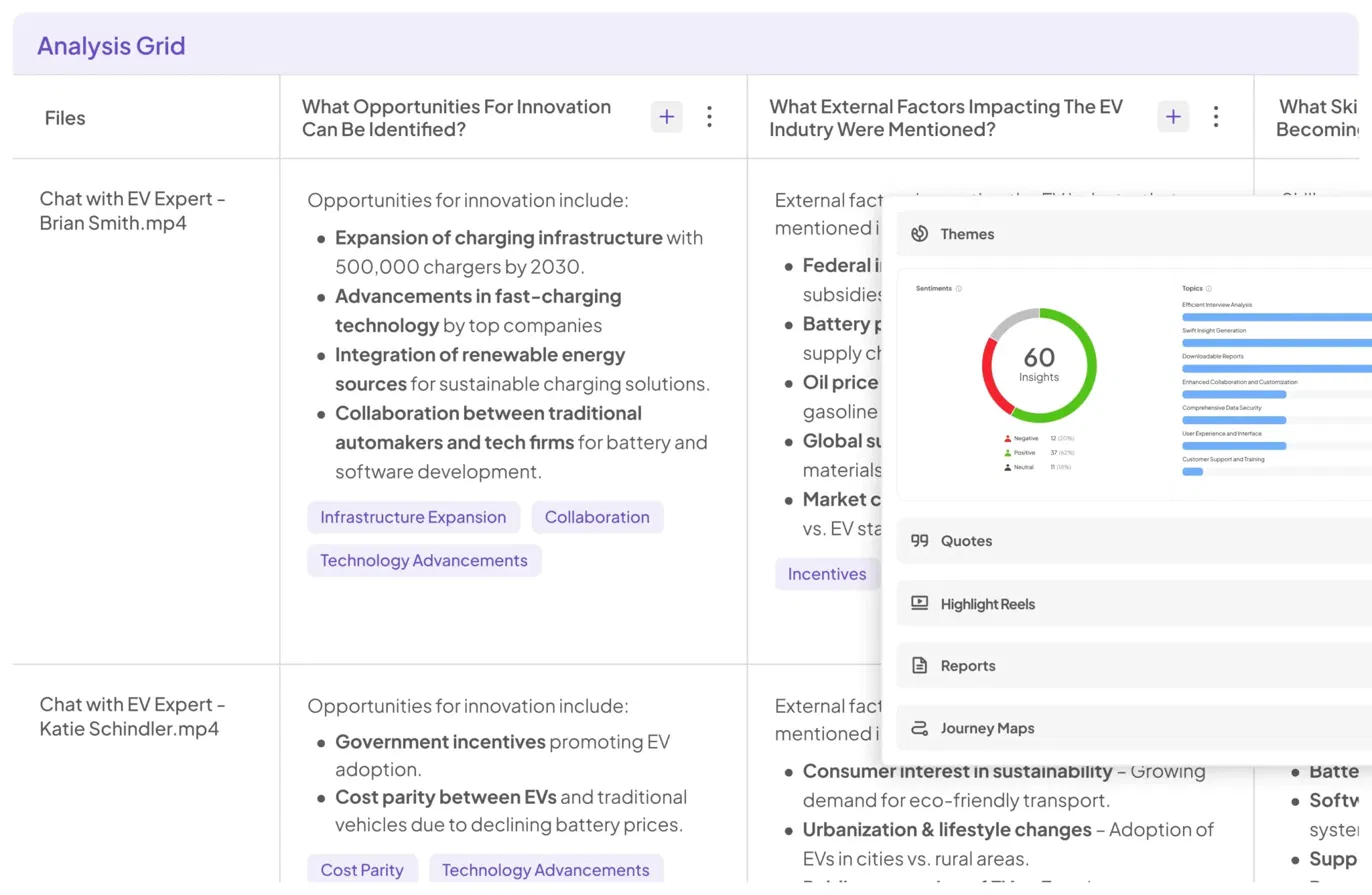
Insight7 analysis grid

4. Separate Valuable Feedback From Noise

Not all feedback deserves equal weight, and pretending otherwise makes programs unmanageable. Some comments describe a systemic problem, and some describe a bad day, which is one of the known limits of qualitative data.

Useful filters are recurrence, specificity, and segment. A specific complaint repeated by the same customer type is signal, while a vague one-off is usually not.

The exception is severity. A single report of something with legal, safety, or compliance implications outranks any volume threshold and should route immediately.

5. Quantify Customer Complaints and Pain Points

Qualitative feedback becomes persuasive when it carries a number. “Customers dislike the returns process” moves nobody, while a share of contacts tied to a specific step in that process moves budget.

Count how often each theme appears, what it costs in contact volume or handle time, and which segments it affects. Those three numbers turn customer pain points into a business case, and they are what makes analyzing feedback worth the time it takes.

Be careful with the causal claim. Analysis shows which pain points appear alongside churn or repeat contacts, and that is correlation rather than proof that fixing one changes the other.

Doing that by hand is where most teams stop, because every conversation has to be tagged before anything can be counted. 

Insight7 attaches a call count and a written summary to each reason as it extracts it, so the size of a problem arrives with the finding rather than as a separate project. A QA lead, going into a budget conversation, already has the number attached to the complaint.

Book a demo now and see Insight7 in action.

6. Compare Qualitative and Quantitative Signals

The strongest findings show up in both. When a satisfaction score dips in the same period that a theme spikes in conversations, you have a story rather than a data point.

The difference between qualitative and quantitative analysis is worth being deliberate about, because the two answer different questions and get conflated constantly in reporting.

Quantitative tells you how many and how much. Qualitative feedback tells you what and why. Programs that report only the first spend a lot of time explaining what their own feedback data means.

Closing the Feedback Loop

The feedback loop is the part that separates a voice-of-the-customer program from an expensive listening exercise. Everything before it is preparation.

A closed loop has three moving parts: the finding reaches an owner, the owner changes something, and the customer learns that it changed.

Route Findings to Named Owners

Insights addressed to everyone get actioned by nobody. Each recurring theme needs a person, a team, and a date attached before it leaves the report.

Match the finding to the team that can act on it. A pricing objection belongs with the person who owns pricing, and a broken confirmation email belongs with the team that sends it, and routing both to CX guarantees neither moves.

Where the finding concerns how conversations are handled rather than a product or process, it belongs in coaching. Customer feedback about agent behavior is coaching input, and it is far more credible than a manager’s impression because the customer said it. 

Insight7 holds the conversation analysis and the scoring in one place, so a theme about how agents handle a specific objection turns into a named coaching item on a scorecard rather than a line in a report someone has to translate into a training plan.
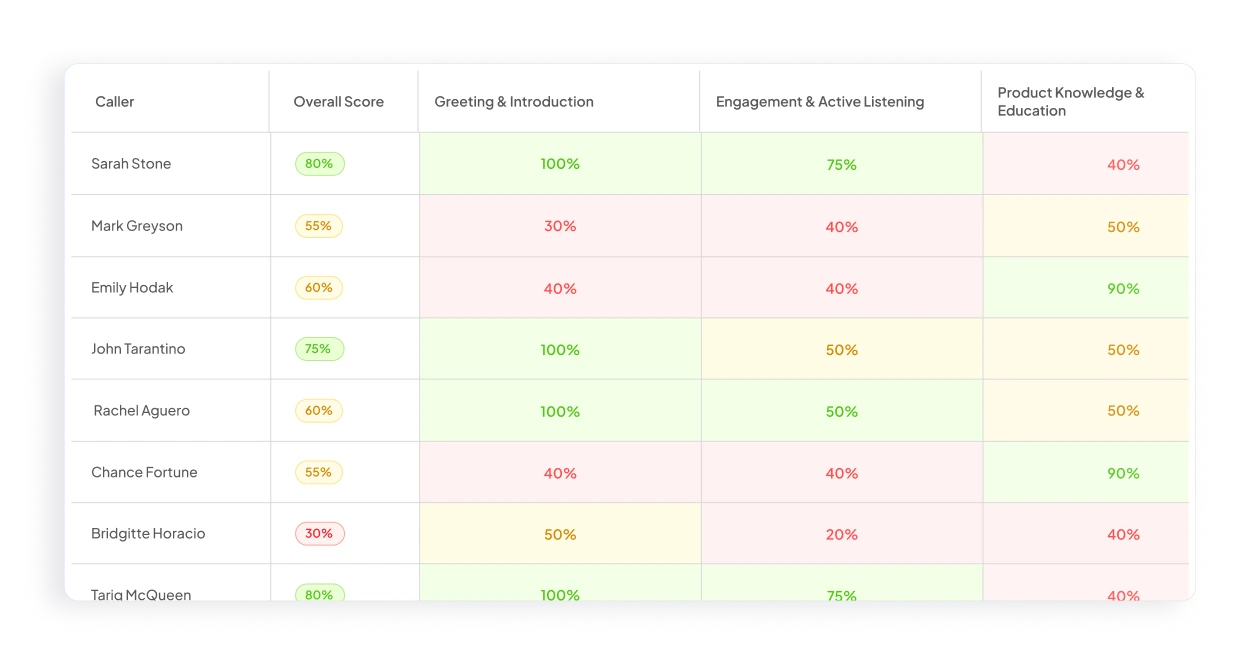
Call scoring

Track Actions, Not Just Insights

Most programs track how much feedback they collected. Very few track what changed as a result, which is the number that justifies the program.

Keep a simple record of themes raised, owners assigned, and actions completed. A recurring performance report is a reasonable place to house it, since the reporting rhythm already exists.

Tell Customers What Changed

The outer loop is the one almost everyone skips. Customers who gave feedback and heard nothing back learn that giving feedback does nothing.

Closing it does not require much. A short note naming the change and crediting the feedback that prompted it is enough, and it measurably improves willingness to respond next time.

This is also where customer loyalty is built rather than measured. Customers who see their input reflected in the product behave differently from customers who filled in a form, and that is how customer engagement and stronger customer relationships come out of a feedback program.

Reduce Customer Complaints by Fixing Causes

The most direct way to reduce customer complaints is to remove what causes them, which sounds obvious and is skipped constantly in favor of handling complaints faster.

That is what continuous improvement looks like in practice. Each cycle removes a cause, existing customers stop contacting you about it, and the capacity that frees up goes toward the next one.

It also helps you retain customers. They rarely leave because of one incident, and they frequently leave after the third time the same thing happened.

Measure Against Business Outcomes

Tie the program to outcomes the business already reports: customer retention, repeat contact rate, customer lifetime value, and the key performance indicators your operation runs on.

The connection is rarely clean and should not be overstated. Retention moves for many reasons, and a voice-of-the-customer program is one input among pricing, product, competition, and market conditions.

State it honestly, and the program survives scrutiny. Claim credit for every point of retention, and the first bad quarter takes the program down with it.

Build a VoC Strategy Your Team Can Sustain

A successful voice of the customer program is usually a small one run consistently rather than a large one run twice. The VoC strategy that survives is the one your team can maintain in a normal week.

Start with one source, one analysis rhythm, and one owner. A monthly review of conversation themes with three assigned actions beats a quarterly program that produces a fifty-page deck nobody finishes.

Whatever voice-of-the-customer software you settle on should serve that rhythm rather than set it. Tooling decided before the rhythm exists tends to produce reports on a schedule nobody chose.

Involve customer service teams from the start rather than presenting findings to them later. They recognize patterns immediately, and their context turns an odd category into a known process failure, which is the deeper understanding a dashboard never delivers.

Connect the customer strategy to something the business already wants. Framed as a route to business growth, retention, or competitive advantage, the program gets funded, while framed as listening, it gets cut in the first hard quarter.

Common Voice of the Customer Mistakes

A few failure patterns recur and are all avoidable.

  • Collecting more than you can analyze: Every unread survey response is a promise to a customer that you broke.
  • Treating the metric as the program: A satisfaction score is a thermometer, and no amount of staring at a thermometer changes the temperature.
  • Running it as a CX-only project: Findings that require product, pricing, or policy changes need those owners involved from the start.
  • Reporting themes without impact: A ranked list of complaints with no cost attached competes badly against every other budget request.
  • Ignoring the conversations you already record: The richest source of customer insights in most companies is sitting in a recording archive nobody has searched.

Improve Your Voice-of-the-Customer Program With Insight7

Most voice of the customer programs are limited by analysis capacity rather than collection. The feedback exists, and reading enough of it consistently is what nobody can do at volume.
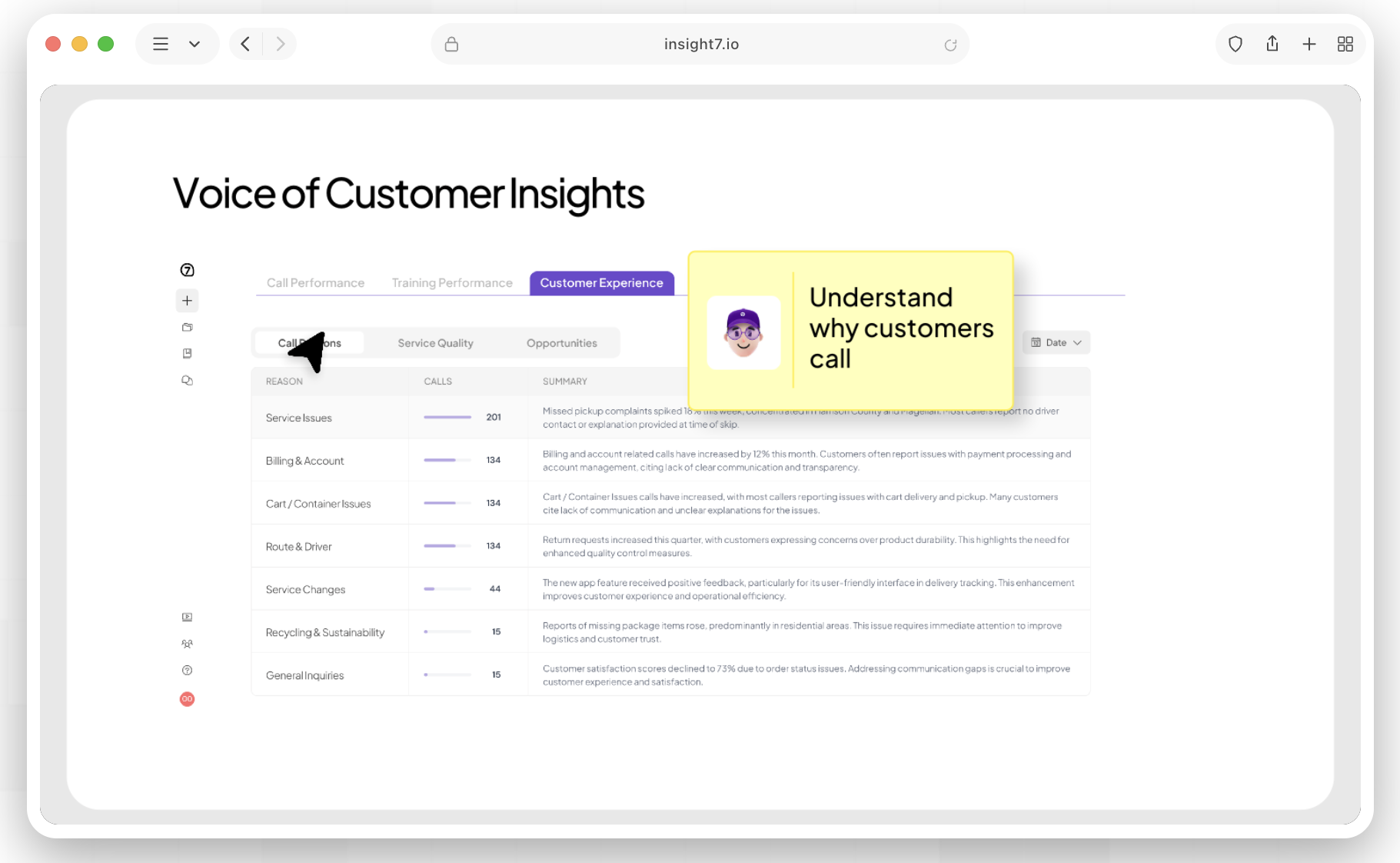
Voice of Customer Insights

Insight7 analyzes customer interactions on every connected conversation, extracts the recurring themes, pain points, and requests, and tracks how they move over time.

Managers get VoC insights with volume and segment attached rather than a wall of transcripts, which is what turns collected feedback into something that can improve customer satisfaction rather than describe it.

Since the same platform also handles scoring and coaching, findings about how conversations are handled route directly into agent development instead of stopping at a report. 

A theme like customers repeatedly asking the same unanswered question becomes both a coaching priority and a knowledge-base gap, traceable to the calls that revealed them.

Insight7 holds a 4.7 rating on G2, where reviewers describe the same shift from manual qualitative analysis to themes they can act on.

“Insight7 has saved us analysis time. I’ve been feeding feedback from sales calls, conversations, and emails and it’s been great input into the product roadmap and helped us better address people’s problems.”

Daniel Patricio, CEO, Abra

See what a month of your own customer conversations reveals when every one of them is analyzed.

FAQs About Voice of the Customer

What is meant by voice of the customer?

Voice of the customer is the practice of systematically capturing what customers say about their needs, expectations, and experience, then using it to guide decisions.

It covers direct input such as customer surveys and interviews, indirect input such as online reviews, and inferred signals such as repeat contacts and churn behavior. The defining feature is use, not collection, since feedback that changes nothing is not a voice-of-the-customer program.

What is an example of the voice of the customer?

A support team notices the same question appearing in conversations after a billing change, quantifies how many contacts it accounts for, and traces it to an unclear line on the invoice.

Finance rewrites the line, contact volume on that topic falls, and the customers who raised it are told what changed. That full sequence is voice of the customer in practice, and the part most programs skip is everything after the noticing.

What is VoC in CX?

In customer experience work, VoC is the input layer. Customer experience is the whole of how customers interact with a company, while VoC is the set of methods used to find out what that experience is actually like and where it breaks.

CX teams typically own the VoC program, though acting on what it finds usually requires product, operations, and service owners as well.

How to identify the voice of a customer?

Start with the feedback you already hold rather than a new survey. Map your customer touchpoints, list every place feedback is currently generated including recorded conversations and support tickets, then categorize that material against a consistent set of themes.

Weight the themes by frequency, segment, and cost, and the priorities identify themselves without anyone having to guess what customers care about most.

Upcoming Webinar Banner
Get the exact strategies 100+ sales leaders say are working right now to scale revenue in the AI era