


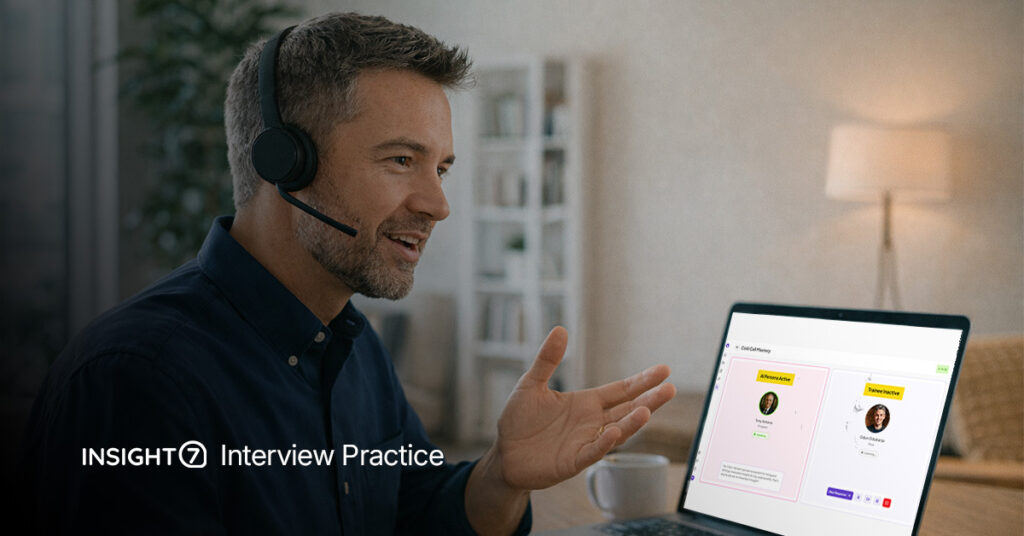
Apple HR interviews test whether your talent decisions reflect the functional depth, culture stewardship, and Apple ecosystem understanding that the company applies to every hire. Apple's show don't tell interview culture means every claim about talent judgment or HR impact is probed until the real depth or its limits become clear. Interviewers expect candidates who can name the specific criteria behind their talent decisions, demonstrate genuine empathy alongside accountability, and show outcomes that prove their involvement changed something measurable for the employee or the organization.
Start your free Apple HR practice session.
What interviewers actually evaluate
Behavioral Judgment, Talent Decisions & Employee Relations
Apple HR interviews test whether you apply principled judgment with Apple's culture standards in mind, and whether your talent decisions demonstrate functional depth rather than process compliance. What separates strong candidates is explicit decision criteria grounded in Apple's values, the ability to hold a position when a business leader pushes back, genuine empathy combined with accountability in difficult situations, and downstream outcomes that show the employee or the business was genuinely better because of your involvement.
Functional depth, Talent judgment, Culture stewardship, Apple ecosystem understanding, Empathy-accountability balance, Outcome specificity
What gets scored in every session
Specific, sentence-level feedback.
| Dimension | What it measures | How to answer |
|---|---|---|
| Behavioral Judgment | Did you demonstrate independent, principled judgment, or defer to process? We score whether your decisions show you actually made a call grounded in Apple's values. | Personal decision ownership, non-default choices |
| Talent Decision Quality | Were your hiring or performance decisions data-informed and clearly reasoned? We probe the criteria used, not just the outcome. | Explicit evaluation criteria, decision rationale |
| Empathy + Rigor Balance | Strong HR answers demonstrate both. We flag answers that are all empathy with no accountability, or all accountability with no emotional intelligence. | Dual signal in employee relations stories |
| Outcome Specificity | "We resolved it" is not an outcome. We look for a downstream result: for the employee, the team, or the business. | Specific outcome, retention signal, business impact |
How a session works
Step 1: Get your Apple HR question
You are assigned questions based on where candidates for this role typically struggle most, which for Apple HR means principled talent judgment aligned with Apple's culture and outcomes that extend beyond case closure. Each session starts fresh with a new question targeting a different evaluation dimension.
Step 2: Answer by voice
Speak your answer as you would in a real interview. The AI listens for STAR structure and evaluation signal alignment, specifically whether your decision criteria are explicit, your empathy and accountability are both present, and your Result includes a downstream business or employee outcome.
Step 3: Get scored dimension by dimension
Instant scores across all four rubric dimensions. Each gets a score, a flagged weakness, and a specific sentence-level fix. Apple HR interviewers probe for process-default answers and talent decisions that describe outcomes without naming the criteria behind them.
Step 4: Re-answer and track improvement
Revise based on feedback and answer again. See the before/after score change across Behavioral Judgment, Talent Decision Quality, Empathy and Rigor Balance, and Outcome Specificity. Your weakness profile updates across sessions so if you consistently default to policy rather than judgment, that becomes the focus of your next question assignment.
Frequently Asked Questions
What questions does Apple ask in HR interviews?
Apple HR interviews are behaviorally structured and culture-focused. Common questions include:
- "Tell me about a time you made a talent decision that required you to hold a position against a business leader's preference"
- "Describe a situation where you had to balance empathy for an employee with accountability to Apple's performance standards"
- "Walk me through a hiring decision you are most proud of and what criteria made it the right call"
- "Tell me about a time you changed a people process and measured whether it actually worked"
Each question tests principled judgment, Apple culture alignment, and downstream outcomes.
What are the 5 C's of interviewing for Apple HR roles?
In Apple HR interview contexts, the 5 C's map to: Context (the talent or employee situation), Criteria (the specific Apple-aligned standards you applied), Choice (the decision you made and why), Courage (whether you held the position when challenged), and Consequence (the downstream outcome for the employee, team, or business). For Apple HR interviews, Criteria and Consequence are most often underdeveloped by candidates who describe their HR approach without naming the specific standards they applied or the measurable result.
What questions will HR ask you in an Apple interview?
Apple HR interviews probe for talent judgment, culture stewardship, business partnership, and the ability to navigate difficult employee situations in an environment where Apple's standards are exceptionally high. Expect questions about a hiring decision where you used Apple-specific criteria, an employee relations situation that required both empathy and a clear accountability outcome, a case where you held a position a business leader disagreed with, and a people process change you drove with a measurable result.
What are the 3 C's of interviewing in an HR context?
The 3 C's framework in HR interviews covers: Competence (the specific talent or HR skill being evaluated), Character (values and judgment alignment, especially important at Apple), and Culture fit (whether your way of working aligns with Apple's depth-over-breadth, secrecy, and quality standards). For Apple HR roles, Character and Culture fit carry more weight than at most companies because Apple's culture is unusually specific and candidate screening for it is rigorous.
What are the most common failure modes in Apple HR interviews?
The most consistent failures are:
- Describing a talent decision without naming the Apple-specific criteria used to make it
- Employee relations stories that end with "we resolved the issue" without a downstream outcome
- Empathy-only answers in difficult situations with no accountability component
- Stories about holding a position under pressure that describe wanting to push back without evidence of actually doing so
- Apple culture described in general terms without specific examples of how it shaped a talent or people decision
Also practice
All eight Apple role interview practice pages.
- Sales
- Customer Service
- Product Management
- Marketing
- Finance
- Operations
- Leadership
- Legal & Compliance
One full session free. No account required. Real, specific feedback.








