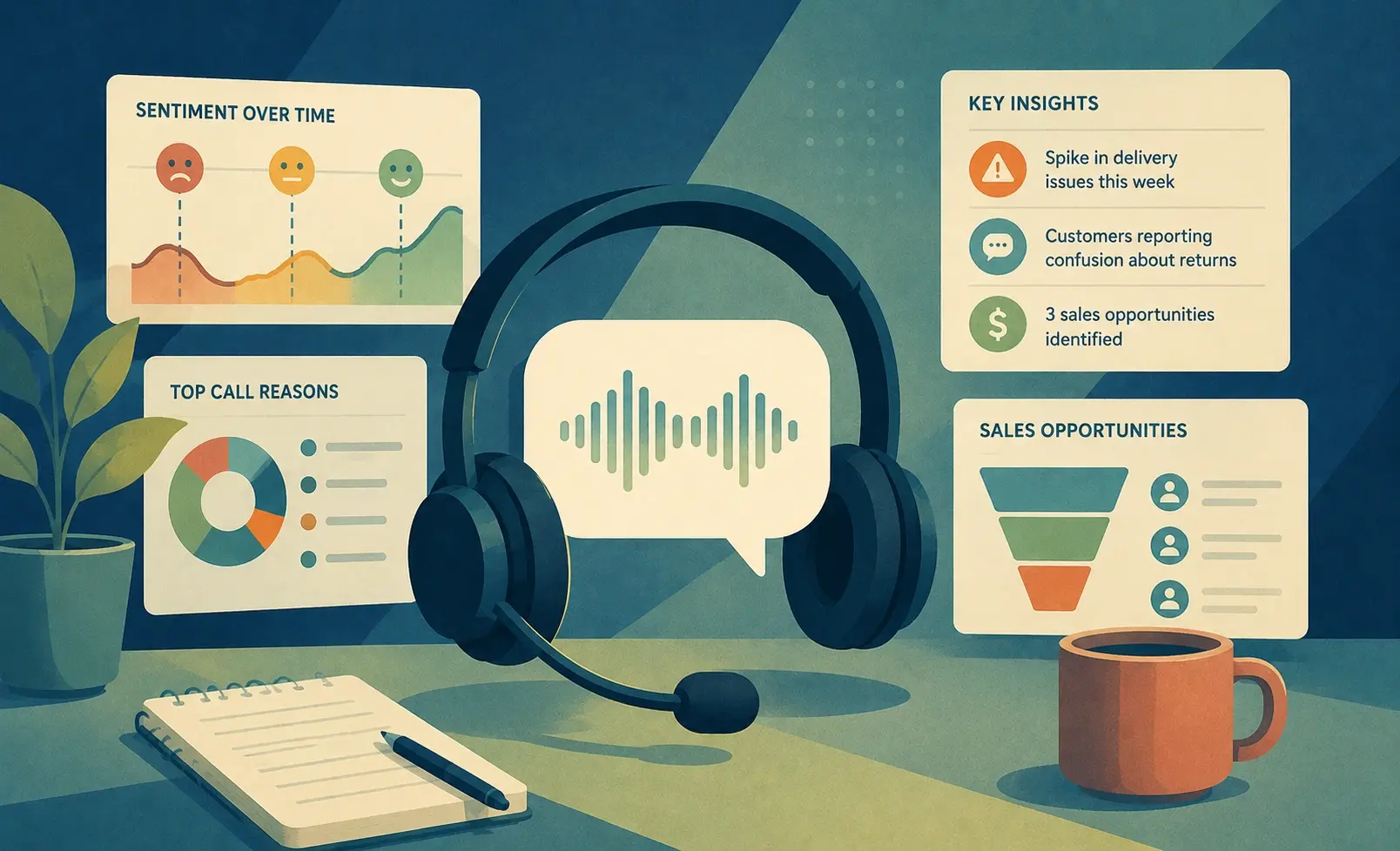
Sales enablement leaders and contact center QA directors invest in coaching programs, only to find most platforms tell them what coaching happened but not whether it worked. The difference between coaching activity tracking and coaching outcome tracking is the difference between a training log and a performance management system. This comparison focuses on platforms that track whether scores or behaviors actually changed after a coaching session.
Methodology
Platforms were evaluated across four dimensions weighted for teams that need to prove coaching ROI across multiple cycles:
| Criterion | Weighting | Best For |
|---|---|---|
| Outcome tracking depth | 40% | Proving whether coaching moved scores |
| Data source for recommendations | 30% | Conversation data vs. CRM activity signals |
| Cycle-over-cycle trend visibility | 20% | Multi-period improvement evidence |
| Implementation time | 10% | Speed to first actionable data |
According to Gartner on sales coaching ROI measurement, the majority of organizations cannot quantify coaching ROI because they measure activity completion rather than behavioral change outcomes.
What is the difference between coaching activity tracking and coaching outcome tracking?
Coaching activity tracking records that a session happened: date, duration, and topics covered. Coaching outcome tracking measures whether the behavior being coached actually changed in subsequent scored calls or deals. The gap between these two measures is where most coaching programs lose accountability. Logging 50 sessions per month is not the same as showing which sessions produced measurable score improvement in the 30 days following.
How many coaching cycles does it take to see measurable score improvement?
Most behavioral change programs require three to five coaching cycles before reliable trend data emerges. A single session's impact is hard to isolate from call volume variability. Platforms that surface trends across minimum 15 to 20 scored interactions per cycle provide statistically meaningful improvement signals.
Avoid this common mistake: measuring coaching program effectiveness by session completion rates alone. A team with 100% coaching attendance but flat QA scores is not running an effective coaching program. It is running a well-attended one.
Quick comparison
| Platform | Tracks Activity? | Tracks Outcomes? | Best For |
|---|---|---|---|
| Insight7 | Yes | Yes | QA-integrated outcome tracking per criterion |
| Mindtickle | Yes | Yes | Sales competency certification with milestone gates |
| Gong | Yes | Partial | Deal-connected rep behavior trends |
| Salesloft | Yes | Limited | Coaching activity within cadence workflow |
Insight7
Insight7 connects QA scoring directly to coaching outcomes. When a supervisor conducts a session on a specific competency, the platform tracks whether scores on that criterion improve in the subsequent 15 to 30 calls scored for that agent. Supervisors see per-criterion score trends rather than overall QA averages, isolating whether a coached skill actually moved without manually reviewing calls.
The mechanism runs from call scoring to gap identification to auto-suggested scenario in a single workflow. TripleTen processes over 6,000 learning coach calls per month through Insight7, tracking coaching progress at scale without adding QA headcount. The coaching module requires Insight7 team setup and is not fully self-service for initial configuration.
Insight7 is best suited for contact center and sales teams with 30 or more agents where QA scoring is already in place and the coaching program needs outcome data to prove effectiveness to stakeholders.
The closed loop between QA scoring, auto-suggested practice, and criterion-level improvement tracking makes Insight7 the strongest platform for teams that need to answer: did this coaching session actually move scores?
Mindtickle
Mindtickle is a sales readiness platform built around competency frameworks and milestone-gated certification. Managers define a competency model, build assessment gates at each milestone, and track reps through the learning path. A rep cannot "complete" a competency without demonstrating it through assessment, not just attendance. Teams where coaching criteria change frequently will find the milestone structure constraining rather than enabling.
Mindtickle is best suited for sales organizations with 50 or more reps that have a defined competency model and want assessment-gated certification as proof of coaching effectiveness.
Mindtickle is the strongest platform for teams that can define competency milestones in advance and want assessment gates as the accountability layer.
Gong
Gong is a revenue intelligence platform that tracks rep behavior on recorded calls alongside deal and pipeline data. If a rep improves their discovery question score and pipeline conversion improves in the same period, Gong can surface that correlation — a mechanism standalone QA tools cannot replicate. Outcome tracking is less granular at the competency level for teams that want to isolate a single skill's improvement independent of deal context.
Gong is best suited for B2B sales teams with 20 or more reps where pipeline data exists and coaching outcomes need to connect to revenue movement.
Gong connects call behavior improvement to pipeline outcomes, making it the right choice when revenue is the ultimate coaching outcome measure.
Salesloft
Salesloft is a sales engagement platform where coaching activity is embedded within the cadence workflow. Managers see call activity and coaching session notes together, connecting coaching activity to outreach execution. Outcome tracking is limited to the engagement activity layer: score improvement on specific competencies requires integration with a separate call analytics tool.
Salesloft is best suited for outbound sales teams already using Salesloft for cadence management that want coaching activity in the existing workflow without adding a standalone platform.
Salesloft is an activity tracker with coaching context, not an outcome measurement tool. Teams that need to prove coaching moved skills will require a separate analytics layer.
AmplifAI
AmplifAI is a contact center performance coaching platform that identifies a specific metric gap, recommends the corresponding coaching action from a predefined playbook, and tracks whether that action produced metric improvement in the subsequent evaluation period. The playbook model is most effective when performance metrics are well-defined and stable. Teams with frequently changing QA criteria will find playbook maintenance time-intensive.
AmplifAI is best suited for contact centers with 50 or more agents and established QA metric frameworks that need structured playbook guidance rather than open-ended coaching tools.
AmplifAI's playbook-driven cycle maps each metric gap to a specific recommended action, then tracks whether that action worked across the team.
CoachHub
CoachHub is a digital coaching platform for leadership and executive development that matches employees with external certified coaches and tracks session engagement. Outcome tracking relies primarily on self-assessment surveys and goal completion reports rather than objective performance metrics, making it appropriate for qualitative leadership development rather than contact center or sales performance coaching.
CoachHub is best suited for HR and leadership development teams running executive or high-potential programs where the coaching relationship and qualitative development are the primary outputs.
CoachHub is the right platform for leadership development with external coach relationships, but it is not a performance outcome tracking tool for contact center or sales coaching programs.
If/Then Framework
- If your primary need is proving that coaching sessions moved QA scores on specific criteria, use Insight7, because criterion-level pre/post score tracking connects coaching events to outcome data rather than overall averages.
- If your team runs structured sales onboarding with predefined competency milestones, use Mindtickle, because assessment-gated certification prevents reps from advancing without demonstrating the skill.
- If coaching outcomes need to connect to revenue movement and deal data, use Gong, because its deal intelligence layer surfaces the correlation between call behavior improvement and pipeline conversion.
- If your team already uses Salesloft for cadence management and activity tracking is sufficient, use Salesloft, because embedding coaching notes in the existing workflow eliminates tool switching.
- If you run a large contact center with established QA metrics and need playbook-driven coaching, use AmplifAI, because its gap-to-playbook mechanism reduces supervisor decision time while tracking outcomes.
- If your program is executive or leadership development where qualitative growth is the primary measure, use CoachHub, because external certified coaches fit that context better than performance-metric-focused tools.
FAQ
What is the difference between coaching activity tracking and coaching outcome tracking?
Activity tracking records that coaching happened. Outcome tracking measures whether the coached behavior changed in subsequent scored calls or deals. Most coaching platforms provide activity data. Only a subset, including Insight7, Mindtickle, and AmplifAI, link coaching events to objective performance metric changes.
How many coaching cycles does it take to see measurable score improvement?
Meaningful trend data requires three to five coaching cycles with 15 to 20 scored interactions per cycle. Single-session impact is difficult to isolate from performance variability. Platforms that track per-criterion trends across multiple cycles allow teams to distinguish genuine improvement from score fluctuation.
How do you evaluate coaching platform effectiveness over multiple cycles?
Compare QA scores on the specific criterion being coached before and after each session, across a minimum of three cycles. Identify whether the coaching intervention or the practice format needs adjustment when improvement stalls after two cycles. A platform that does not surface criterion-level trends cannot support this analysis.