Segment Marketing V User Personas: Marketing Implication for Businesses

product manager looking for insight in a chart

Marketing is a complex and continuously evolving field that requires businesses to stay up-to-date with the latest trends and technologies to remain competitive in the marketplace.  One of the cornerstones of effective marketing is segmentation, which involves dividing a market into distinct groups of customers with similar characteristics, needs, and preferences. However, segmentation alone may not be enough to deliver a truly personalized and satisfying customer experience. This is where user personas come in – fictional characters that represent the various types of customers that a business serves.  User personas help businesses better understand their customers and develop marketing strategies that cater to their specific needs and preferences. While both segmentation and user personas aim to improve the effectiveness of marketing strategies, they differ in their approach and scope. This article will explore the differences between segment marketing and user personas, and how they impact the customer experience.  We will also delve into the importance of gathering customer feedback for effective marketing strategies and how AI technologies can assist in analyzing this feedback to enhance the overall customer experience. The Importance of Segmentation in Marketing In marketing, segmentation refers to the process of dividing a market into distinct groups of customers with similar characteristics, needs, and preferences. By identifying relevant segments, businesses can tailor their marketing strategies to target specific groups with messaging and promotions that resonate with them.  This can significantly improve the effectiveness of marketing campaigns by making them more personalized and relevant to customers. Target Audience Segmentation allows businesses to identify their target audience and create a marketing plan that speaks directly to that audience. By developing a thorough understanding of who their customers are, what motivates them, and what their buying habits are, businesses can create targeted marketing campaigns that drive targeted traffic to their sites. Market Analysis and Market Research To identify relevant segments, businesses must conduct market analysis and market research. Market analysis involves analyzing industry trends, competitive landscape, and customer behavior to identify patterns and trends.  Market research, on the other hand, involves gathering data and feedback directly from customers through surveys, focus groups, and other research methods. Together, these two processes provide businesses with the insights they need to identify relevant segments and develop effective marketing strategies. Overall, segmentation is a critical component of any marketing strategy. By dividing a market into distinct segments and focusing on the specific needs and preferences of each group, businesses can create targeted marketing campaigns that yield better results.  Plus, by conducting thorough market analysis and research, businesses can ensure that they are targeting the right segments and creating messaging that resonates with their customers, ultimately leading to increased sales and customer satisfaction. Leveraging User Personas for Effective Marketing User personas are fictional representations of your target audience, outlining their needs, preferences, and behavior patterns. By creating user personas, businesses can better understand the wants and needs of their customers, allowing them to create more effective marketing campaigns. Before developing user personas, it is important to conduct market research and customer segmentation. This will help identify the most relevant characteristics of your target audience, such as age, gender, income, and interests. Developing User Personas When creating user personas, it is important to consider a range of factors, such as demographics, psychographics, and behavior patterns. This can include factors such as job title, pain points, goals, and buying behavior. The more detailed your user personas, the more effectively you can target your marketing campaigns. It is also important to ensure that your user personas are based on real customer data. This can be achieved by conducting surveys, focus groups, and customer interviews. Using User Personas for Customer Segmentation User personas can be used to segment customers based on their preferences and behavior patterns. For example, a business selling skincare products may create user personas based on different skin types, such as oily, dry, or sensitive skin. By doing this, they can create more targeted marketing campaigns that speak to the specific needs of each group. By leveraging user personas in this way, businesses can create more engaging and relevant marketing campaigns. This can lead to increased customer engagement, loyalty, and ultimately, sales. Enhancing Marketing Strategies with Feedback and AI Gathering customer feedback is critical for businesses to improve their marketing strategies. Customer feedback provides valuable insights into what customers like, what they dislike, and what they want from a product or service. The Importance of Customer Feedback Analysis Customer feedback analysis refers to the process of collecting and analyzing customer feedback to identify trends and patterns that businesses can use to improve their marketing strategies. By gathering feedback from surveys, social media, email, and other sources, businesses can gain a better understanding of their customers’ needs and preferences. AI technologies can assist in customer feedback analysis, offering businesses a more efficient and accurate way to analyze large amounts of data. AI algorithms can identify patterns and trends across customer feedback, enabling businesses to tailor their marketing strategies to specific customer segments. The Role of AI in Improving the Customer Experience AI technologies can also help automate processes to enhance the overall customer experience. Chatbots, for example, can provide customers with quick and personalized responses to their inquiries, improving their satisfaction levels and overall experience with a business. Additionally, AI technologies can be used to create personalized marketing campaigns based on customer data and feedback analysis. This can help businesses deliver more relevant and tailored messages to their target audience, increasing the effectiveness of their marketing strategies. FAQ What is the difference between segment marketing and user personas? Segment marketing involves dividing a market into distinct segments based on demographic, psychographic, or behavioral characteristics. User personas, on the other hand, are fictional representations of target customers that help businesses understand their needs, preferences, and behavior. Why is segmentation important in marketing? Segmentation allows businesses to target specific groups of customers with tailored marketing strategies. By analyzing market data and identifying relevant segments, businesses can create more effective

Product-Led Growth: From Product to Profit
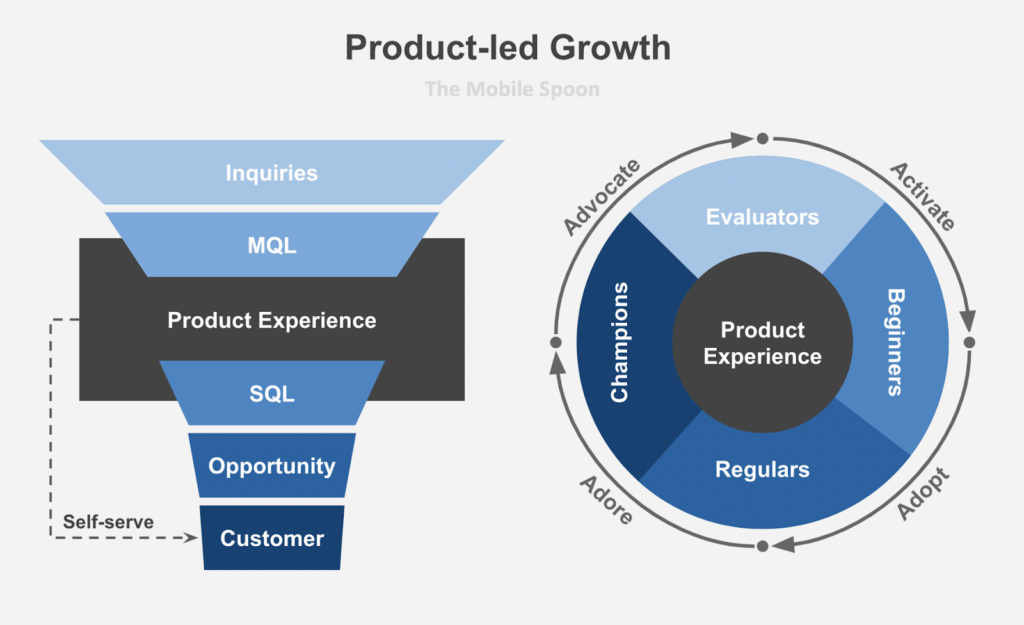
photo credit: The Mobile Spoon

In 2009, a small team of entrepreneurs set out to disrupt the traditional software industry by building a product that users would love. They focused on creating a simple, easy-to-use product that solved a real pain point for their target audience. That product was Slack, and today it’s a household name with millions of users worldwide. Slack is just one example of a product-led growth (PLG) company that has leveraged its product to achieve rapid growth and success. PLG is a business strategy that focuses on creating a product that sells itself, rather than relying on traditional sales or marketing tactics. It’s a mindset that prioritizes user experience and fosters growth through word-of-mouth and organic channels. In this article, we’ll dive deeper into what PLG is, how it works, and its implications for businesses. What is Product-Led Growth? Product-led growth is a business strategy that puts the product at the center of the growth engine. PLG companies prioritize creating a product that provides value to the user right from the start, with the goal of fostering user adoption and driving growth through word-of-mouth and organic channels. The best PLG companies focus on creating a product that is easy to use, intuitive, and solves a real pain point for the user. They prioritize user experience over sales or marketing tactics, and rely on the product to sell itself. This approach is in stark contrast to sales-led growth (SLG) and marketing-led growth (MLG), which rely on traditional sales or marketing tactics to generate revenue. Examples of Top Product Led Growth Companies Slack is just one example of a successful PLG saas company. Other examples include: Zoom: Zoom’s easy-to-use video conferencing software has become a go-to solution for remote work and virtual events. Dropbox: Dropbox’s cloud storage solution has made it easy for users to store, share, and collaborate on files across devices. Grammarly: Grammarly’s writing assistant tool has become a must-have for anyone looking to improve their writing skills. Insight7: Insight7 is an AI powered product discovery tool that helps product teams do customer research 10x faster by generating insights from customer interviews and surveys in one click. Implications of Product-Led Growth Companies that experience product-led growth are characterized by their ability to deliver exceptional product experiences that encourage frequent usage and referral to their networks. These companies experience significant growth due to their viral nature, where users derive immediate unique value from the product or service and are incentivized to attract new users through the network effect. Product-led growth companies are leading the charge in driving growth across both B2B and B2C software and services, and they represent the convergence of three critical corporate functions: product management, marketing, and sales/customer success. Product managers are increasingly taking on marketing responsibilities such as conducting customer interviews, while marketers are now involved in product management duties, such as boosting usage through referral programs. This shift has resulted in customer success/support becoming a critical component of both marketing and product management. This convergence has significant implications not only for improving collaboration between teams but also for promoting employee satisfaction and ensuring optimal team utilization. Interestingly, tools like Insight7 help teams have a seamless collaborative and automated customer research experience to drive growth. Teams that are product-led have developed extensive insights on this convergence and the product discovery and delivery processes. Insight7 provides software solutions that enable product management teams to streamline their approach to continuous product discovery. However, product-led growth has several implications for businesses, both positive and negative. Positive implications: 1.Increased user adoption: PLG companies prioritize creating products that are easy to use and provide value to the user right from the start. By doing so, they are able to foster user adoption and drive growth through word-of-mouth and organic channels. 2. Lower customer acquisition costs: PLG companies rely on their product to drive growth, rather than traditional sales and marketing tactics. By doing so, they can reduce customer acquisition costs and focus on creating a great user experience. 3. Higher customer lifetime value: PLG companies prioritize creating a product that provides ongoing value to the user. By doing so, they can increase customer lifetime value and generate more revenue over time. Negative implications: 1.Longer sales cycles: PLG companies rely on the product to sell itself, which can result in longer sales cycles as users try the product before committing to it. 2. Risk of low conversion rates: PLG companies rely on the product to convert users into paying customers. If the product does not provide enough value or is not easy to use, users may not convert to paying customers. 3. Limited market size: PLG companies may have limited market size, as their product may only appeal to a specific set of users. This can limit their potential for growth. Product-Led Growth vs. Other Growth Strategies PLG vs. SLG: SLG focuses on using sales tactics to acquire new customers while PLG focuses on creating a product that sells itself. SLG typically involves a high-touch sales process, where sales teams work to convince potential customers to buy the product. In contrast, PLG companies prioritize creating a product that users love and that provides enough value to convert them into paying customers without the need for a sales team. PLG vs. MLG: MLG focuses on using marketing tactics to generate demand for the product. Marketing teams use tactics like paid advertising, content marketing, and social media to raise awareness of the product and generate leads. While PLG companies may use some of these tactics, they prioritize creating a product that is easy to use and provides value to the user right from the start, rather than relying solely on marketing tactics to generate demand. While there are both positive and negative implications of this approach, PLG companies like Slack, Zoom, and Dropbox have proven that it can lead to rapid growth and success. By prioritizing the product and user experience, PLG companies have been able to reduce customer acquisition costs, increase customer lifetime value,

How To Determine Market Viability Of Your Product

Market Viability

When it comes to market viability, even great business ideas can fail if your target market is too small. Ensuring that your organization is focused on a large enough market will make it easier to generate sustained revenues over time and help your business thrive. Here’s how to calculate market size and whether it’s big enough to be viable: Top-Down: How Big Is The Market? In the Top-Down approach, the goal is to find the largest market size of the universe surrounding your product by using industry research and reports. For example: Your organization is developing a new furniture product “ACME Chair”, made from a special sustainable material that’s stronger and lower cost than competitors. Step 1: Find “Total Addressable Market (TAM)”, which measures the total revenue opportunity available for your product. To do so, use online and publicly available data such as The Bureau of Economic Analysis for national Gross Domestic Product (GDP) spending, The U.S. Small Business Administration, customer market research like Nielsen and Statista, censuses, or government data. Total Addressable Market (TAM) = Total Revenue Opportunity Total Addressable Market (TAM) = $80.9BN = (US national spend on Furniture in 2017 based on GDP) (Source: www.bea.gov) Total Addressable Market is the first basic Top-Down indicator of your maximum market revenue. Although organizations will never capture all of their TAM, it is useful for our next step, finding a more narrow approximation of market revenue called “Serviceable Addressable Market”. Step 2: Next find “Serviceable Addressable Market (SAM)”, which measures the percentage of TAM that can actually be reached through your business model. Continuing Our Example: ACME Chair can only be distributed in California due to shipping constraints, and is best suited for office environments rather than the home. Serviceable Addressable Market (SAM) = (TAM) x (% Opportunities as Part of Business Model #1) x (% Opportunities as Part of Business Model #2) x (“…” Business Model #3, etc.) Serviceable Addressable Market (SAM) = $267M = ($80.9BN as TAM) x (13% as California’s percentage of US GDP) x (55% as percentage of furniture spend in commercial vs. residential) x (4.7% as percentage of chairs vs. other furniture) (Source: www.bea.gov; www.statista.com; Note: when calculating SAM you can include more than three “Opportunities as Part of Business Model” to narrow accuracy even further). In summary, use TAM to calculate SAM to find basic Top-Down market size. Although inflated to a best-case-scenario figure, it reveals potential revenues given your organization’s current business model and constraints. Bottoms-Up: What Are Potential Sales In The Target Market? In the Bottoms-Up approach, the goal is to determine specifics of your potential market revenue by using data or surveys from actual references including customer or competitor usage. Step 1: Survey potential customers on their willingness to pay for your product at your desired price. Continuing Our Example: ACME Chair conducted a survey where 5 out of 20 Californian corporations say they are willing to pay the price of $300 per unit for 2 units. (Assume that $300 per unit is the average unit price in this industry and 2 units per company is a standard purchase order). Step 2: Find Target Market Potential Sales. Use your internal surveys and public research to project revenues. Target Market Potential Sales = (% Customers With Interest From Survey) x (Price Customers Will Pay) x (# Units Customers Will Buy) x (# of Opportunities as Part of Business Model) Target Market Potential Sales = $109M = (25% = 5 Customers With Interest From Survey ÷ 20 Customers Surveyed) x ($300 as Price Customers Will Pay) x (2 as Units Customers Will Buy) x (728K = 5.6 million Commercial Offices in the US x 13% as California’s percentage of US GDP) (Source: ACME Chair’s internal survey; www.bea.gov; www.eia.gov) Target Market Potential Sales is a more accurate portrayal of possible revenues — it is an actual depiction of what’s valuable to customers and what they are willing to pay right now. A market viability analysis requires you to evaluate three components of your presumed target market so that you know your customers inside and out: The market size. Namely, is it big enough to accommodate you, a new competitor on the block but one with a unique selling proposition that will set you apart? Is there room for this market to grow? Is the target market amenable to changes, improvements, and new products (meaning growth) from you? Your target market members. Are they willing and able to pay for your product or service? Will they keep coming back? Are they likely to tell their friends and family members about you? As the lifeblood of your business, the more you know about your potential customers, the better. Your competitors. Who are they? What do they do differently? What is your plan to triumph over them? Now comes the recursive part. Your goal is to eliminate any market segment that is too small or consists of people who can’t or won’t do business with you. Target Audience Holds the Key Of the three elements to market viability, by far the most critical is your target audience, Product Plan explains. The day you stop learning about your customers will probably be the day you roll up the carpets at your business for the final time. In other words, gathering intel about them is not just recursive; it should also be perpetual. At the same time, expect it to be messy as some information comes to you in dribs and drabs while other pieces soak you with detail. Take it all, take it out of order because there is no right order, and reflect on each nugget until you can deliver a speech addressing each of these questions: What value does your product or service deliver to your customers? A value proposition may teem with benefits or revolve around a single but hugely provocative one. What features does your product or service offer that are incomparable to your customers? What problem does your product or service solve? Why do your customers need it in their lives? How does it make their lives easier? By contrast, if

How To Analyze Market Research Data

How To Analyze Market Research Data

As a product team or a startup, you need to collect market research data. This research can be carried out by the team or by a third-party researcher but can you generate insights from it? The product team will realize that they do not know how to generate useful insight from the research data sets. You see, carrying out research and analyzing the results are 2 separate things. In this article, we’ll look at how to analyze market research data to gain insights from it. If you have market research data that needs to be analyzed and you’re not quite sure how to reach insightful conclusions, here are 3 simple questions you should answer: 1. Could we display the data in a more meaningful way? The first question to ask when trying to gather insights from market research data involves how you are displaying the data. When data usually starts as a spreadsheet of numbers, it can be difficult to see what the numbers really mean or to recognize patterns that exist. Therefore, start by organizing your quantitative data into graphs to see trends over time (ex. line graph or bar graph) or percentages of response frequencies (ex. pie chart). Once you’ve identified interesting trends from your quantitative data, dive deeper into support qualitative data. For example, if you see that 70% customers find the support feature of your website difficult to use yet all other features only have 5% of customers struggling to use them, this needs further analysis! Through reading comments and follow-up written questions, you may find problems such as repeated error messages, a certain feature being too slow, too many fields need to be filled out before they can submit a ticket, etc. 2. Are we just looking for what we want to see? It’s important to remember that confirmation bias, looking for what you want to see, is a real and prevalent threat to usable market research insights. If your market research has a particular goal in mind, be sure you’re not cherry picking data that confirms the particular goal. You should also be wary of market research data that seems “too good to be true” because often times, it is! Checking your sample size and statistical confidence are two good ways to start determining whether your research findings are simply up to chance or whether they are real. 3. Are we doing analysis just to analyze? When doing market research, it can be easy to do more analysis than necessary because the analysis process is what you’re focused on, not the results. While we do support meticulous analysis of market research data, you have to remember that experience, common sense and logic also play a huge part in data analysis. So think through the graphs you’re creating and the in-depth analysis focus you choose to decide whether it is really necessary or whether you are just doing this analysis because you’ve been asked to analyze the results. Reasons for analyzing market research Here are some reasons to analyze market research: Helps with strategic planning: Analyzing your marketing research can help you draw conclusions about your company’s financial health and where you can continue to grow and improve, whether it be into new markets or with new initiatives. You can analyze the strength of each potential plan and determine the strategic benefits. Identifies trends: Analyzing your market research can help you identify patterns in competitors’ products and your own revenue to help you stay up to date with the changing needs of your customers. Depending on the timing of your analysis, you may be able to identify relevant trends before your competitors and stay ahead of the market. Clarifies your position: Analyzing your market research can help you place your product or brand in relation to your competitors. You can get a better understanding of what you offer compared to other brands or products, so you can clarify how to best position yourself to potential customers. Forecasts business projections: Analyzing your market research can help you create an idea of what the future of your business might look like. You can compare information about competition and trends with the expected results from your strategic plans to project future growth for your company.  

Why B2B Software Startups Need Research Repositories

Why B2B Software Startups Need Research Repositories

B2B software startups do a lot of research whether it’s a research into their market place or about something as simple as what color to use on a button. In this article, we will go through what a research repository is and why it’s critical to a b2b SaaS startup. What is a research repository? One place to store all research artifacts. Every organization leverages them a little differently, but for us it serves as a central spot for team members to add research they have done and for everyone to have access to it. Why do you need a research repository? As your startup continues to grow, you will need a place to go and review historical insights. This will help reduce the time spent digging through old reports. It helps inform new product decisions and features, and enables all team members to learn more about our users by accessing findings whenever they want.  Depending on the tool, you can leverage it to start seeing patterns or trends across different research studies and to speed up research in general by having a consistent process for analyzing and sharing findings. You also can avoid duplicating research by having visibility into everything you’ve done. While that might not seem imperative right now, you have the opportunity to establish a foundation of research insights that you’ll continue to lean on and leverage as you grow. How to choose a research repository for your startup? Research repositories have become an essential tool for product development and product marketing teams.  Product development and product marketing teams research customers, market segments and other contexts. The context is usually about the competitive market with a constant need to collect data and insights about competitors, new technologies that impact business conditions and many other issues to help grow the business and drive the market In the technology industry, for example, a research repository might be used to store market and competitive research and feedback from focus groups about a new product under development. It can also be used to collect information about customer pain points related to a new feature in an existing product. Regardless of the industry, a software product company needs to be able to rapidly access relevant research evidence to aid in strategic decisions related to the enterprise. A research repository helps to achieve this objective by storing information on the company’s various customers, markets, competitors, technologies, products and internal activities.  Traditionally, this information has been collected and maintained in paper files but today most enterprises use digital document management systems to keep documents organized and up-to-date. Such systems are ineffective at storing information and data in forms that encourage analysis or understanding of connections among information. This leads to fragmented use of data sources and eventually to chaos when a company needs to use its collected data for research, market analysis or strategic planning. A flexible software tool purpose-built for storing a wide variety of data types can make it easier to analyze and gain insights. This tool is sometimes called an “insights engine” and can be used to create visualizations of connections and patterns in the data sets. When choosing a research repository, your company should carefully consider its ability to meet your business requirements. It must clearly provide functionality for storing, managing and analyzing relevant data for your business environment. Let’s look at four key capabilities a good research repository should have:  Organize documents in a taxonomy that’s relevant to your organization Because different types of information are stored under different taxonomies, it should be easy to search for a given type of information.  Store and organize structured data for analysis These data might include market research or customer satisfaction survey data that are stored in tabular form but need to be analyzed to understand market trends or to identify opportunities for improving customer satisfaction. Data can also include diagrams, charts and images that need to be grouped with other descriptive information in a structured way for further analysis.  Extract data from unstructured information sources and transform it Insight engines typically analyze textual data in blogs, forums and other unstructured areas to better understand the opinions and expectations of customers and other stakeholders. These texts are often stored in digital formats and can include information such as product documentation, sales reports and support emails. Software tools are needed to extract this information from source documents and convert it into structured format so it can be stored in the appropriate place in your research results archive. Create visualizations based on analytic queries Innovative companies use a research repository to store research findings from customer feedback, user testing sessions and general analysis.  So there you have it, what a research repository is and why you need it for your startup. To get started using a research repository, click on the link to check out Insight7 innovative research repository.

State of Payment Gateway Software Market 2022

  Payment Gateway Software Market 2022 Introduction  A payment gateway is a merchant service provided by an e-commerce application service provider that authorizes credit card or direct payments processing for e-businesses, online retailers, bricks and clicks, or traditional brick and mortar. The term includes not only the physical card-reading devices found in brick-and-mortar retail stores but also the payment processing portals found in online stores. However, brick-and-mortar payment gateways in recent years have begun accepting phone-based payments using QR codes or Near Field Communication (NFC) technology. A payment gateway is simply an online money operating gateway that joins customers and the merchant together through digital mode. A payment gateway authenticates the customer’s card details safely, ensures enough funds available in the bank account, and eventually enables merchants to get paid. In short, a payment gateway is an online interface for money transfers between the customer and the merchant. The online payment option is an asset to any business because the online mode ensures secure & smooth payment transactions and helps in decreasing the company’s financial losses due to late payments. Payment Gateway essentially functions as a middleman between banks and other mobile applications and e-commerce websites where an online transaction is conducted. By encrypting sensitive data, the payment gateway authenticates online transactions. Furthermore, payment gateways ensure security by safeguarding against online fraud through the use of card verification values (CVV) and address verification systems (AVS). The market is likely to develop dramatically in the coming years, due to the growing popularity of online transactions. The payment gateway helps businesses to perform online transactions in a more secure way. The growing demand for various smartphone-based digital payment apps is also supporting the payment gateway market growth. Market size & Growth rate The Global Payment Gateway Market size is expected to reach $73. 9 billion by 2027, rising at a market growth of 22. 0% CAGR during the forecast period. A payment gateway is a software and a server that shares all information relevant to an online transaction involving a certain bank account and responds to customers about the success or failure of their transaction. Market Drivers Rising internet penetration across the globe is boosting the payment gateway market demand. The increasing internet penetration is enabling customers to use various digital payment methods such as net banking and mobile wallets. The market growth can be attributed to the increasing demand for mobile-based payments across the globe. Rising e-commerce sales and the shift in merchant and consumer preference to digital channels for enabling online money transfers are projected to propel the growth of the market in the forthcoming years. Technological advancements and the rapid rate of internet penetration globally have enabled financial service providers to offer novel digital services to customers. The rising popularity of mobile-based apps for making money transfers also propels internet banking demand. Governments globally are making efforts to promote internet services across rural areas. Market Trends The global online payment gateway market is witnessing vast revenue growth. The adoption of online payment solutions in major enterprises across industries is increasing at an even faster pace. Besides, the demand for user-friendly payment solutions in the online marketplace and purchasers is rising continually. Changing business need for increased online payment solutions and services to stay at the forefront of the market offer significant opportunities. The market is characterized by intensified rivalry among major players and is fueled by strategic partnerships. These partnerships allow vendors and fintech companies to tap opportunities created by the globalization of e-commerce. For instance, in July 2021, Apple announced a service that will let users pay for any Apple Pay purchase in installments. Apple will use Goldman Sachs, its existing partner since 2019 for the Apple Card credit card, as the lender for the loans. Payment gateways and processors have long played the hidden fee game. This is one area in which modern gateways like Stripe and Sezzle have made progress, by using simple, blended pricing models, but big problems still remain. Merchant processing fees generally fall into one of two categories: (1) wholesale fees, and (2) markups. Wholesale fees are the interchange rates set by issuing banks and credit card companies. They are consistent regardless of which gateway you choose, so don’t waste your time trying to shop around for lower interchange rates. Markup fees are how your processor and/or gateway make a profit from your business. Challenges & Risks Customers’ increased danger of online fraud serves as the payment gateway’s primary impediment. There is a great likelihood that some socially irresponsible element may misuse the account information that must be entered in order to make an online payment on the online payment gateway application. This is the primary factor impeding the market expansion for payment gateways. Also, the payment gateway market remains substantially consolidated, with the top six vendors holding over 70% of the market revenue share. PayPal, Stripe, and Square accounted for the major chunk of the industry. Opportunities Companies are increasingly seeking payment gateways that provide secure internet transactions and help prevent credit or debit card scams and other fraudulent activities. Because they eliminate the need for consumers to deal with the hassles of shopping from physical stores and waiting in long queues. Consumers can efficiently complete the entire transaction online, enjoying a seamless shopping experience.  More than one in three respondents (37%) say their businesses are planning to make investments in payment processing over the next 12 months, positioning payment processing as a top four area of commerce technology investment for merchants. Savvy merchants recognize that payments are about more than cost and ultimately should enhance their organization’s agility and adaptability. Retailers and e-commerce merchants across the globe are focusing on expanding their businesses in other regions and are partnering with payment service providers. These partnerships are allowing merchants to benefit from the opportunities generated by the globalization of the e-commerce sector. Payment gateways help merchants that manage a large volume of transactions automate the complete money transfer process with faster

Current State of e-Commerce Software Market 2022

  The Current State of e-Commerce Software Market 2022 Source: a2ztaxcorp.com Introduction  E-commerce, or electronic commerce, refers to the commercial transactions that are conducted electronically through the internet. It involves buying and selling consumer products, marketplace services, and customer support, along with other activities, such as online auctions, payment gateways, online ticketing, and internet banking. E-commerce is usually classified based on numerous business models, which include Business to Business (B2B), Business to Customer (B2C), Customer to Business (C2B), and Customer to Customer (C2C). It offers various benefits to the seller, such as a global reach, minimal transaction costs, higher margins of profit, direct communication between the parties involved, and quick delivery of goods and services. Some of the major players in the global e-commerce market include Alibaba Group Holding Limited, Amazon.com Inc., Apple Inc., B2W Companhia Digital (Lojas Americanas S/A), Ebay Inc., Groupon Inc., Rakuten, Walmart Inc., Zalando SE, etc. Market size & Growth rate The global e-commerce market is expected to total $5.55 trillion in 2022. That figure is estimated to grow over the next few years, showing that borderless e-commerce is becoming a profitable option for online retailers. While in 2021, retail e-commerce sales amounted to approximately 4.9 trillion U.S. dollars worldwide. This figure is forecast to grow by 50 percent over the next four years, reaching about 7.4 trillion dollars by 2025. Two years ago, only 17.8% of sales were made from online purchases. That number is expected to reach 21% in 2022, a 17.9% increase in e-commerce market share over two years. Growth is expected to continue, reaching 24.5% by 2025, which translates to a  6.7 percentage point increase in just five years. In terms of revenue, Business to Business (B2B) dominated the market for e-commerce with a share of 63.1% in 2019 and is expected to witness the fastest growth from 2020 to 2027. This is attributed to the growing inclination of the companies toward online selling and buying goods and services. Market Drivers Established organizations and large enterprises are leaning towards online business due to lesser expenditure on communication and infrastructure. E-commerce offers the organization an easier reach for the customers, and hence necessary exposure to business is also achieved. E-commerce is also driven owing to the increasing importance of online marketing tools, such as Google ads and Facebook ads. Nowadays, marketing options are in abundance due to the popularity of social media applications, which, in turn, helps in driving the market for e-commerce towards growth trajectories. The aggressive marketing strategies adopted by the payers and increased investments in social media marketing and digital marketing in recent years have significantly driven the growth of the global b2c e-commerce market. Moreover, the easy and convenient payment options, 24/7 customer support, doorstep home delivery to almost every location, and convenient refund and replacement policies of the e-commerce platforms have augmented the demand for the b2c e-commerce channels among global customers. The outbreak of COVID-19 has immensely impacted e-commerce firms on different levels. Governments worldwide enforced social distancing measures, instituted lockdowns or temporarily closed non-essential businesses, and other measures in response to the COVID-19 pandemic that led consumers to ramp up online shopping. This resulted in spikes in e-commerce sales. The pandemic has augmented the adoption of e-commerce. Market Trends Based on payment mode, the card payment segment commanded the largest share of the e-commerce market in 2020. Increasing adoption of credit, debit, and pre-paid cards that provide convenience and security to users fostered the largest share of the card payment segment in the e-commerce market. The impact the COVID-19 pandemic made on supply chains was, a major disruption, along the lines of having an earthquake or tsunami. When the coronavirus broke supply chains around the world, it drove companies to focus on building supply chain resilience or to think of ways to keep supply chains from halting and restoring them quickly when they do. Experts predict that systems won’t “normalize” until 2023 at the earliest. Even once they do, the pandemic has exposed global logistic network vulnerabilities to future political instability, natural disasters, and regulatory changes. Challenges & Risks E-commerce businesses faced several key challenges, such as disrupted supply chains, limited operations due to the lockdown, managing inventory, and overall lack of employees. When it comes to e-commerce, one of the biggest challenges faced is security breaches. There is a lot of information/data that is involved while dealing with eCommerce and a technical issue with data can cause severe damage to the retailer’s daily operations as well as brand image. Shoppers have a myriad of options to choose from these days. ie. If they are looking to buy a handbag, they do some thorough research before finalizing one. If shoppers have several options, how do you make sure they pick you? How do you go about finding that perfect customer that wants your product, at your rate and to the places you can ship? One of the biggest e-commerce challenges is to convert visitors into paying customers. An eCommerce website might have a lot of traffic, a lot of clicks, and impressions but they aren’t making the sales it anticipated. What can they do to get more sales? Opportunities E-commerce websites can be optimized for pre-sales activities and to generate sales leads. At its most basic this can mean having an online version of your promotional materials on your site. Other options include email campaigns, search marketing, or online advertising to attract visitors to your website. The internet can be used to automate aspects of your customer support to reduce the number of routine customer service calls. This can be achieved by using your site to answer the most frequently asked questions, or by putting technical information online. Follow-up emails can be automated to encourage further sales.

Webinar on Sep 26: How VOC Reveals Opportunities NPS Misses
Learn how Voice of the Customer (VOC) analysis goes beyond NPS to reveal hidden opportunities, unmet needs, and risks—helping you drive smarter decisions and stronger customer loyalty.