
Adopting A Continuous Discovery Process For Building Great Products
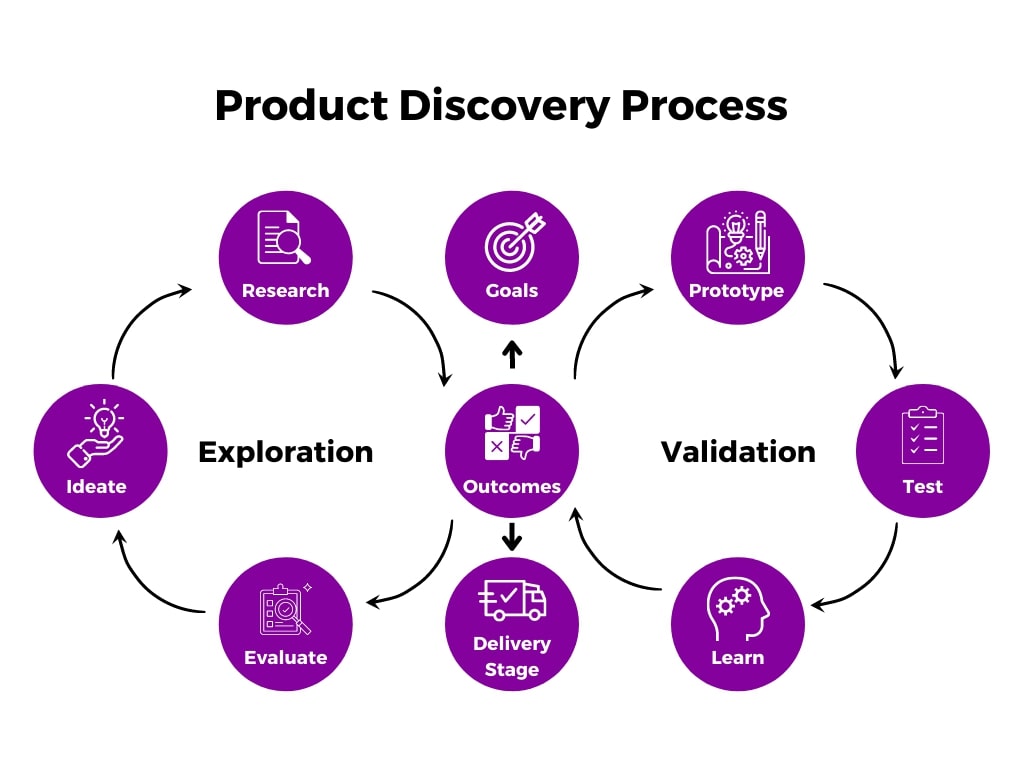
Continuous discovery process involves constantly learning about user needs and opportunities through various research activities such as user interviews and usability testing. The goal of continuous discovery is for product teams to have a tight feedback loop that enables the flow of insights to deliver on the best product experience for a user pain point, need or desire. The product discovery process The typical product discovery process starts with defining the domain or problem space (e.g e-commerce payments or ) you’re trying to solve a problem or set of problems in. The next step is to understand the user or customer segment you’re trying to solve these problems for. This helps the team focus the research on the right areas. You are essentially looking for opportunities to create value that users or businesses are willing to pay for. Once the problem space and user segments are defined, the team then moves on to researching the customer needs and opportunities by carrying out various activities such as user interviews, surveys, usability tests, customer feedback sessions and market research to have a better understanding of the most important problems to solve and the best solutions to them. The continuous discovery process There isn’t a perfect process for doing continuous product discovery and it varies across teams, companies and industries but one main benefit of a continuous product discovery process is that it allows for a more agile approach to product development. By continuously gathering customer feedback and incorporating it into the product, product teams are able to quickly pivot and make changes to improve the product and better meet the needs of your customers. This approach is especially useful in today’s fast-paced, technology-driven market which is constantly evolving meaning customer needs and preferences evolve quickly. How to run product discovery continuously The best teams are able to run product discovery in a continuous manner to build great products and continually improve them. These product teams continually search for new information about user needs, using research activities like weekly customer touch points and hypothesis testing, to uncover user and customer experience insights and user behaviour data. Tools for continuous product discovery It can be difficult to do continuous discovery without the right tools In order to implement a successful continuous product discovery process, it is important to have a dedicated team in place. This team should consist of individuals with a variety of skill sets, including product managers, designers, and developers. The team should also have access to tools and resources that will help them gather and analyse customer feedback, such as user testing software and market research tools. Once the team is in place, the continuous product discovery process can be broken down into a few key steps: Identify customer needs: The first step in the process is to identify the needs of your target customers. This can be done through market research, customer surveys, and other methods of gathering customer feedback. Generate ideas: Once you have a clear understanding of customer needs, the next step is to generate ideas for potential products or features. This can be done through brainstorming sessions, design thinking workshops, and other creative techniques. Test concepts: The next step is to test the viability of your ideas. This can be done through user testing, market validation, and other methods of gathering feedback from potential customers. Iterate and improve: Based on the feedback you receive, you can iterate on your ideas and make improvements to ensure that the product is as successful as possible. This may involve making changes to the product design, adding new features, or even scrapping an idea altogether and starting fresh. By following these steps and continuously gathering customer feedback, you can develop a product that truly meets the needs of your customers and stands a better chance of success in the market. A continuous product discovery process allows for flexibility and adaptability, which is essential in today’s fast-paced business environment. Benefits of continuous product discovery Product discovery is an essential part of the product development process. It is the process of identifying customer needs, validating ideas, and testing concepts to ensure that the product will be successful in the market. A continuous product discovery process is one that is ongoing and iterative, allowing for flexibility and constant improvement. Another advantage of a continuous product discovery process is that it can help reduce the risk of developing a product that fails in the market. By continuously testing and validating ideas, you can identify potential issues early on and make changes before investing too much time and resources into a concept that may not be successful. This can save your company time and money in the long run.
Product Owner vs. Product Manager: What really is the difference?
A product manager and a product owner are two very important roles in the development of a product. They are two roles that are often associated with the development and management of a product within an organization. Some organizations may wonder whether it is necessary to employ both a product manager and a product owner, seeing that their roles are interrelated. But are they really the same? While they may seem quite similar at the surface level and have some overlapping responsibilities, there are however some significant differences between the two roles that are important to understand. Product managers are responsible for the overall strategy and vision for a product. They work closely with cross-functional teams to ensure that the product aligns with the company’s overall goals and objectives. They are also responsible for defining the product roadmap and ensuring that the development team is on track to meet the product’s goals and deadlines. On the other hand, product owners are focused on the day-to-day management of the product. They are responsible for prioritizing and organizing the development team’s work, as well as communicating with stakeholders to ensure that the product meets their needs and expectations. They are also responsible for making decisions about which features and capabilities to include in the product, based on input from the development team, customers, and other stakeholders. The roles and responsibilities of the product owner include what features would be a part of the product release. The product owner defines user stories based on customer requirements and prioritizes them for the development team. One key difference between product managers and product owners is that product managers have a more strategic role, while product owners are more focused on the tactical execution of the product. Product managers are responsible for defining the overall direction and vision for the product, while product owners are responsible for ensuring that the development team can execute and deliver on that vision in a way that meets the needs of stakeholders and customers. They are responsible for the product backlog, which is a prioritized list of all the features and functions that a product should have. The product owner is responsible for maintaining the backlog and prioritizing items on it based on the needs of the business and the development team. They work closely with the development team to ensure that the most important items are being worked on first. Read also: Harnessing Customer Interviews to Build the Right Product Another key difference is that product managers often have a broader scope of responsibility than product owners. Product managers are typically responsible for the entire product lifecycle, from concept to launch and beyond, while product owners are typically focused on the development and release of a specific product or product feature. The product manager is more focused on the big picture and the long-term strategy for the product, while the product owner is more focused on the day-to-day details and making sure that the development team has everything they need to be successful. Overall, the product manager decides what products to build next, and the product owner helps the development team to build the products.
7 Product Discovery Books That Teach What You Should Know

[vc_row type=”in_container” full_screen_row_position=”middle” column_margin=”default” column_direction=”default” column_direction_tablet=”default” column_direction_phone=”default” scene_position=”center” text_color=”dark” text_align=”left” row_border_radius=”none” row_border_radius_applies=”bg” overflow=”visible” overlay_strength=”0.3″ gradient_direction=”left_to_right” shape_divider_position=”bottom” bg_image_animation=”none”][vc_column column_padding=”no-extra-padding” column_padding_tablet=”inherit” column_padding_phone=”inherit” column_padding_position=”all” column_element_direction_desktop=”default” column_element_spacing=”default” desktop_text_alignment=”default” tablet_text_alignment=”default” phone_text_alignment=”default” background_color_opacity=”1″ background_hover_color_opacity=”1″ column_backdrop_filter=”none” column_shadow=”none” column_border_radius=”none” column_link_target=”_self” column_position=”default” gradient_direction=”left_to_right” overlay_strength=”0.3″ width=”1/1″ tablet_width_inherit=”default” animation_type=”default” bg_image_animation=”none” border_type=”simple” column_border_width=”none” column_border_style=”solid”][vc_column_text] In product development, so many of our ideas will not work. With product discovery, product teams can limit waste and rebuilds by up to 50%. It is much cheaper to build the right thing the first time by having a clear understanding of the problem and co-creating the solution with customers. Product teams are able to go faster and build greater products by following the right product discovery processes. Here are seven product discovery books that teach you everything you need to know. 7 Must-Read Product Discovery Books 1. Inspired: How to Create Tech Products Customers Love by Marty Cagan In this book, Marty Cagan provides a framework for creating successful products, which involves understanding the customer, identifying a market opportunity, and building a great team to execute on the opportunity. Cagan’s book is essential reading for anyone in the technology industry who wants to create products that customers will love. This book is an essential read for every product manager. Some people call it the product management bible. 2. Continuous Discovery Habits by Teresa Torres In her book, Teresa Torres shares a framework for developing habits that lead to building successful products. According to Torres, there are four main habits that every product development team should adopt: focus on the customer, embrace change, fail fast, and learn constantly. By following these habits, teams can continuously improve their product development process and better meet the needs of their customers. She offers as structured and sustainable approach to continuous discovery and opportunity mapping. She also points out that it is essential to interview your customers regularly (ideally weekly). 3. The Mom Test: How to Talk to Customers & Learn If Your Business Is a Good Idea When Everyone Is Lying to You by Rob Fitzpatrick In this book, Rob Fitzpatrick shares a set of simple rules for crafting good customer interview questions that even a person’s mom can’t lie to them about. The measure of usefulness of an early customer conversation is whether it provides concrete facts about their lives and world views. These facts, in turn, allow us to improve our business. Eventually you do need to mention what you’re building and take people’s money for it. However, the big mistake is almost always to mention your idea too soon rather than too late. The book advises that you shouldn’t ask your mom whether your business is a good idea because she loves you and will lie to you. It is the ultimate guide for interviewing your customers. 4. Jobs to be Done: Theory to Practice by Tony Ulwick In his book, “Jobs to be Done: Theory to Practice,” Tony Ulwick lays out a framework for understanding customer behavior and designing products that meet customer needs. Ulwick’s framework is based on the idea that customers don’t just purchase products, they “hire” them to do a job. By understanding the “job” that a customer is trying to get done, companies can design products that are more likely to be successful. In summary, he shares in the book that people don’t buy products. They “hire” them to do jobs. He also provides insights on how to define and prioritize customer needs. 5. Sprint: How to solve complex problems and test ideas in just 5 days by Jake Knapp This book by Jake Knapp that lays out a framework for solving complex problems and testing ideas in just five days. The sprint process includes four main steps: brainstorming, sketching, deciding, and prototyping. By following this process, companies can quickly and efficiently come up with solutions to complex problems. The book describes a specific Product Discovery technique invented in Google. It is recommended that the ideas in it are compared with Teressa Torres’s approach, particularly interviewing your customers before ideating. You may want to combine those approaches. 6. The Lean Product Playbook: How to Innovate with Minimum Viable Products and Rapid Customer Feedback by Dan Olsen This book by Dan Olsen that lays out a framework for designing and developing successful products. Olsen’s framework is based on the Lean Startup methodology, and it emphasises the importance of validated learning, customer feedback, and continual iteration. By following Olsen’s framework, companies can increase their chances of developing successful products. Key insights from the book include the complete Lean Product Process – discovering and creating products while minimising waste and rework. The author also shares insights around Business Model, Value Proposition, MVP, Product-Market Fit, Product Discovery, and more. 7. Testing Business Ideas: A Field Guide for Rapid Experimentation by Alex Osterwalder In this book, Alex Osterwalder provides a framework for testing business ideas quickly and efficiently. Osterwalder’s framework is based on the Lean Startup methodology, and it emphasizes the importance of validated learning, customer feedback, and continual iteration. By following Osterwalder’s framework, companies can increase their chances of developing successful products. Some lessons from the book include, starting from an idea, then using the design loop to improve it, using discovery experiments to examine your assumptions and information about dozens of tools and techniques anyone can easily apply. Conclusion: What Next After Reading These Product Discovery Books? As you go through these books, you will gain a deeper understanding on how to perform effective product discovery, but your next question might be, what next? [/vc_column_text][/vc_column][/vc_row]
The Power of User Interviews in Building Successful Products

User interviews are the gold mine of product development. As someone who has worked on B2C and B2B products across multiple domains and at both startups and big tech companies, I have seen product teams use various methodologies, approaches and tools to learn about user needs. One thing all these product companies and teams have in common though is the acknowledgement that the best way to understand user needs is to talk to them directly. Steve Blank calls this process “customer development” in his book – The Four Steps to the Epiphany and it essentially describes a process of building products that are grounded in an intimate understanding of user needs. This process starts with a focus on the user and involves talking to them directly to understand their needs, wants and pains. User interviews help product managers and teams understand the key entities around a problem they are trying to solve: the user, how their product can help the user and the market realities around the user. Here are four ways user interviews help product teams to build successful products: 1. Understanding the why behind a problem 2. Understanding the market realities around a problem 3. Understanding how to solve the problem 4. Understanding how to make good product judgment 1. Understanding the why behind a problem User interviews help the product trifecta or triad (product managers, designers and engineers) to understand the why behind the problem they are solving. They provide insights to causatives, user reasoning, conditions, influencers, limitations etc which can’t be obtained from product usage analytics or any other quantitative sources. This is even more critical for new product development where there isn’t any data on user behavior, feature requests or support tickets. There is no other way to know what users want, why they want it and how best to provide it to them without talking to them. 2. Understanding the market realities around a problem User interviews also help the product team understand the current market realities around a problem space given how quickly the market changes. In my experience, I have seen product managers work with two-year old insights in complex problem areas which is likely to yield the wrong outcomes because the factors influencing the user are likely to have changed. Users might have been using an aggregation tool to simplify their workflow but are now using AI to automate the entire process. 3. Understanding how to solve the problem Speaking to users not only helps you understand the problem space, it also helps you figure out the right way to solve it and even the right scope to begin with. It is very easy to get caught up in the excitement of building a new product and lose sight of what is actually important to users. User interviews keep you grounded and tethered to reality. They help you understand what is actually important to users and what is not. They help you understand how users think about the problem, what their workflow is and how your product can fit into that. User interviews also help you validate your assumptions. It is easy to make assumptions about what users want or how they will use a product but these assumptions can be wrong. The only way to know for sure is to talk to actual users. 4. Understanding how to make good product judgment User interviews help you build empathy for your users. It is easy to get lost in your own world and forget that there are actual people out there who will be using your product. User interviews help you understand their world, their issues and their pains. This understanding is critical for building successful products. This is super critical for early stage startups, employees and founders. If you don’t continually meet with users or customers, eventually all of your insights and knowledge about them becomes obsolete. There’s a saying “It isn’t the things you don’t know what to kill you, it’s the things that you know for sure that just ain’t so”.
