
Sales team nesting programs: Using agent assist to prepare new reps
Sales team nesting programs are essential for onboarding new representatives effectively, ensuring they transition smoothly from training to live interactions. However, traditional methods often fall short in providing the real-time support that new hires need to build confidence and competence. This is where agent assist technology comes into play, bridging the gap between classroom learning and practical application. By leveraging AI-driven insights and support, organizations can enhance their nesting programs, leading to better performance and retention among new sales reps. The New Hire Challenge & Real-Time Agent Assist Solution The Training-to-Floor Gap is a common hurdle in sales team onboarding. New agents may grasp theoretical concepts during training but struggle to apply them in real-world scenarios. The pressure of live customer interactions, compounded by performance anxiety, can lead to mistakes and increased attrition rates. This gap not only affects new hire confidence but also places additional strain on supervisors who must manage multiple agents simultaneously. Real-time agent assist technology addresses this challenge by providing immediate support during live calls. With features such as speech-to-text transcription, AI-driven context analysis, and dynamic guidance, new reps receive the information they need precisely when they need it. This technology helps ensure consistency in quality and speeds up the time to proficiency, ultimately enhancing the overall customer experience. How Real-Time Agent Assist Works Core Technology Components: Live Call Intelligence: The system transcribes conversations in real-time, allowing agents to focus on the customer rather than note-taking. AI-Powered Context Analysis: By understanding customer intent and emotional state, the system can provide tailored suggestions that enhance the interaction. Dynamic Guidance Display: Relevant information, scripts, and compliance reminders are presented to agents during calls, ensuring they have the right tools at their fingertips. Knowledge Base Integration: The technology can surface critical product information and troubleshooting steps based on the context of the conversation, reducing hold times and improving response accuracy. In-Call Support for New Agents: Next Best Action Recommendations: As the customer speaks, the system suggests the most effective responses or actions. Auto-Populated Product Details: When a customer asks a question, relevant product information is displayed, allowing agents to respond confidently without lengthy searches. Compliance Reminders: The system triggers alerts before critical disclosures, helping agents adhere to regulations and company policies. De-escalation Techniques: If a customer shows signs of frustration, the system suggests strategies to calm the situation, empowering agents to handle conflicts effectively. Designing Agent Assist-Enabled Nesting Programs Pre-Nesting Setup: Technology Configuration: Organize knowledge bases by call type and complexity, create a script library with dynamic branching logic, and define compliance rules with real-time triggers. Agent Preparation: Familiarize new hires with the system interface and train them on how to interpret and use AI suggestions naturally. Common New Hire Scenarios & Agent Assist Support: Unfamiliar Product Question: Without Agent Assist: The agent holds the call to search for answers, leading to customer frustration. With Agent Assist: The system detects the product mention and surfaces relevant details instantly, allowing for a confident response. Customer Objection: Without Agent Assist: The agent struggles to respond effectively, risking a lost sale. With Agent Assist: The system recognizes the objection pattern and displays proven rebuttals, enabling the agent to respond appropriately. Escalating Customer: Without Agent Assist: The agent may panic and transfer the call unnecessarily. With Agent Assist: The system detects sentiment shifts and suggests de-escalation techniques, helping the agent resolve the issue without escalation. Scaling, Implementation & ROI Scaling Nesting Programs Without Adding Supervisors: Traditional nesting programs often require a proportional increase in supervisory staff as the number of new agents grows. This can be unsustainable and costly. However, with agent assist technology, one supervisor can effectively monitor 10-15 nesting agents simultaneously, significantly increasing capacity without compromising quality. Implementation Roadmap: Phase 1: Pilot Program (Weeks 1-4): Test a single nesting cohort to establish performance baselines and gather feedback for optimization. Phase 2: Optimization (Weeks 5-8): Adjust guidance algorithms based on pilot data and refine supervisor alert thresholds for balanced support. Phase 3: Scale (Weeks 9+): Roll out the program across all nesting cohorts, integrating it into standard onboarding processes. Measurable Benefits: Reduced Nesting Duration: Faster onboarding leads to earlier revenue contributions. Improved New Hire Retention: Enhanced support decreases turnover costs associated with replacing agents. Increased Supervisor Capacity: Supervisors can support more agents, avoiding the need for additional hires. Quality Improvement: Fewer errors and better customer experiences result in reduced rework and higher satisfaction. Frequently Asked Questions Q: Will agents become dependent on agent assist and never develop true skills?A: The graduated assistance approach ensures agents build confidence and competence over time, gradually reducing support as they gain proficiency. Q: How does agent assist work for remote/virtual nesting programs?A: Agent assist provides supervisors with real-time monitoring capabilities, allowing for effective support even in remote settings. Q: Can agent assist replace supervisors during nesting?A: No, agent assist amplifies supervisor capacity by providing real-time support, allowing supervisors to focus on higher-value coaching. Q: How quickly can we implement agent assist for an upcoming training class?A: Typical implementation takes 4-6 weeks for pilot readiness, allowing for thorough testing and optimization before scaling. Q: What happens to agent assist after nesting ends?A: Agent assist continues to provide value throughout an agent's tenure, supporting ongoing development and handling complex scenarios as they arise. By integrating agent assist technology into your sales team nesting programs, you can create a more effective onboarding experience that not only prepares new reps for success but also enhances overall team performance and customer satisfaction.
How agent assist standardizes nesting programs across locations and teams
The transition from training to live customer interactions can be a daunting challenge for new agents in a contact center. As organizations expand across multiple locations and teams, ensuring consistency and quality in the onboarding process becomes increasingly complex. This is where agent assist technology plays a crucial role in standardizing nesting programs, enhancing new hire confidence, and ultimately improving customer service outcomes. The Training-to-Floor Gap New agents often grasp concepts during training but struggle to apply them in real-time customer interactions. This gap can lead to costly attrition, quality issues, and supervisor burnout. During the critical early weeks of employment, agents face time pressure and performance anxiety, which can hinder their ability to perform effectively. Without adequate support, they may forget up to 70% of the training content, leading to mistakes and escalations that frustrate both customers and supervisors. Agent assist technology bridges this gap by providing real-time support during live interactions. By offering dynamic guidance and contextual information, it empowers agents to make informed decisions, thereby enhancing their confidence and performance. This is particularly vital during the nesting phase, where new hires take calls under the supervision of experienced agents. How Real-Time Agent Assist Works Core Technology Components: Live Call Intelligence: Agent assist systems utilize real-time speech-to-text transcription to analyze conversations, enabling a deeper understanding of customer intent and emotional state. Dynamic Guidance Display: Relevant information, scripts, and compliance reminders are presented on the agent's screen during calls, allowing for immediate access to necessary resources. In-Call Support for New Agents: The system offers next best action recommendations, auto-populates product details based on customer inquiries, and provides de-escalation tactics when customer frustration is detected. Benefits of Real-Time Support: Increased Supervisor Capacity: With agent assist, one supervisor can effectively monitor 10-15 nesting agents simultaneously, compared to the traditional limit of 3-5. This scalability removes bottlenecks and ensures consistent support across teams. Immediate Feedback: Real-time alerts notify supervisors when agents struggle, allowing for targeted intervention without interrupting the customer interaction. Automated Quality Scoring: This reduces the manual review burden while maintaining consistency in performance evaluations. By integrating agent assist technology into the nesting process, organizations can create a more supportive environment for new hires, leading to faster onboarding and improved service quality. Designing Agent Assist-Enabled Nesting Programs Pre-Nesting Setup: Technology Configuration: Organize the knowledge base by call type and complexity, create a script library with dynamic branching logic, and define compliance rules with real-time trigger configurations. Agent Preparation: Familiarize agents with the screen layout and guidance interpretation, ensuring they understand how to use AI suggestions naturally. Common New Hire Scenarios & Agent Assist Support: Unfamiliar Product Question: Without agent assist, agents may freeze or escalate calls due to lack of knowledge. With agent assist, relevant product details are surfaced instantly, allowing for confident responses. Customer Objection: Traditional methods may lead to weak responses or lost sales. Agent assist recognizes objection patterns and displays proven rebuttals, enhancing agent effectiveness. Compliance-Critical Moment: Agent assist triggers reminders for required disclosures, helping agents avoid violations and ensuring compliance during critical interactions. By implementing these strategies, organizations can enhance their nesting programs, ensuring that new hires receive the support they need to thrive. Supervisor Efficiency & Performance Monitoring Traditional vs. Agent Assist-Enabled Supervision: Feature Traditional Supervision Agent Assist-Enabled Supervision Agent Monitoring Capacity 3-5 agents 10-15+ agents Coaching Method Post-call only In-call instant messaging Quality Scoring Manual Automated with real-time updates Performance Insights Limited Comprehensive analytics Real-Time Performance Monitoring Dashboard: Live Agent Status: Provides an overview of agent activities, including current call status and quality scores. Alert Notifications: Supervisors receive alerts for compliance risks, escalation needs, and knowledge gaps. Intervention Tools: Instant messaging allows for discreet coaching, while performance dashboards highlight areas needing attention. By leveraging agent assist technology, supervisors can focus on higher-value coaching activities, ensuring that agents receive the guidance they need to succeed. Scaling, Implementation & ROI Scaling Nesting Programs Without Adding Supervisors: As organizations grow, scaling nesting programs can become a challenge. Traditional models require proportional increases in supervisory staff, which can be unsustainable. Agent assist technology provides a solution by multiplying supervisor efficiency, allowing them to support more agents without compromising quality. Implementation Roadmap: Pilot Program (Weeks 1-4): Test with a single nesting cohort, establishing performance baselines and collecting feedback for optimization. Optimization (Weeks 5-8): Adjust guidance algorithms based on pilot data and refine supervisor alert thresholds. Scale (Weeks 9+): Roll out to all nesting programs, integrating into standard onboarding processes and continuously measuring impact on retention and quality. ROI & Business Case: Reduced Nesting Duration: Faster time to proficiency leads to earlier revenue contributions. Improved New Hire Retention: Lower replacement costs and reduced recruiting/training expenses. Increased Supervisor Capacity: Supports more agents without additional hiring. Quality Improvement: Fewer errors and better customer experiences. By investing in agent assist technology, organizations can enhance their nesting programs, leading to improved agent performance, customer satisfaction, and overall business success.
How real-time agent guidance improves nesting pass rates
The contact center landscape is evolving rapidly, and organizations are increasingly recognizing the importance of effective onboarding processes. One of the most significant challenges faced by contact centers is ensuring that new agents transition smoothly from training to real customer interactions. This transition, often referred to as the nesting phase, is critical for agent success and retention. Real-time agent guidance has emerged as a powerful tool to improve nesting pass rates, ensuring that new hires not only feel supported but also become proficient in their roles more quickly. The Training-to-Floor Gap New hires often enter the contact center with a solid understanding of the concepts taught during training. However, when faced with live calls, they frequently struggle to apply this knowledge effectively. The pressure of real-time interactions, combined with performance anxiety, can lead to costly mistakes, decreased customer satisfaction, and even early attrition. This gap between training and actual performance creates a significant burden on supervisors, who are often tasked with monitoring multiple agents but lack the capacity to provide individualized support. Real-time agent assist technology bridges this gap by providing immediate support during live interactions. This technology enables agents to access relevant information, scripts, and compliance reminders as they engage with customers, thereby reducing the likelihood of errors and enhancing overall performance. By addressing the training-to-floor gap, organizations can significantly improve nesting pass rates and ensure that new hires feel confident and capable in their roles. How Real-Time Agent Assist Works Core Technology Components: Live Call Intelligence: This feature includes real-time speech-to-text transcription of conversations, allowing agents to refer back to what was said during the call. AI-Powered Context Analysis: The system analyzes customer intent, emotional state, and conversation progress, providing agents with insights that enhance their responses. Dynamic Guidance Display: Relevant information, scripts, and compliance reminders are presented on the agent's screen during calls, ensuring they have the necessary tools at their fingertips. Knowledge Base Integration: The system surfaces product information, policy details, and troubleshooting steps based on the context of the conversation, reducing hold times and knowledge searches. In-Call Support for New Agents: Next Best Action Recommendations: As customers speak, the system suggests the most appropriate responses or actions, guiding agents through complex interactions. Scripts and Talk Tracks: For scenarios that new agents may not have mastered, the system provides scripts that can be easily referenced during the call. Compliance Reminders: These alerts trigger before critical disclosures, helping to prevent regulatory violations. De-escalation Tactics: When customer frustration is detected, the system suggests techniques to calm the situation, empowering agents to handle challenging interactions effectively. Nesting Program Enhancement with Agent Assist Designing Agent Assist-Enabled Nesting Programs: To maximize the benefits of real-time agent guidance, organizations should consider the following steps in designing their nesting programs: Pre-Nesting Setup: Technology Configuration: Organize the knowledge base by call type and complexity level, ensuring that agents can easily access the information they need. Script Library Creation: Develop dynamic branching logic for different scenarios, allowing agents to navigate various customer interactions seamlessly. Compliance Rule Definition: Establish real-time triggers for compliance reminders to ensure agents adhere to regulations during calls. Quality Scorecard Integration: Implement live performance metrics that allow supervisors to monitor agent progress in real-time. Agent Preparation: Screen Layout Familiarization: Train agents on how to use the call controls and the agent assist guidance panel effectively. Guidance Interpretation Training: Teach agents how to utilize AI suggestions naturally without sounding robotic, fostering a more authentic customer interaction. Technology Trust-Building: Encourage agents to understand when to rely on guidance versus exercising their judgment, promoting confidence in their abilities. Common New Hire Scenarios & Agent Assist Support: Unfamiliar Product Question: Without Agent Assist: The agent places the customer on hold to search for information, leading to longer handling times and potential frustration. With Agent Assist: The system detects the product mention and surfaces relevant details instantly, allowing the agent to respond confidently without delay. Customer Objection: Without Agent Assist: The agent may freeze or provide a weak response, resulting in lost sales or decreased customer satisfaction. With Agent Assist: The system recognizes the objection pattern and displays proven responses, enabling the agent to select the appropriate rebuttal in real-time. Supervisor Efficiency & Performance Monitoring The integration of real-time agent guidance not only benefits new hires but also significantly enhances the efficiency of supervisors. Traditional nesting programs limit supervisors to monitoring only 3-5 agents at a time, creating bottlenecks and inconsistent support. However, with real-time dashboards, supervisors can effectively monitor 10-15+ agents simultaneously. Real-Time Performance Monitoring Dashboard: Live Agent Status: Provides an overview of agent activity, including whether they are on a call, available, or in after-call work. Real-Time Quality Scores: These scores update during calls, allowing supervisors to identify agents who may need immediate support. Alert Notifications: The system sends alerts for compliance risks or when an agent struggles, enabling timely intervention. Performance Analytics: Supervisors can track patterns across multiple agents, identifying common challenges and facilitating targeted coaching. By leveraging real-time agent assist technology, organizations can create a more supportive environment for new hires, leading to improved nesting pass rates and ultimately enhancing overall performance and customer satisfaction. In conclusion, real-time agent guidance is a game-changer for contact centers looking to improve their nesting programs. By addressing the training-to-floor gap, providing in-call support, and enhancing supervisor efficiency, organizations can ensure that new agents transition smoothly into their roles, leading to better performance and higher retention rates.
Remote and virtual nesting programs: Using real-time support effectively
Overview In the evolving landscape of remote work, organizations face unique challenges in onboarding and training new hires, particularly in customer-facing roles. Remote and virtual nesting programs have emerged as a vital solution to bridge the gap between theoretical training and practical application. These programs aim to enhance new hire confidence, reduce early attrition, and ensure a smooth transition from training to production. However, the operational stakes are high. Companies need to prioritize speed to proficiency, maintain quality consistency, and manage supervisor capacity effectively. This blog post explores how real-time support technologies can enhance remote nesting programs, ensuring that new agents receive the guidance they need to succeed in their roles. The Training-to-Floor Gap One of the most significant challenges in agent onboarding is the training-to-floor gap. While new hires may grasp concepts during classroom training, they often struggle to apply this knowledge during live customer interactions. The pressure of real-time decision-making, coupled with performance anxiety, can lead to costly mistakes, increased attrition rates, and supervisor burnout. This gap is particularly pronounced in remote settings where new hires may feel isolated and unsupported. Real-time agent assist technology addresses this issue by providing immediate support during customer interactions. By leveraging AI-driven insights and contextual guidance, organizations can help new hires navigate complex conversations with confidence. This not only enhances the agent's ability to perform but also improves customer satisfaction, as agents are better equipped to handle inquiries and resolve issues on the first call. How Real-Time Agent Assist Works Core Technology Components: Live Call Intelligence: Real-time speech-to-text transcription captures the conversation between the agent and the customer, allowing for immediate analysis. AI-Powered Context Analysis: The system understands customer intent, emotional state, and conversation progress, providing agents with relevant insights. Dynamic Guidance Display: Agents receive on-screen prompts with scripts, objection responses, and compliance reminders tailored to the context of the call. Knowledge Base Integration: The system surfaces product information, policy details, and troubleshooting steps based on the ongoing conversation. In-Call Support for New Agents: Next best action recommendations appear as the customer speaks, guiding agents through the conversation. Scripts and talk tracks for common scenarios are displayed, helping agents who may not have mastered specific responses. Compliance reminders trigger at critical moments, reducing the risk of regulatory violations. De-escalation tactics are suggested when the system detects customer frustration, empowering agents to resolve conflicts effectively. This technology not only enhances the agent's performance during calls but also allows supervisors to monitor multiple agents simultaneously, increasing their capacity to support new hires. Designing Agent Assist-Enabled Nesting Programs Pre-Nesting Setup: To implement an effective agent assist-enabled nesting program, organizations should focus on the following areas: Technology Configuration: Knowledge Base Organization: Structure the knowledge base by call type and complexity level to ensure easy access to relevant information. Script Library Creation: Develop a dynamic script library that includes branching logic for various scenarios, allowing agents to navigate different customer interactions seamlessly. Compliance Rule Definition: Set up clear compliance rules and configure real-time triggers to alert agents when critical disclosures are needed. Quality Scorecard Integration: Utilize live performance metrics to evaluate agent interactions and provide targeted coaching. Agent Preparation: Screen Layout Familiarization: Train agents to navigate the call controls alongside the agent assist guidance panel effectively. Guidance Interpretation Training: Teach agents how to use AI suggestions naturally, ensuring they sound conversational rather than robotic. Technology Trust-Building: Foster a culture of trust in technology by demonstrating its benefits and showing agents when to rely on guidance versus exercising their judgment. By preparing agents effectively and configuring technology to support their needs, organizations can significantly enhance the nesting experience, leading to faster onboarding and improved performance. Supervisor Efficiency & Performance Monitoring Traditional vs. Agent Assist-Enabled Supervision: In traditional nesting programs, supervisors can typically monitor only 3-5 agents at a time, leading to bottlenecks and inconsistent support. However, with real-time agent assist technology, supervisors can effectively manage 10-15+ agents simultaneously through a unified dashboard. Key Features of Agent Assist for Supervisors: Real-Time Alerts: Supervisors receive notifications when agents struggle or deviate from protocol, enabling timely interventions. Instant Message Coaching: Supervisors can provide in-call coaching via instant messaging without interrupting the customer interaction. Automated Quality Scoring: This feature reduces the manual review burden while maintaining consistency across evaluations. Performance Analytics: Supervisors can identify patterns in agent performance, allowing for targeted coaching and support. By leveraging these capabilities, organizations can enhance supervisor efficiency, ensuring that new hires receive the guidance they need while maintaining high-quality customer interactions. Frequently Asked Questions Q: How does agent assist technology improve remote nesting programs?A: Agent assist technology provides real-time support and guidance during customer interactions, helping new hires apply their training effectively and confidently. Q: Will agents become dependent on agent assist and never develop true skills?A: No, the graduated assistance approach ensures agents gradually gain independence while benefiting from support during critical learning periods. Q: How quickly can we implement agent assist for an upcoming training class?A: Implementation typically takes 4-6 weeks for pilot-ready configuration, allowing time for optimization based on feedback and performance data. Q: Can agent assist replace supervisors during nesting?A: No, agent assist amplifies supervisor capabilities, allowing them to focus on high-value activities while technology handles routine support. Q: What happens to agent assist after nesting ends?A: Agent assist continues to provide value throughout an agent's tenure, supporting ongoing skill development and performance improvement. By integrating real-time support technologies into remote nesting programs, organizations can significantly enhance the onboarding experience for new hires, leading to improved performance, higher retention rates, and ultimately, better customer satisfaction.
Scaling nesting programs without adding more supervisors using live assist
Scaling a nesting program can be a daunting challenge, especially when it comes to maintaining quality and efficiency without overburdening supervisors. Traditional nesting programs often rely heavily on one-on-one supervision, which can limit scalability and increase operational costs. However, leveraging live assist technology can bridge this gap, allowing organizations to support more new hires effectively without the need for additional supervisors. This article explores the critical first weeks of agent onboarding, the challenges faced, and how real-time agent assist technology can enhance the nesting experience. The New Hire Challenge & Real-Time Agent Assist Solution The critical first weeks of a new hire's journey are pivotal for their long-term success. During this period, agents transition from classroom training to live customer interactions, a shift that can be overwhelming. Many agents understand concepts in theory but struggle to apply them under the pressure of real-time customer interactions. This gap can lead to costly attrition, decreased quality, and supervisor burnout. Real-time agent assist technology acts as a safety net, providing immediate support and guidance during these crucial interactions, ensuring that new hires feel confident and capable. Why Traditional Nesting Falls Short Supervisor Capacity Limitations In a traditional nesting setup, one supervisor typically monitors only 3-5 agents simultaneously. This creates significant bottlenecks as the number of new hires increases, leading to inconsistent support and increased stress for supervisors who are already stretched thin. Real-Time Support Delivery Gap Post-call coaching fails to address the immediate needs of agents during live interactions. Agents often require assistance at the moment when they are faced with customer inquiries, and waiting for post-call feedback can result in missed opportunities and increased customer dissatisfaction. Remote/Hybrid Complexity With the rise of remote and hybrid work environments, providing in-the-moment support becomes even more challenging. Supervisors may struggle to offer the same level of guidance to remote agents, leaving them feeling isolated and unsupported during their critical early weeks. Knowledge Retention Drop-Off Research indicates that agents can forget up to 70% of training content within weeks without reinforcement through real-world application. This knowledge drop-off can lead to mistakes, escalations, and ultimately, customer dissatisfaction. How Real-Time Agent Assist Works Core Technology Components Live Call Intelligence: Real-time speech-to-text transcription captures both agent and customer dialogue, allowing for immediate analysis. AI-Powered Context Analysis: The technology understands customer intent, emotional state, and conversation progress, providing relevant insights to agents. Dynamic Guidance Display: Agents receive contextual prompts on their screens, such as scripts, compliance reminders, and objection responses, tailored to the specific conversation. Knowledge Base Integration: The system surfaces relevant product information and troubleshooting steps based on the ongoing conversation. In-Call Support for New Agents Next Best Action Recommendations: As customers speak, the system suggests appropriate responses and actions. Scripts and Talk Tracks: Agents can access scripts for common scenarios they may not have mastered yet. Compliance Reminders: Alerts trigger before critical disclosures, helping prevent compliance violations. De-escalation Tactics: The system detects customer frustration and suggests techniques to calm the situation. Supervisor Amplification Increased Monitoring Capacity: One supervisor can effectively monitor 10-15 agents simultaneously through a real-time dashboard, significantly increasing their capacity. Real-Time Alerts: Supervisors receive notifications when agents struggle, allowing for targeted interventions. Instant Messaging Coaching: Supervisors can provide in-call coaching without interrupting the customer interaction. Automated Quality Scoring: This reduces the manual review burden while maintaining consistency across interactions. Scaling Nesting Programs Without Adding Supervisors Traditional Scaling Limitations In a conventional approach, scaling from 10 to 50 new agents typically requires a proportional increase in supervisors. This is not only unsustainable but also expensive, creating hiring and training bottlenecks that can stifle business growth. Agent Assist Scaling Advantages Efficiency Multiplier: With one supervisor able to support 10-15 agents, organizations can scale their nesting programs without the need for additional hires. Consistency Across Locations: The technology provides identical support across all teams, eliminating variations in coaching styles. Rapid Cohort Onboarding: Organizations can launch larger training classes while the technology handles real-time support, allowing supervisors to focus on exceptional cases. Remote Support: Distributed teams receive the same level of guidance as in-office agents, ensuring quality remains high regardless of location. Implementation Roadmap Phase 1: Pilot Program (Weeks 1-4) Test the technology with a single nesting cohort. Establish performance baselines and gather initial feedback for optimization. Phase 2: Optimization (Weeks 5-8) Adjust guidance algorithms based on pilot performance data. Refine supervisor alert thresholds to balance support and independence. Phase 3: Scale (Weeks 9+) Roll out the program across all nesting teams. Integrate the technology into standard onboarding processes, continuously improving based on feedback. Frequently Asked Questions Q: Will agents become dependent on agent assist and never develop true skills?A: No, the graduated assistance approach prevents dependency by gradually reducing support as agents gain confidence. Q: How does agent assist work for remote/virtual nesting programs?A: Agent assist provides real-time monitoring and support, ensuring remote agents receive the same guidance as in-office teams. Q: Can agent assist replace supervisors during nesting?A: No, it amplifies supervisor capacity, allowing them to focus on higher-value coaching rather than routine support. Q: How quickly can we implement agent assist for an upcoming training class?A: Typical implementation takes 4-6 weeks for pilot readiness, ensuring quality guidance and supervisor adoption. Q: What happens to agent assist after nesting ends?A: It continues to provide value throughout the agent's tenure, supporting ongoing development and skill reinforcement. By integrating live assist technology into your nesting program, you can scale effectively, enhance agent confidence, and improve overall customer satisfaction—all without the need for additional supervisory resources.
How agent assist reduces the supervisor workload in nesting programs
In the fast-paced environment of contact centers, the transition from training to live customer interactions can be daunting for new agents. This is especially true during the nesting phase, where new hires take their first calls with the support of experienced supervisors. However, the pressure on supervisors can become overwhelming as they strive to ensure quality and efficiency while managing multiple agents. This is where agent assist technology comes into play, significantly reducing supervisor workload and enhancing the overall effectiveness of nesting programs. The Training-to-Floor Gap One of the most significant challenges in contact centers is the gap between training and real-world application. New agents often grasp theoretical concepts during classroom training but struggle to apply them effectively during live calls. This disconnect can lead to increased attrition rates, quality issues, and supervisor burnout. Agent assist technology addresses this gap by providing real-time support during customer interactions. By offering immediate access to relevant information and guidance, agent assist tools help agents navigate complex situations, thereby reducing the need for constant supervisor intervention. This not only empowers new hires but also alleviates the pressure on supervisors, allowing them to focus on higher-level coaching and performance management. How Real-Time Agent Assist Works Core Technology Components: Agent assist technology is built on several key components that work together to enhance agent performance: Live Call Intelligence: This includes real-time speech-to-text transcription of conversations, enabling agents to focus on the interaction rather than taking notes. AI-Powered Context Analysis: The system understands customer intent and emotional state, providing agents with tailored responses and suggestions. Dynamic Guidance Display: Relevant information, such as scripts and compliance reminders, is presented on the agent's screen during calls, ensuring they have the tools they need at their fingertips. Knowledge Base Integration: Agents can access product information and troubleshooting steps based on the context of the conversation, minimizing hold times and knowledge gaps. By integrating these components, agent assist tools create a supportive environment where new hires can thrive, leading to faster onboarding and improved confidence. Nesting Program Enhancement with Agent Assist Designing Agent Assist-Enabled Nesting Programs: To maximize the benefits of agent assist technology, organizations should consider the following steps when designing their nesting programs: Pre-Nesting Setup: Technology Configuration: Organize the knowledge base by call type and complexity level, ensuring agents can easily find relevant information. Script Library Creation: Develop a dynamic script library with branching logic for different scenarios, allowing agents to respond appropriately to various customer inquiries. Compliance Rule Definition: Establish clear compliance guidelines and configure real-time triggers to alert agents when critical disclosures are required. Agent Preparation: Screen Layout Familiarization: Train agents on how to navigate the call controls and the agent assist guidance panel effectively. Guidance Interpretation Training: Help agents learn to use AI suggestions naturally, ensuring they maintain a conversational tone with customers. By implementing these strategies, organizations can create a robust nesting program that leverages agent assist technology to support new hires effectively. Supervisor Efficiency & Performance Monitoring Traditional vs. Agent Assist-Enabled Supervision: The introduction of agent assist technology transforms the role of supervisors in nesting programs. Traditional supervision often limits one supervisor to monitoring just 3-5 agents at a time, leading to bottlenecks and inconsistent support. In contrast, with agent assist, supervisors can effectively monitor 10-15+ agents simultaneously through a unified dashboard. Real-Time Performance Monitoring Dashboard: Live Agent Status: Supervisors can view agent activity in real-time, including whether they are on a call, available, or in after-call work. Alert Notifications: The system provides alerts for compliance risks, customer escalations, or knowledge gaps, enabling supervisors to intervene promptly. Supervisor Intervention Tools: Instant Message Coaching: Supervisors can send real-time messages to agents without interrupting the customer interaction, providing support when it’s needed most. Automated Quality Scoring: The system automatically evaluates calls against pre-set quality standards, reducing the manual review burden and ensuring consistency. By enhancing supervisor efficiency and performance monitoring, agent assist technology not only improves the support new hires receive but also allows supervisors to focus on developing their teams further. Frequently Asked Questions Q: Will agents become dependent on agent assist and never develop true skills?A: No, agent assist is designed to gradually reduce support over the nesting period, ensuring agents develop competence while benefiting from real-time assistance. Q: How does agent assist work for remote/virtual nesting programs?A: Agent assist provides supervisors with real-time monitoring capabilities for remote agents, ensuring consistent support and guidance, regardless of location. Q: Can agent assist replace supervisors during nesting?A: No, agent assist amplifies supervisor capabilities, allowing them to focus on higher-value activities while providing real-time support to agents. Q: How quickly can we implement agent assist for an upcoming training class?A: Implementation typically takes 4-6 weeks, allowing for proper configuration and training to ensure effective use of the technology. Q: What happens to agent assist after nesting ends?A: Agent assist continues to provide value throughout an agent's tenure, supporting ongoing development and handling unfamiliar scenarios as they arise. By adopting agent assist technology, contact centers can significantly reduce the workload on supervisors during nesting programs, leading to improved agent performance, higher retention rates, and ultimately, enhanced customer satisfaction.
Real-time coaching during nesting: Building confidence before solo calls
Real-time coaching during nesting is a crucial element in developing confident, capable agents who can handle customer interactions effectively. As organizations strive to enhance their training programs, understanding the challenges faced during the nesting phase is essential. This blog post will explore the significance of real-time coaching, the common hurdles new hires encounter, and how leveraging AI-powered solutions like Insight7 can bridge the gap between training and live calls. The New Hire Challenge & Real-Time Agent Assist Solution The transition from classroom training to live customer interactions is often fraught with challenges. New hires may grasp theoretical concepts but struggle to apply them in real-time situations, leading to performance anxiety and a lack of confidence. This gap can result in costly attrition, quality issues, and supervisor burnout, as supervisors are unable to provide the necessary support to every new agent during high-pressure moments. Real-time agent assist technology, such as Insight7, addresses these challenges by offering immediate support during live calls. This technology helps new agents navigate complex customer interactions, ensuring they feel more confident and capable from the outset. By providing dynamic guidance and contextual information, real-time coaching empowers new hires to make informed decisions, ultimately enhancing their performance and reducing the time it takes to reach proficiency. Why Traditional Nesting Falls Short Supervisor Capacity Limitations In traditional nesting programs, a supervisor can typically monitor only 3-5 agents simultaneously. This limitation creates bottlenecks in support, as supervisors cannot provide personalized assistance to every agent who needs it. As a result, new hires may feel isolated and unsupported, leading to increased anxiety and decreased performance. Real-Time Support Delivery Gap Another significant issue with traditional nesting is the reliance on post-call coaching. This misses the critical moment when agents need help the most—during actual customer interactions. Without real-time support, agents may struggle to recall training content or apply it effectively, leading to mistakes and customer dissatisfaction. Remote/Hybrid Complexity The rise of remote and hybrid work environments has further complicated the nesting process. Virtual nesting makes it nearly impossible for supervisors to provide in-the-moment support, leaving new hires feeling disconnected. This lack of immediate feedback can hinder their confidence and ability to perform well under pressure. Knowledge Retention Drop-Off Research shows that agents forget up to 70% of training content within weeks if not reinforced through real-world application. This knowledge retention drop-off can lead to mistakes, escalations, and frustrated customers, further exacerbating the challenges faced by new hires. How Real-Time Agent Assist Works Real-time agent assist technology leverages advanced AI capabilities to provide new agents with the support they need during live calls. Here’s how it works: Core Technology Components Live Call Intelligence: The system transcribes conversations in real-time, allowing it to analyze context, customer intent, and emotional cues. Dynamic Guidance Display: Relevant information, scripts, and compliance reminders are presented on the agent's screen during calls, ensuring they have the necessary tools at their fingertips. In-Call Support for New Agents: As customers speak, the system provides next-best-action recommendations, surfaces scripts for common scenarios, and triggers compliance reminders at critical moments. Supervisor Amplification: Supervisors can monitor 10-15 agents simultaneously through a real-time dashboard, receiving alerts when agents struggle or deviate from protocols. This allows for targeted intervention without interrupting customer interactions. By integrating real-time agent assist technology into the nesting process, organizations can significantly enhance the training experience for new hires, leading to improved confidence and performance. Nesting Program Enhancement with Agent Assist Designing Agent Assist-Enabled Nesting Programs Pre-Nesting Setup: Technology Configuration: Organize the knowledge base by call type and complexity level, and create a script library with dynamic branching logic for various scenarios. Agent Preparation: Familiarize agents with the screen layout and guidance interpretation training to ensure they can leverage AI suggestions effectively. Common New Hire Scenarios & Agent Assist Support Unfamiliar Product Question: Without Agent Assist: The agent puts the customer on hold to search for answers, leading to frustration. With Agent Assist: The system detects the product mention and surfaces relevant details instantly, allowing the agent to respond confidently. Customer Objection: Without Agent Assist: The agent freezes or provides a weak response, resulting in a lost sale. With Agent Assist: The system recognizes the objection pattern and displays proven responses, enabling the agent to select the appropriate rebuttal. Compliance-Critical Moment: Without Agent Assist: An agent may forget to deliver a required disclosure, leading to potential violations. With Agent Assist: The system triggers a reminder at the right moment, ensuring compliance. By implementing these strategies, organizations can create a more supportive nesting environment that fosters agent confidence and reduces the time to proficiency. Frequently Asked Questions Q: Will agents become dependent on agent assist and never develop true skills?A: No, the graduated assistance approach ensures agents gradually gain independence while benefiting from real-time support during critical learning phases. Q: How does agent assist work for remote/virtual nesting programs?A: Agent assist provides supervisors with real-time monitoring capabilities, allowing them to support remote agents effectively without physical presence. Q: Can agent assist replace supervisors during nesting?A: No, agent assist amplifies supervisor capabilities, allowing them to focus on high-value coaching while the technology handles routine guidance. Q: How quickly can we implement agent assist for an upcoming training class?A: Typical deployment takes 4-6 weeks for pilot-ready configuration, ensuring quality guidance and supervisor adoption. Q: What happens to agent assist after nesting ends?A: Agent assist continues to provide value throughout an agent's tenure, supporting ongoing development and performance enhancement. By focusing on real-time coaching during the nesting phase, organizations can build confident agents who are well-prepared to handle customer interactions independently. Implementing AI-powered solutions like Insight7 not only enhances training efficiency but also significantly improves overall customer satisfaction.
Live agent assist during nesting: Supporting supervisors and trainers
In the fast-paced world of customer service, the transition from training to actual customer interactions can be daunting for new agents. The nesting phase, where new hires begin taking calls under the supervision of experienced agents, is critical for building confidence and competence. However, this phase often presents challenges for both the new hires and their supervisors. One effective solution to enhance the nesting experience is the integration of live agent assist technology, which supports supervisors and trainers in real-time. This blog post explores the operational stakes involved, the gap between training and live interactions, and how real-time agent assist technology can bridge that divide. The New Hire Challenge & Real-Time Agent Assist Solution The critical first weeks of an agent's career are pivotal in determining their long-term success. During this period, agents transition from theoretical knowledge gained in training to practical application during live customer interactions. Unfortunately, many new hires struggle to apply what they've learned under the pressure of real-time calls. This gap creates costly attrition, quality issues, and increased supervisor burnout, as supervisors can only monitor a limited number of agents at a time. Real-time agent assist technology addresses this issue by providing support during live interactions. By offering immediate access to relevant information and guidance, this technology helps new agents navigate complex customer inquiries with greater confidence. For supervisors, it alleviates the burden of monitoring multiple agents simultaneously, allowing them to focus on providing targeted support when it's most needed. Why Traditional Nesting Falls Short Supervisor Capacity Limitations In a traditional nesting setup, one supervisor can effectively monitor only 3-5 agents at a time. This limitation creates bottlenecks in support, as supervisors struggle to provide consistent guidance across growing teams. As a result, new hires may feel isolated and unsupported, leading to decreased confidence and increased anxiety. Real-Time Support Delivery Gap Post-call coaching often misses the critical moment when agents need help the most—during the actual customer interaction. By the time feedback is provided, the opportunity for immediate improvement has passed, leaving agents to navigate future calls without the benefit of real-time support. Remote/Hybrid Complexity With the rise of remote and hybrid work environments, traditional nesting methods have become increasingly ineffective. Supervisors may find it nearly impossible to provide in-the-moment support to remote new hires, exacerbating feelings of isolation and disconnection. Knowledge Retention Drop-Off Research indicates that without reinforcement through real-world application, agents can forget up to 70% of their training content within weeks. This knowledge drop-off can lead to mistakes, escalations, and ultimately, customer dissatisfaction. How Real-Time Agent Assist Works Core Technology Components Real-time agent assist technology is designed to empower agents during live interactions through several key features: Live Call Intelligence: The system provides real-time speech-to-text transcription of conversations, allowing agents to focus on the interaction rather than note-taking. AI-Powered Context Analysis: This feature understands customer intent and emotional state, enabling agents to respond appropriately. Dynamic Guidance Display: Relevant information, scripts, and compliance reminders are presented on the agent's screen during calls, ensuring they have the tools they need at their fingertips. Knowledge Base Integration: The system surfaces product information and troubleshooting steps based on the context of the conversation, reducing hold times and knowledge searches. In-Call Support for New Agents During a call, agents receive real-time support through features such as: Next Best Action Recommendations: Suggestions appear as customers speak, guiding agents on how to proceed. Script and Talk Track Assistance: For unfamiliar scenarios, scripts are surfaced to help agents navigate the conversation effectively. Compliance Reminders: Alerts are triggered before critical disclosures to prevent violations. De-escalation Techniques: When customer frustration is detected, the system suggests appropriate de-escalation tactics. Supervisor Amplification With real-time agent assist, supervisors can monitor 10-15 agents simultaneously through a unified dashboard. This increased capacity allows for: Real-Time Alerts: Supervisors receive notifications when agents struggle or deviate from protocol, enabling timely intervention. Instant Messaging Coaching: Supervisors can provide in-call coaching without interrupting the customer interaction. Automated Quality Scoring: This feature reduces the manual review burden while maintaining consistency across quality assessments. Nesting Program Enhancement with Agent Assist Designing Agent Assist-Enabled Nesting Programs To effectively implement agent assist technology in nesting programs, organizations should consider the following steps: Pre-Nesting Setup: Technology Configuration: Organize the knowledge base by call type and complexity level to streamline access to information. Script Library Creation: Develop a dynamic library with branching logic for various scenarios. Compliance Rule Definition: Set up real-time triggers for compliance reminders to minimize risks. Quality Scorecard Integration: Incorporate live performance metrics to facilitate ongoing evaluation. Agent Preparation: Screen Layout Familiarization: Ensure agents understand how to navigate the call controls and agent assist guidance panel. Guidance Interpretation Training: Teach agents how to use AI suggestions naturally without sounding robotic. Technology Trust-Building: Help agents understand when to follow guidance versus when to exercise their judgment. Common New Hire Scenarios & Agent Assist Support Unfamiliar Product Question: Without Agent Assist: Agent puts the customer on hold to search for answers, leading to frustration. With Agent Assist: Relevant product details are surfaced instantly, allowing the agent to respond confidently. Customer Objection: Without Agent Assist: Agent struggles to respond effectively, resulting in a lost sale. With Agent Assist: The system recognizes objection patterns and displays proven responses, improving conversion rates. Compliance-Critical Moment: Without Agent Assist: An agent forgets a required disclosure, leading to regulatory risks. With Agent Assist: The system triggers a reminder, ensuring compliance and protecting the organization. Escalating Customer: Without Agent Assist: Agent panics and unnecessarily transfers the call, increasing customer frustration. With Agent Assist: The system detects sentiment shifts and suggests de-escalation techniques, helping the agent retain the customer. Complex Technical Issue: Without Agent Assist: Agent lacks knowledge and takes excessive time searching for answers. With Agent Assist: The system identifies the issue category and presents a step-by-step troubleshooting workflow, leading to quick resolutions. By integrating real-time agent assist technology into nesting programs, organizations can enhance the onboarding experience for new hires while providing supervisors with the tools they need to effectively support their
AI Coaching Use Cases: How Teams Improve Performance
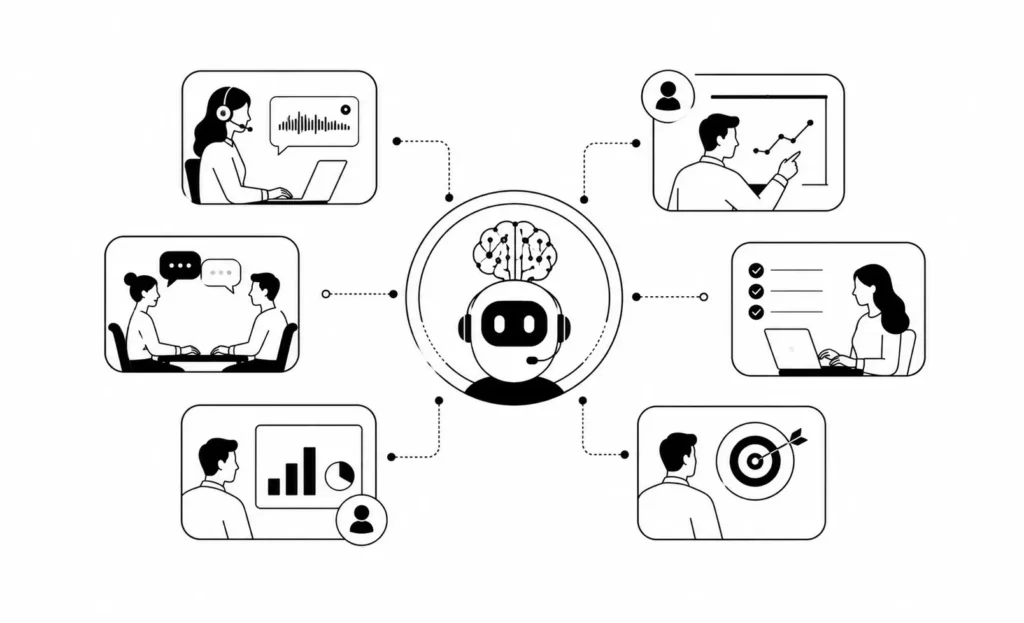
Training teams today is harder than ever and AI coaching solves that. Customers expect faster responses, sales cycles are more complex, and leaders juggle distributed teams with shrinking attention spans. Traditional workshops aren’t enough — people forget up to 70% of what they learn within a week. The solution: AI coaching. Not a replacement for trainers or managers, but a force multiplier. AI lets teams practice real scenarios, build muscle memory, and get instant feedback, helping them perform at their best every day — not just after training. Across Sales, Customer Service, and Leadership, Coaching with AI tackles real challenges teams face every day. Here’s how. AI Coaching In Sales Sales is unpredictable. One missed discovery question, a weak objection response, or a poor pricing explanation can cost a deal. AI gives sales reps the opportunity to practice these moments repeatedly until they become instinctive. Objection Handling Sales reps frequently encounter tough objections — pricing pushback, timing concerns, or competitors. Many freeze or respond defensively under pressure.AI coaching enables realistic objection roleplays and provides targeted feedback, helping reps stay calm, persuasive, and confident. Discovery Calls Reps often miss critical qualification questions or fail to uncover customer needs, leading to lost opportunities. AI coaching guides reps through discovery conversations, ensuring they consistently uncover valuable insights, improving lead quality and deal potential. Prospecting & Cold Calls Initiating conversations with new prospects is challenging and often inconsistent. AI coaching provides scenario-based practice for openings, transitions, and rapport-building, helping reps start strong and build confidence before they even pick up the phone. Product Pitching Inconsistent or unclear presentations reduce effectiveness. AI coaching lets reps practice tailored product pitches, ensuring clarity, relevance, and alignment with customer needs. Negotiation & Pricing Negotiating value and pricing under pressure is a high-stakes skill. AI allows safe negotiation simulations, helping reps build confidence, navigate difficult conversations, and improve win rates. Renewal & Upsell Many reps miss upsell opportunities or fail to communicate value effectively. AI simulates renewal and upsell conversations, increasing retention and account growth. Product & Process Knowledge Testing A deep understanding of products and internal processes is essential. AI reinforces knowledge through scenario-based testing, ensuring reps communicate confidently and accurately. Tool-Specific Knowledge Testing CRM and sales tools are only as effective as the reps using them. AI simulates tool-based tasks to improve proficiency and reduce errors. Post-Training Reinforcement Without follow-up, workshop skills fade quickly. AI provides exercises and roleplays after formal training, reinforcing learning and helping knowledge stick. Customer Service AI Coaching Customer service teams deal with high-pressure interactions every day. Frustrated or angry customers, inconsistent processes, and complex tools can all reduce efficiency and satisfaction. AI helps reps practice empathy, consistency, and proactive support. Customer Complaint Handling Reps often struggle to manage frustrated or angry customers. AI simulates complaint scenarios, providing real-time feedback to improve empathy, de-escalation, and resolution skills. Support Ticket Resolution Following inconsistent processes can cause errors and delays. Coaching wth AI reinforces correct procedures, improving efficiency and service consistency. Proactive Customer Success CS teams often react rather than anticipate customer needs. AI tools offer simulations for proactive engagement, helping reps identify churn signals and increase customer satisfaction. Product & Process Knowledge Testing Reps need accurate knowledge at their fingertips. AI tests understanding through simulated interactions, ensuring correct guidance and reducing errors. Tool-Specific Knowledge Testing Ticketing platforms and internal dashboards can be complex. AI coaching provides hands-on practice, improving tool usage and accuracy. Post-Training Reinforcement Workshops alone are not enough. AI delivers follow-up exercises and roleplays to reinforce skills over time, keeping service quality high. AI Coaching In Leadership Leaders face uniquely challenging conversations — giving feedback, coaching employees, handling conflicts, and motivating teams. AI coaching gives them a safe environment to practice and refine their skills, improving outcomes for the entire organization. Performance Feedback Coaching Conversations Guiding employee performance and development requires skill. Coaching with AI enables realistic coaching roleplays, fostering team growth and engagement. Difficult Conversations Sensitive issues often get avoided. AI simulations allow leaders to practice conflict resolution, improving outcomes while reducing stress. Delegation & Empowerment Poor delegation creates bottlenecks and lowers accountability. coaching with AI guides leaders in assigning tasks and empowering teams, boosting overall performance. Team Conflict Mediation Leaders aren’t trained therapists but must resolve interpersonal disputes. AI simulates conflict scenarios, helping leaders mediate effectively and maintain cohesion. Recognition & Motivation Many leaders under-recognize achievements or fail to motivate. AI provides practice in recognition conversations, enhancing engagement and morale. Post-Training Reinforcement Leadership skills degrade without consistent practice. AI delivers exercises, reflection prompts, and reinforcement to ensure long-term development. Why AI Coaching Matters Now Teams don’t just need more training. They need continuous practice, personalized reinforcement, and actionable feedback that adapts to real-world challenges. AI coaching provides: Safe, realistic practice for high-pressure situations Instant feedback and improvement guidance Reinforcement that turns learning into habit Scalable training across entire organizations When teams practice more, they perform better — faster ramp times, higher productivity, improved customer experiences, and stronger leadership. How Insight7 Makes AI Coaching Actionable At Insight7, we make AI coaching practical and measurable. Our platform: Evaluates calls and interactions across Sales, Customer Service, and Leadership Identifies skill gaps and provides targeted improvement suggestions Delivers scenario-based simulations and roleplays Reinforces skills continuously to ensure long-term retention Insight7 helps you move from theory to real-world impact, helping organizations train smarter, retain knowledge longer, and improve performance faster.
How To Shape, Guide And Trust Qualitative Research With AI
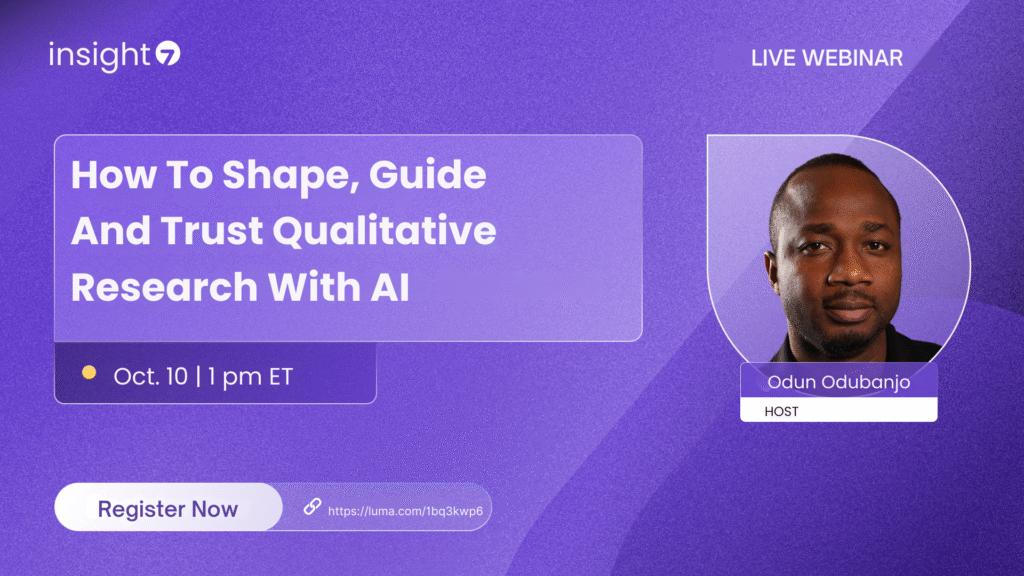
In qualitative research, speed is important, but trust and reliability are critical. Insight7 helps in-house research teams shape and guide AI-powered analysis, ensuring every insight is accurate, actionable, and aligned with your research goals. What You’ll Learn in This Webinar In this session, you’ll discover how to: Shape AI analysis to match your methodology and goals Guide AI to focus on the insights that matter most Ensure calls and interviews are evaluated reliably and consistently Spot product gaps and emerging trends with confidence Apply best practices to maintain rigor while improving efficiency Why This Matters Qualitative research only drives impact when it can be trusted to reflect reality. Manual analysis can be slow, inconsistent, and prone to oversight. This webinar demonstrates how AI can help teams accelerate workflows without sacrificing reliability, giving your team confidence in every insight. Register Now Join us on Oct 10 to see how in house teams are turning calls and interviews into reliable, actionable insights. Don’t miss this opportunity to gain practical strategies that improve efficiency, maintain rigor, and give your team confidence in every insight.. Click Here To Reserve Your Spot Explore Our Report – The Rise of DIY Research: Empowering Teams With Automated Tools This report dives into how automated tools are enabling research teams to work faster, smarter, and with greater impact. Download the Report
