Sales performance coaching for remote sales teams using agent assist
-
 Bella Williams
 - 10 min read

Sales performance coaching for remote sales teams has become increasingly vital in today’s digital landscape. With the rise of remote work, traditional coaching methods have struggled to keep pace with the unique challenges of managing distributed teams. Supervisors often face limitations in capacity, leading to inconsistent coaching and delayed feedback. This can result in decreased agent performance, burnout among supervisors, and a lack of skill development among team members. However, leveraging AI-powered solutions like agent assist can transform coaching practices, enabling real-time feedback and support that enhances performance across the board.
Understanding the Coaching Scalability Crisis
Traditional coaching models are often time-consuming and inefficient. The standard process typically involves:
- Listening to recorded calls: 20-30 minutes per call.
- Manual quality scoring and documentation.
- Scheduling one-on-one sessions: 30-60 minutes.
- Reviewing calls with agents.
- Following up in the next cycle.
This results in a time investment of 1-2 hours per agent per week, allowing supervisors to coach only 8-10 agents at a time. For a center with 100 agents, this means needing 10-12 supervisors, which is not feasible. Additionally, coaching often occurs days or weeks after calls, leading to delayed feedback and missed opportunities for improvement.
The traditional model also suffers from:
- Inconsistent Quality: Different supervisors have varying coaching styles.
- Agent Passivity: Agents often wait for feedback instead of seeking self-improvement.
- Remote Invisibility: Work-from-home agents can feel isolated, lacking immediate support.
This results in performance plateaus, quality inconsistency, and supervisor burnout, ultimately affecting customer experience.
The Shift to Real-Time Coaching
Real-time coaching offers a solution to the limitations of traditional methods. Here’s how it contrasts with conventional coaching:
| Aspect | Traditional Coaching | Real-Time Coaching |
|---|---|---|
| Timing | Days/weeks after the call | During the actual call |
| Focus | Review of past performance | In-the-moment guidance |
| Impact | Corrects historical behavior | Prevents errors before they happen |
| Agent Engagement | Passive recipient | Active learner applying feedback immediately |
| Coverage | 2-5% of calls reviewed | 100% of calls monitored |
How Real-Time Coaching Works
With AI-powered agent assist, the process of coaching becomes instantaneous. Here’s how it operates:
- During the Call: The agent assist monitors conversations, detecting coaching opportunities such as missed upsells or poor customer empathy.
- Real-Time Prompts: When an opportunity arises, a prompt appears on the agent's screen, allowing them to apply coaching immediately.
- Supervisor Monitoring: Supervisors can view all agents simultaneously through a dashboard, receiving alerts for critical moments requiring intervention.
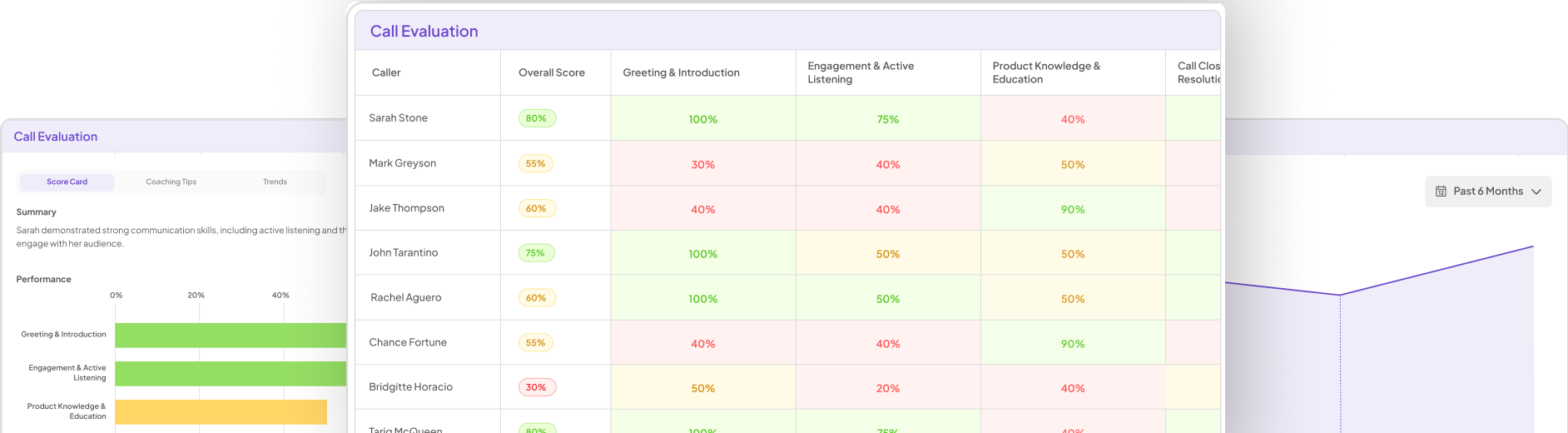
- Performance Data: The system captures performance data automatically, preparing supervisors for effective coaching sessions.
This approach allows one supervisor to coach 20-30 agents effectively, compared to just 8-10 with traditional methods.
Implementation Strategy for Agent Assist
To successfully implement agent assist in remote sales teams, a phased rollout is recommended:
Preparation:
- Pilot with Champions: Start with 2-3 top supervisors and 20-30 agents to gather feedback and refine workflows.
- Training: Provide comprehensive training to all supervisors on the new methodology.
Execution:
- Full Rollout: After the pilot, extend the program to all supervisors and agents, establishing clear standards for use.
- Continuous Monitoring: Use performance data to identify areas for improvement and adjust coaching strategies accordingly.
Evaluation:
- Measure Effectiveness: Track metrics such as agent performance improvement, coaching efficiency, and business outcomes like conversion rates and customer satisfaction.
- Iterate and Improve: Use feedback to refine the system and enhance the coaching experience continuously.
Practical Value of Real-Time Coaching
The benefits of integrating agent assist into your coaching strategy are substantial:
- Faster Skill Development: Agents receive immediate feedback, allowing for quicker adjustments and improvements.
- Increased Engagement: Real-time support encourages agents to take ownership of their performance.
- Reduced Supervisor Burnout: With AI handling routine coaching tasks, supervisors can focus on strategic development rather than administrative duties.
- Enhanced Customer Experience: Immediate coaching leads to better agent performance, resulting in improved customer satisfaction and loyalty.
By adopting real-time coaching through agent assist, organizations can overcome the challenges of remote sales coaching, ensuring consistent performance and quality across their teams. Embracing this technology not only enhances the coaching process but also drives better business outcomes, making it an essential tool for modern sales teams.