
Insight7 is Heading to Transform 2025!
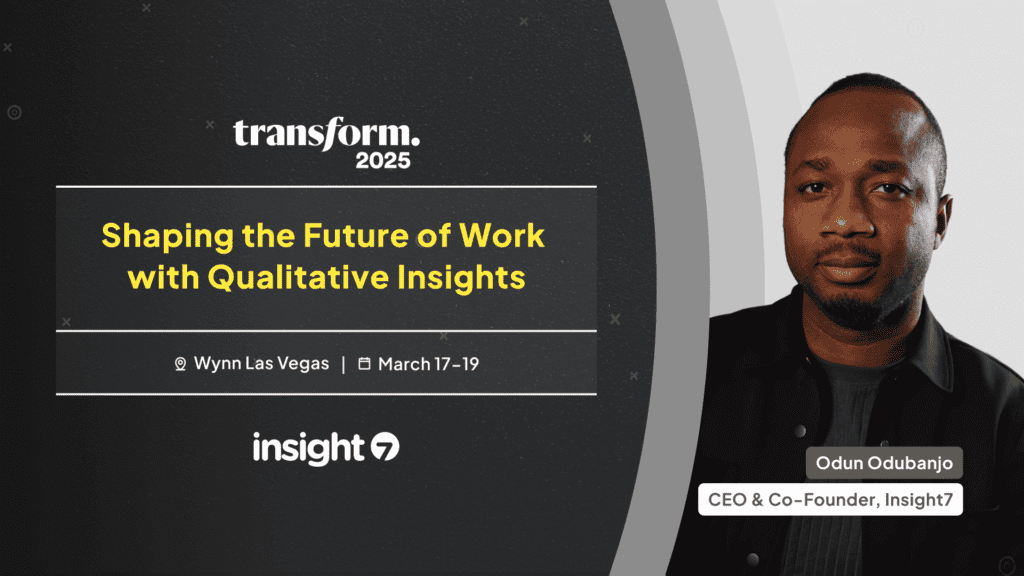
[vc_row type=”in_container” full_screen_row_position=”middle” column_margin=”default” column_direction=”default” column_direction_tablet=”default” column_direction_phone=”default” scene_position=”center” text_color=”dark” text_align=”left” row_border_radius=”none” row_border_radius_applies=”bg” overflow=”visible” disable_element=”yes” overlay_strength=”0.3″ gradient_direction=”left_to_right” shape_divider_position=”bottom” bg_image_animation=”none” gradient_type=”default” shape_type=””][vc_column column_padding=”no-extra-padding” column_padding_tablet=”inherit” column_padding_phone=”inherit” column_padding_position=”all” column_element_direction_desktop=”default” column_element_spacing=”default” desktop_text_alignment=”default” tablet_text_alignment=”default” phone_text_alignment=”default” background_color_opacity=”1″ background_hover_color_opacity=”1″ column_backdrop_filter=”none” column_shadow=”none” column_border_radius=”none” column_link_target=”_self” column_position=”default” gradient_direction=”left_to_right” overlay_strength=”0.3″ width=”1/1″ tablet_width_inherit=”default” animation_type=”default” bg_image_animation=”none” border_type=”simple” column_border_width=”none” column_border_style=”solid”][image_with_animation image_url=”92728″ image_size=”full” animation_type=”entrance” animation=”None” animation_movement_type=”transform_y” hover_animation=”none” alignment=”” border_radius=”none” box_shadow=”none” image_loading=”default” max_width=”100%” max_width_mobile=”default”][/vc_column][/vc_row][vc_row type=”in_container” full_screen_row_position=”middle” column_margin=”default” column_direction=”default” column_direction_tablet=”default” column_direction_phone=”default” scene_position=”center” text_color=”dark” text_align=”left” row_border_radius=”none” row_border_radius_applies=”bg” overflow=”visible” overlay_strength=”0.3″ gradient_direction=”left_to_right” shape_divider_position=”bottom” bg_image_animation=”none”][vc_column column_padding=”no-extra-padding” column_padding_tablet=”inherit” column_padding_phone=”inherit” column_padding_position=”all” column_element_direction_desktop=”default” column_element_spacing=”default” desktop_text_alignment=”default” tablet_text_alignment=”default” phone_text_alignment=”default” background_color_opacity=”1″ background_hover_color_opacity=”1″ column_backdrop_filter=”none” column_shadow=”none” column_border_radius=”none” column_link_target=”_self” column_position=”default” gradient_direction=”left_to_right” overlay_strength=”0.3″ width=”1/1″ tablet_width_inherit=”default” animation_type=”default” bg_image_animation=”none” border_type=”simple” column_border_width=”none” column_border_style=”solid”][vc_column_text] Why This Matters: We’re attending Transform 2025 with a clear mission: to redefine the way organizations harness employee insights because we believe that they are a powerful catalyst for positive change. When organizations truly listen to and understand their teams, they can create a more inclusive, innovative, and effective work environment. At Transform 2025, we’ll explore the latest trends and best practices in employee insights and share our own experiences and learnings, to help organizations build stronger, more resilient teams. What is Transform 2025? Transform 2025, taking place from March 17-19 at Wynn Las Vegas, is set to be a groundbreaking convergence of innovative minds and visionary leaders. This premier event invites global executives, forward-thinking entrepreneurs, and tech-savvy investors to immerse themselves in a dynamic environment where cutting-edge technology meets creative strategy. With hands-on experience, attendees will experience an engaging mix of interactive sessions, collaborative workshops, and unique networking opportunities, all designed to inspire transformative change in workplace culture and pave the way for a future defined by meaningful connections and revolutionary ideas. Insight7’s Participation As a proud sponsor of Transform 2025, we’re excited to contribute to the conversation on employee insights and workplace innovation. Our CEO, Odun Odubanjo, will be actively participating in the conference, engaging in discussions on how AI-driven qualitative analytics can help businesses truly understand and care for their people, driving not just better products, but stronger, more engaged teams. As Odun recently shared on LinkedIn: “A company’s greatest asset is its people. But employee insights are often the most underutilized resource in any business. As we head to Transform 2025, I’m excited to showcase how AI-driven qualitative analytics can help businesses truly understand and care for their people, driving not just better products, but stronger, more engaged teams. Because at the end of the day, business is about people, those who build, support, and grow it.” At Insight7, we believe that great decisions start with understanding the unspoken needs of job applicants, employees, and customers. Our tool transforms qualitative data into instant, data-driven insights. During Transform 2025, Odun will delve into: How AI is transforming decision-making in HR and workplace innovation The role of fast, data-backed insights in building people-first organizations How leaders can uncover hidden patterns in employee feedback to drive real change Let’s connect at Transform 2025! If you’re passionate about transforming your organization through deeper, data-backed understanding of your workforce, let’s connect at Transform 2025. Join us in exploring new horizons in HR decision-making and discover how to turn everyday feedback into powerful, actionable insights. We look forward to seeing you in Las Vegas and embarking on this transformative journey together. [/vc_column_text][/vc_column][/vc_row]
Insight7 Announces Sponsorship of the QRCA Annual Conference 2025
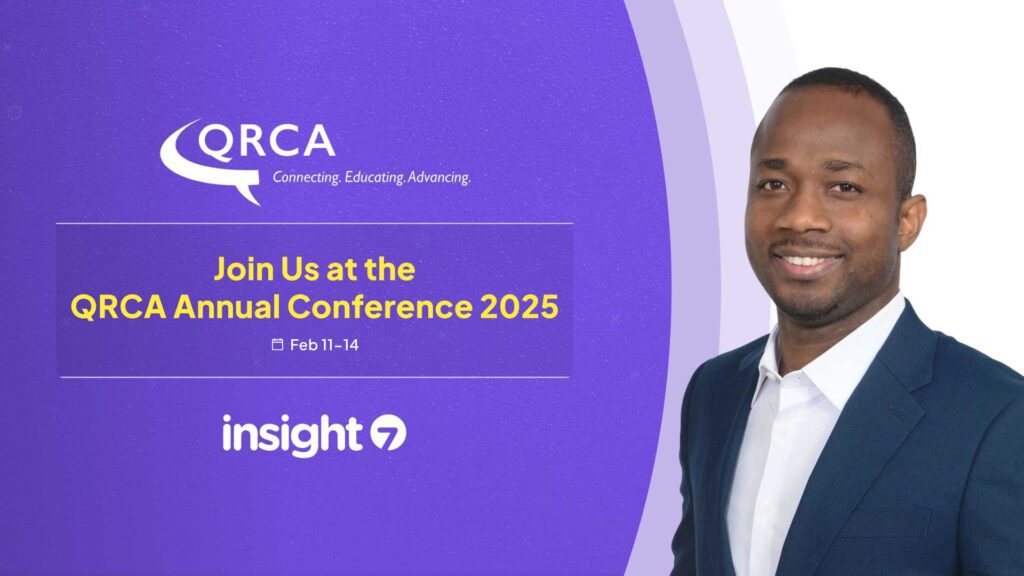
[vc_row type=”in_container” full_screen_row_position=”middle” column_margin=”default” column_direction=”default” column_direction_tablet=”default” column_direction_phone=”default” scene_position=”center” text_color=”dark” text_align=”left” row_border_radius=”none” row_border_radius_applies=”bg” overflow=”visible” overlay_strength=”0.3″ gradient_direction=”left_to_right” shape_divider_position=”bottom” bg_image_animation=”none”][vc_column column_padding=”no-extra-padding” column_padding_tablet=”inherit” column_padding_phone=”inherit” column_padding_position=”all” column_element_direction_desktop=”default” column_element_spacing=”default” desktop_text_alignment=”default” tablet_text_alignment=”default” phone_text_alignment=”default” background_color_opacity=”1″ background_hover_color_opacity=”1″ column_backdrop_filter=”none” column_shadow=”none” column_border_radius=”none” column_link_target=”_self” column_position=”default” gradient_direction=”left_to_right” overlay_strength=”0.3″ width=”1/1″ tablet_width_inherit=”default” animation_type=”default” bg_image_animation=”none” border_type=”simple” column_border_width=”none” column_border_style=”solid”][vc_column_text] We are excited to announce that Insight7 is sponsoring our first-ever conference, the QRCA Annual Conference 2025, taking place from February 11-14, 2025, in Philadelphia, Pennsylvania. This sponsorship marks a significant milestone for us as we continue to support and drive innovation within the qualitative research community. About QRCA Conference The QRCA (Qualitative Research Consultants Association) Annual Conference is one of the most anticipated global events for qualitative research professionals. It brings together researchers, strategists, and industry leaders to explore cutting-edge methodologies, share best practices, and discuss emerging trends in qualitative research. Sponsoring this conference reaffirms our commitment to transforming the way qualitative research is conducted—empowering researchers with technology that helps uncover deeper insights faster and accurately. Our CEO Takes the Stage at QRCA 2025 Every breakthrough begins with a single bold step into the unknown. At QRCA 2025, our CEO, Odun Odubanjo, will take the stage to explore this very idea in the session: “Courage to Innovate: Uncovering Unknown Unknowns from Qualitative Data.” Innovation isn’t just about new ideas—it’s about having the courage to challenge conventions, embrace uncertainty, and rethink the way we explore data. Insight7 was born from this philosophy, transforming the painstaking process of qualitative research into something powerful, seamless, and lightning-fast. But true innovation doesn’t happen in a vacuum. It thrives on research, on uncovering patterns hidden beneath complexity, and on turning those discoveries into game-changing insights. This is where qualitative research shines—and why it’s time for a revolution. In this session, Odun will dive into the mindset and methodology that drive innovation in qualitative research. He will explore how embracing uncertainty leads to breakthroughs, why research is the foundation of every transformative idea, and how technology is reshaping the way we uncover insights. He will also share the journey behind building Insight7 and how it eliminates manual processes, reduces bias, and accelerates insight extraction from days to minutes. Attendees will also get a first-hand look at our platform in action through a demonstration. The Future of Qualitative Research Starts Here Insight7 is on a mission to revolutionize qualitative research. No more spreadsheets, no more manual data wrangling, no more guesswork or bias—just faster, smarter insights that fuel innovation. Let’s Connect at QRCA 2025 If you’re attending QRCA 2025, we’d love to connect! Whether you’re looking to optimize your research process or explore how Insight7 can help you uncover powerful insights, this is the perfect opportunity to engage with our team and learn more. See you in Philadelphia![/vc_column_text][/vc_column][/vc_row]
Best Practices for a Successful B2B Product Development Process with Chris Long
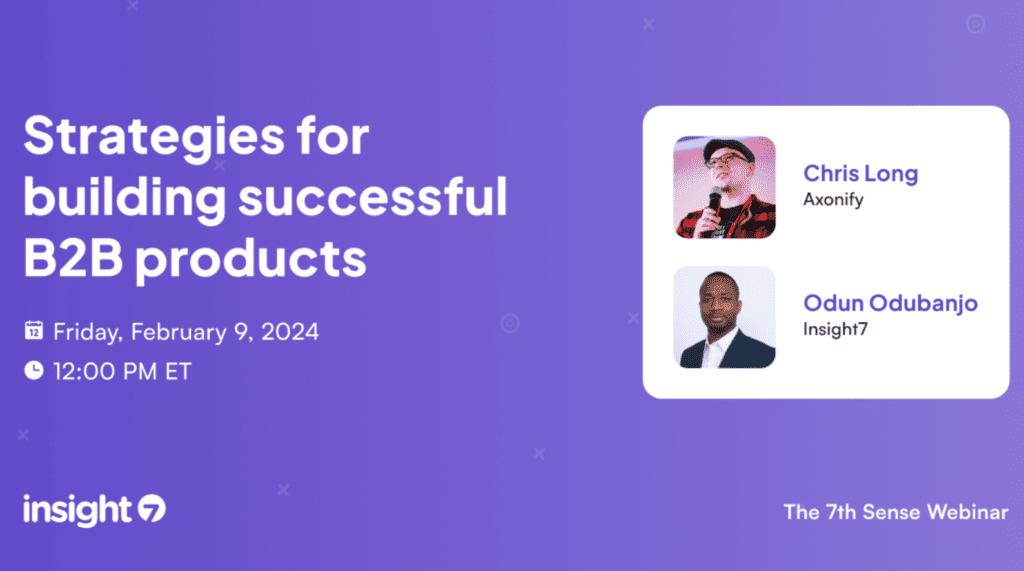
In this episode, Chris Long, VP of Product at Axonify joins Odun Odubanjo, CEO at Insight7 to discuss strategies for building successful B2B products from his experience leading B2B product development processes at high-growth tech companies like Shopify and Booking.com. Odun Odubanjo Hi everyone. Uh, welcome to this episode of The Seventh Sense. Uh, this week I have Chris Long, who is the VP of product at Axonify, and, uh, Chris has also led product teams at companies like Shopify, booking.com and Super slide. Uh, Chris, I’m super excited to have you here. Thank you for joining us. Chris Long Yeah, my pleasure. It’s, uh, awesome to be here. Really excited for today’s conversation. Odun Odubanjo Yeah, absolutely. Uh, on today’s episode, we’ll be discussing strategies for building successful B2B products. And, and Chris, you have a ton of experience there. Um, but before we dive in, you know, I’d love to, to learn a little bit about how you go into B2B product development. So you, you know, you started your career writing software and now you are leading product team. So why, why did you make that transition ? Chris Long Yeah, it’s, uh, so I started off in software development. I went to school for computer science, but my first job outta university, I was actually the third employee. Um, and when you’re the third employee, you’re doing a lot of, a bit of everything. Um, like I was answering phone calls, I was doing all sorts of things. Yeah. Uh, and through that process I kind of figured out, I actually like the what are we doing and why are we doing, rather than necessarily the how don’t get me. I still love the how, like I’m coding on the side. I’m like having a lot of fun with, uh, chat GPD and stuff. But the one, the why is what really got me interested. So I lucked out. I ended up in a product management role at a company that was rebooting how they approach product management. And they actually, in my first month or second month, they sent the entire product team to a Marty Kagan workshop. Odun Odubanjo Okay. Chris Long Um, and, uh, that kind of set my tone for being a product manager and being a product leader. Um, I like Marty Kagan is great. I love him. Um, I love a lot of his writings around. It’s a little bit too perfect world, um, some cases, but, uh, that the fundamental ideas of how he views product management has kind of been the baseline for me and has really helped driven my growth and my career as, uh, yeah. Coming off that foundation of, uh, I always wonder if like when I joined an organization that was all about, uh, more scrum product owner or other things along those lines, would my career have been very different? And I think it would’ve been in a lot of ways. Odun Odubanjo Yeah. Interesting. So the shout out Marty, uh, for inspiring a lot of us in product today. Uh, so, so let’s get into the, the topic for the day a B2B product development and really making that successful. Mm-Hmm. be that you could easily tell, you know, a B2B product from a B2C product. Um, but today, you know, users, consumers, they, they want consumer grade products and even in a B2B settings. Um, what remains unique about building B2B products, um, today? Chris Long Yeah, I think like one of the key things with B2B products that always comes up is who’s buying your product isn’t who’s using your product. Like I think we’ve all been in that where it’s, uh, it’s B two B2C or variations of that, and you have layers there too. So it’s not just one user who’s using it. Um, you actually have like the executive buyer, you have the champion, you have an administrator. In our case, like with Exonify, we work with frontline teams, retail teams. So you then have a manager at a location and they finally have the end user of our product in a lot of those cases. So those layers just adds a lot of complication to things as well. And it sort of adds those complications from both the sales side of things all the way to how your product’s being used. Chris Long And you consider all those different elements as well there. Um, so for the executive buyer, it needs to be how are you presenting the value that they’re getting from your product? Yeah. Uh, for your champion or administrator, how do you make it easy for them as well? Um, and then the other thing too with uh, B2B products is those users, all the people in that stack are not using the product because they want to. So all those different users are generally the expectation from their company is like, Hey, you need to use it. Um, so like Google meets, it’s the expectation within your company that you use Google meets, you might much prefer Zoom or something else along those lines, but that’s what matters there as well. Um, and the last like B2B side of things too is like, there’s very, you can’t take as many shortcuts on that side of things too. Chris Long Like there’s security, scalability requirements, those layers I was talking about apply to releases as well. Um, when you release something, you have to go first to the administrator. They have to think about how does it impact their organization. You can’t just flip a flag and turn it on for everyone. But there is really, like, to your point, the consumerization like that is happening. The expectation within the market now is like, you look and interact and act like a Facebook, like a Gmail, like all these products that people are used to using, that’s becoming an expectation
