
Top Evaluation Questions for Effective Assessment
[vc_row type=”in_container” full_screen_row_position=”middle” column_margin=”default” column_direction=”default” column_direction_tablet=”default” column_direction_phone=”default” scene_position=”center” text_color=”dark” text_align=”left” row_border_radius=”none” row_border_radius_applies=”bg” overflow=”visible” overlay_strength=”0.3″ gradient_direction=”left_to_right” shape_divider_position=”bottom” bg_image_animation=”none”][vc_column column_padding=”no-extra-padding” column_padding_tablet=”inherit” column_padding_phone=”inherit” column_padding_position=”all” column_element_direction_desktop=”default” column_element_spacing=”default” desktop_text_alignment=”default” tablet_text_alignment=”default” phone_text_alignment=”default” background_color_opacity=”1″ background_hover_color_opacity=”1″ column_backdrop_filter=”none” column_shadow=”none” column_border_radius=”none” column_link_target=”_self” column_position=”default” gradient_direction=”left_to_right” overlay_strength=”0.3″ width=”1/1″ tablet_width_inherit=”default” animation_type=”default” bg_image_animation=”none” border_type=”simple” column_border_width=”none” column_border_style=”solid”][vc_column_text]Assessment evaluation questions play a crucial role in enhancing the effectiveness of any assessment process. Understanding these questions allows assessors to gather pertinent information that can significantly impact decision-making. Engaging stakeholders with well-crafted questions fosters an environment of trust and clarity. These inquiries not only aid in understanding the participants’ backgrounds but also help identify any factors that could influence results. By focusing on the most relevant assessment evaluation questions, teams can ensure they are adequately prepared for clinical assessments. This preparation includes obtaining critical information regarding medical conditions and exclusionary criteria. As a result, the assessment process becomes more streamlined, ultimately leading to better outcomes and satisfaction for all involved. Identifying the Purpose of Your Evaluation Identifying the purpose of your evaluation is a crucial step in the assessment process. Before diving into assessment evaluation questions, it’s essential to articulate what you aim to achieve. This clarity helps in designing your evaluation and ensures that it effectively addresses the needs of stakeholders. Knowing the purpose informs the selection of criteria and metrics, giving direction to your entire evaluation framework. Begin by pondering a few key questions: What specific outcomes are you trying to measure? Who are the primary audiences for this evaluation? Is your aim rooted in improvement, accountability, or both? These reflections will guide the formulation of relevant assessment evaluation questions, leading to insightful, actionable results. Moreover, a focused purpose fosters buy-in from stakeholders, promoting a collaboration that enhances the evaluation’s effectiveness. Understanding your intent not only streamlines the process but also elevates the quality of insights gained from your efforts. Clarifying Goals and Objectives Clarifying goals and objectives is essential for effective assessment. It allows teams to align on desired outcomes and understand the purpose behind their evaluation efforts. Clearly defined goals provide a framework for all subsequent steps in the assessment process, guiding decision-making and resource allocation. Without clarity, teams may struggle to measure effectiveness or identify areas for improvement. To ensure successful evaluations, focus on several key elements. First, articulate specific outcomes you wish to achieve through assessment. This helps tailor evaluation methods to meet those goals accurately. Second, establish metrics that can effectively gauge progress, ensuring they align with your overall objectives. Finally, regularly revisit these goals and objectives, adapting them based on feedback and changing circumstances. By consistently refining your approach, you will enhance the relevance of assessment evaluation questions, making them more actionable and impactful. Aligning Evaluation Questions with Goals To effectively assess outcomes, aligning evaluation questions with your goals is essential. This alignment ensures that assessment evaluation questions directly measure what matters most for your objectives. First, identify your primary goals and then formulate questions that target specific outcomes. Each question should resonate with your overarching aims, providing clear insights into whether or not you are achieving what you set out to do. Consider also the nature of the data you will collect. Questions should facilitate gathering information that is not only relevant but also actionable. This strategic approach allows for continuous improvement, as you can adjust your evaluation methods based on the insights you gather. By ensuring that assessment evaluation questions reflect your goals, you create a framework for meaningful evaluations that drive positive change and growth. Crafting Effective Assessment Evaluation Questions Crafting effective assessment evaluation questions involves understanding the core purpose of your assessment. A well-structured question can clarify objectives, ensuring you gather meaningful feedback. Begin by formulating questions that are clear and concise, focusing on specific aspects of the assessment. Use open-ended questions to encourage detailed responses, which can illuminate areas for improvement. It’s critical to frame questions that align with assessment criteria while avoiding ambiguity. Consider incorporating different types of questions to cover various dimensions. For instance, use quantitative rating scales to gather measurable data alongside qualitative questions for deeper insights. Regularly revising and refining these questions based on participant feedback can enhance their effectiveness over time. Each question should serve a purpose and should ultimately lead to actionable insights that inform future assessments. Building a robust set of assessment evaluation questions lays the foundation for continuous improvement and meaningful outcomes. Types of Questions to Incorporate To create an effective assessment, it’s crucial to incorporate various types of questions that capture the depth and scope of the evaluation. First, consider open-ended questions, which allow participants to express their thoughts freely, providing richer insights. These questions can clarify experiences and expectations, making them essential for understanding diverse perspectives. Additionally, closed-ended questions offer quantifiable data, enabling quick analysis of trends and patterns in responses. Incorporating Likert scale questions can help assess attitudes or perceptions by providing a range of options. This format facilitates a structured response while maintaining the nuance of individual opinions. Finally, scenario-based questions can simulate real-life situations, gauging how participants might respond in practice. By blending these types of questions, assessments can be both comprehensive and focused, ultimately leading to more precise evaluation outcomes. Ensuring Clarity and Relevance Clarity and relevance are essential for the effectiveness of assessment evaluation questions. Ensuring participants clearly understand each question fosters meaningful engagement and enhances the quality of responses. Careful wording and a straightforward context can reduce confusion, leading to more accurate feedback and insights. To achieve clarity, questions should be specific and concise. For example, instead of asking, “What do you think about our services?” consider a more targeted approach, such as, “How satisfied are you with the response time of our customer service team?” This specificity helps respondents provide focused and useful answers. Additionally, maintaining relevance is crucial in keeping respondents engaged. Aligning questions with the objectives of your assessment ensures that the information gathered directly contributes to your goals. Regularly reviewing and updating assessment evaluation questions can help maintain this alignment, ensuring ongoing clarity and
The Best way to Transcribe Audio From Customer Interviews

If you’re looking for the best way to transcribe audio recordings from your customer interviews, you’ve come to the right place. As a business owner, market researcher, or anyone who conducts customer interviews, you know how valuable the insights gained from these conversations can be. However, trying to take notes during an interview can be a challenge, often leading to missed details or inaccuracies. This is where transcribing the audio from customer interviews becomes crucial. By having a verbatim record of the interview, you can fully capture the customer’s voice, tone, and exact words, allowing for a more in-depth analysis and better decision-making. In this comprehensive guide, we’ll explore the best practices for transcribing audio from customer interviews, covering everything from preparation to post-transcription analysis. Whether you’re a small business owner or part of a large enterprise, this guide will equip you with the tools and knowledge you need to accurately transcribe and leverage customer insights. Ps. If you are in a hurry to get your audio recording transcribed, click here to transcribe your audio in seconds. Best way to Transcribe Audio Recordings: Preparing for Transcription There are many factors that influence how your transcript will turn. This is why the following outlines the best steps to take in order to ensure an efficient transcription: 1. Invest in Quality Audio Equipment Before you even start the interview process, investing in quality audio equipment is essential. A clear audio recording will make the transcription process smoother and more accurate. Consider purchasing a dedicated digital voice recorder or a high-quality microphone for your computer or smartphone. 2. Ensure Optimal Recording Conditions The environment in which you conduct the interview can significantly impact the audio quality. Choose a quiet room with minimal background noise and echo. If conducting the interview remotely, ensure that both you and the interviewee have a stable internet connection and a quiet environment. 3. Obtain Consent and Explain the Process Before recording the interview, it’s crucial to obtain the customer’s consent. Explain the purpose of the recording and how the transcription will be used. This not only demonstrates transparency but also helps put the customer at ease, ensuring a more natural and open conversation. 4. Test Your Equipment and Audio Quality Prior to the interview, test your audio equipment to ensure it’s functioning correctly and that the audio quality is satisfactory. This will help you identify and address any issues before the actual interview, minimizing the risk of poor audio quality and potential transcription errors. Phase 2: Best way to Transcribe the Audio Recording 1. Choose the Right Transcription Method There are several methods for transcribing audio, each with its own pros and cons. You can choose to transcribe the audio manually, use automated transcription software, or outsource the task to a professional transcription service. Consider factors such as accuracy, turnaround time, and cost when selecting the most appropriate method for your needs. Manual Transcription: Manual transcription involves listening to the audio and typing out the conversation verbatim. This method is generally more time-consuming, labor-intensive, and expensive, especially for longer interviews. Automated Transcription Software: This is the best way to transcribe audio recordings. Automated transcription software uses speech recognition technology to convert audio into text. While this method is faster and more affordable, the accuracy can vary depending on the software’s capabilities and the audio quality. Popular options include services like Insight7, Trint, and Otter.ai. Professional Transcription Services: Outsourcing the transcription task to a professional service can be a convenient option, especially for businesses with a high volume of interviews or those requiring highly accurate transcriptions. These services typically employ human transcriptionists and offer additional quality assurance measures. 2. Establish Transcription Guidelines [optional] Regardless of the transcription method you choose, it’s essential to establish clear guidelines for consistency. This includes determining whether to include filler words (e.g., “um,” “ah”), indicating pauses or interruptions, and standardizing the formatting of speaker identifications and timestamps. 3. Utilize Transcription Tools and Software To streamline the transcription process, consider using dedicated transcription tools and software. These tools can help you control playback speed, insert timestamps, and easily navigate through the audio. Some popular options include Insight7, InqScribe, and oTranscribe. Click here to transcribe your audio recordings in seconds. 4. Review and Proofread the Transcription Once the transcription is complete, it’s crucial to review and proofread the text for accuracy. Listen to the audio again while following along with the interview transcript to ensure that no words or details were missed or misinterpreted. This step is essential for maintaining the integrity of the customer’s voice and ensuring that the insights derived from the interview are accurate. Phase 3: Post-Transcription Analysis and Insights 1. Identify Key Themes and Insights Once you have accessed the best way to transcribe audio files and generated your transcripts, you can now begin to analyze the customer’s responses. Look for recurring themes, pain points, and areas of opportunity that can inform your business decisions and product or service improvements. Tools like Insight7 helps you identify key themes and insights. 2. Leverage Qualitative Data Analysis Tools To streamline the analysis process, consider using qualitative data analysis tools designed for coding and categorizing interview data. These tools can help you identify patterns, organize themes, and extract valuable insights more efficiently. Popular options include Insight7, MAXQDA, and Dedoose. 3. Combine Transcripts with Other Data Sources For a more comprehensive understanding of your customers, consider combining the transcribed interview data with other data sources, such as survey responses, customer feedback, or behavioral data. This multi-dimensional approach can provide a more holistic view of your customers’ needs, preferences, and behaviors. You can upload all these data on Insight7 to get a more wholistic analysis. 4. Share Insights and Implement Changes Once you have extracted the key insights from the transcribed interviews, it’s essential to share these findings with relevant stakeholders within your organization. Use the insights to inform product development, marketing strategies, customer service improvements, and other business decisions that can enhance the customer experience
Best AI Transcription Service for Analzying Customer Interviews

Using AI transcription service has been a game-changer for many businesses. Understanding the voice of your customers is paramount to delivering exceptional experiences and staying ahead of the competition. One of the most effective ways to gain this invaluable insight is through conducting customer interviews. However, manually transcribing and analyzing these interviews can be a time-consuming and arduous task, often leading to crucial insights being overlooked or lost in the process. But AI transcription tools have completely changed things. These cutting-edge solutions harness the power of artificial intelligence to streamline the transcription process, offering unparalleled accuracy, efficiency, and powerful analysis capabilities. In this comprehensive guide, we’ll delve into the transformative power of AI transcription tools for analyzing customer interviews, explore the key benefits they offer, and unveil the top contenders in the market that are revolutionizing the way businesses approach customer feedback analysis. In the meantime, transcribe your interview here. The Benefits of AI Transcription Services for Analyzing Customer Interviews 1. Unparalleled Accuracy and Speed Traditional manual transcription is not only time-consuming but also prone to errors, with even the most experienced transcriptionists struggling to capture every nuance and detail accurately. AI transcription tools, on the other hand, leverage advanced speech recognition and natural language processing algorithms to deliver transcriptions with an astounding accuracy rate of up to 99%. Moreover, these tools can transcribe audio recordings in a fraction of the time it would take a human, allowing businesses to access valuable customer insights much faster, enabling them to respond promptly to emerging trends and feedback. 2. Sentiment and Emotion Analysis One of the most powerful features of AI transcription tools is their ability to analyze sentiment and emotions within the transcribed content. These tools can detect and categorize emotional cues such as frustration, excitement, or hesitation, providing valuable context for understanding the customer’s true sentiments and experiences. For instance, if a customer expresses frustration when discussing a particular product feature or service experience, this insight could inform product development, service improvements, or customer support strategies, enabling businesses to address pain points and enhance customer satisfaction proactively. 3. Keyword and Topic Extraction AI transcription tools can automatically extract key topics, phrases, and keywords from customer interview transcripts, making it easier to identify recurring themes, pain points, or areas of interest. This feature is particularly valuable when analyzing large volumes of customer feedback data, as it enables businesses to quickly pinpoint the most relevant information and identify trends or patterns that may have been overlooked through manual analysis. For example, if the keyword “pricing” is frequently mentioned across multiple customer interviews, it could indicate a need to re-evaluate pricing strategies or provide more transparency around pricing models. 4. Advanced Search and Navigation With AI-powered transcripts, businesses can easily search for specific keywords, phrases, or topics across multiple customer interview recordings. This feature streamlines the analysis process, allowing researchers to quickly locate relevant information without having to listen to entire recordings. A customer experience manager could search for mentions of “customer service” or “response time” to quickly assess customer feedback on those specific aspects, enabling targeted improvements and better resource allocation. 5. Customizable Analysis Templates Many AI transcription tools offer customizable analysis templates tailored for customer feedback analysis. These templates can be configured to highlight specific keywords, sentiments, or topics relevant to the business’s objectives, making it easier to extract actionable insights from the customer interview data. For example, a template focused on product feedback could highlight mentions of specific product features, usability concerns, or desired improvements, providing a clear roadmap for product development teams. 6. Secure and Scalable Cloud-Based Platform Leading AI transcription services are often hosted on secure and scalable cloud-based platforms, ensuring enterprise-grade security and compliance. These platforms can handle large volumes of audio data, making them suitable for businesses of all sizes and industries. Additionally, cloud-based platforms allow for seamless collaboration, enabling team members from various departments, such as customer support, product development, and marketing, to access and analyze customer interview data from anywhere, fostering cross-functional alignment and informed decision-making. The Best AI Transcription Service for Analyzing Customer Interviews With the numerous AI transcription services available in the market, choosing the right one can be a daunting task. To help you make an informed decision, we’ve compiled a list of the top contenders, each with its unique strengths and standout features for customer feedback analysis. 1. Insight7 Insight7 is a leading AI transcription service renowned for its exceptional accuracy and advanced analysis capabilities tailored for customer interviews. Leveraging cutting-edge speech recognition technology and natural language processing algorithms, Verbit can transcribe audio recordings with up to 99% accuracy, capturing even the subtlest nuances and details. Key Features of Insight7 – High-accuracy transcription for various accents and audio quality – Automated sentiment and emotion analysis with customizable categories – Intelligent keyword and topic extraction with hierarchical topic clustering – Advanced search and navigation capabilities with Boolean operators – Customizable analysis templates for customer feedback analysis – Secure and scalable cloud-based platform with enterprise-grade security and compliance Insight7 also offers seamless integration with popular customer relationship management (CRM) and customer experience (CX) platforms, making it easy to incorporate customer interview analysis into existing workflows. Click here to book a demo. 2. Trint Trint is a powerful AI transcription tool that excels in providing in-depth analysis and insights into customer interview data. Its advanced natural language processing capabilities enable it to identify not only keywords and topics but also contextual relationships and sentiment patterns. Key Features of the Trint Transcription Service – Accurate transcription with support for multiple languages and accents – Advanced sentiment and emotion analysis with contextual understanding – Comprehensive keyword and topic extraction with relationship mapping – Customizable dashboards and visualization tools for easy data exploration – Secure cloud-based platform with robust security and compliance features – Integration with popular business intelligence and analytics tools Trint is particularly well-suited for businesses that require advanced analysis and data visualization capabilities, as it provides intuitive dashboards and reporting tools to
How To Analyze Focus Group Data And Get Actionable Insights

[vc_row type=”in_container” full_screen_row_position=”middle” column_margin=”default” column_direction=”default” column_direction_tablet=”default” column_direction_phone=”default” scene_position=”center” text_color=”dark” text_align=”left” row_border_radius=”none” row_border_radius_applies=”bg” overflow=”visible” overlay_strength=”0.3″ gradient_direction=”left_to_right” shape_divider_position=”bottom” bg_image_animation=”none”][vc_column column_padding=”no-extra-padding” column_padding_tablet=”inherit” column_padding_phone=”inherit” column_padding_position=”all” column_element_direction_desktop=”default” column_element_spacing=”default” desktop_text_alignment=”default” tablet_text_alignment=”default” phone_text_alignment=”default” background_color_opacity=”1″ background_hover_color_opacity=”1″ column_backdrop_filter=”none” column_shadow=”none” column_border_radius=”none” column_link_target=”_self” column_position=”default” gradient_direction=”left_to_right” overlay_strength=”0.3″ width=”1/1″ tablet_width_inherit=”default” animation_type=”default” bg_image_animation=”none” border_type=”simple” column_border_width=”none” column_border_style=”solid”][vc_column_text] A Step-by-Step Guide on How to Analyze Focus Group Data and Extracting Powerful Customer Insights Learning how to analyze focus group data with AI tools can supercharge your research endeavors. You’ve just wrapped up a series of highly engaging focus group discussions filled with rich commentary and candid exchanges around your core topics of interest. The hard work of meticulously planning, recruiting participants, and facilitating the live sessions is now complete. But now comes one of the most critical and often overwhelming parts of the process – analyzing all of that raw, unstructured focus group data and synthesizing it into clear, actionable insights that can drive real business impact. Whether your focus groups aimed to pressure test new product concepts, dive into customer pain points and unmet needs, evaluate marketing messaging, or anything in between, sifting through hours of video recordings and transcripts to identify overarching themes and key takeaways can feel like an insurmountable task. That’s where having a proven framework for qualitative data analysis becomes invaluable. Relying on an ad-hoc approach risks missing crucial details or forcing insights that may not be fully grounded in the data. However, a systematic, best-practice methodology allows you to extract maximum value and confidently uncover the most meaningful learnings from your focus group investment. What You Will Learn in This Guide In this step-by-step guide, I’ll outline a practical approach for analyzing focus group recordings, videos, transcripts, and other materials to pinpoint high-impact customer insights. This article covers: • Essential first steps to prep and organize your focus group data • Qualitative coding techniques to identify patterns and critical themes • How to elevate verbatim customer quotes and “aha” moments • Methods for clustering themes into prioritized key insights • Best practices for crafting narrative-driven shareable reports • Tools for performing focus group data analysis By following a systematic process like the one outlined here, you will learn how to analyze you can transform those raw customer discussions into a crystal-clear roadmap for innovating successful new products and experiences tailored to what your target market truly needs and values. Steps on How to Analyze Focus Group Data Like a Pro Step 1: Prepare and Digest the Raw Data Before you can jump into analysis, the first essential step is to collect and prepare all discussion recordings, videos, transcripts, notes, worksheets, and any other outputs and stimuli from your focus group sessions. You want to centralize all of this raw data into a shared repository for your analysis team. It’s critical to have verbatim transcripts covering all focus group dialogue, as these text documents will make it far easier to code and analyze versus trying to analyze audio/video directly. Most focus group consultants and facilities can generate detailed transcripts along with the raw video recordings. If you don’t have your transcripts already, you can upload your recordings here to generate accurate transcripts. Once you have the data compiled and transcripts ready, the next step is for each analyst to review and digest all of the raw focus group materials thoroughly. This includes reading through transcripts, watching video snippets of key moments, and reviewing any notes taken by the moderator and supporting staff. The goal is to immerse yourself in the actual voice of the customer, rereading commentary and analyzing both the actual words and nonverbal cues. It’s about developing a solid comprehension of the sessions before you start looking for overarching trends and extracting insights. Taking the time for this tedious preparatory work upfront helps tune your team’s mindset and bring the focus group environment back to life before diving into coding. Step 2: Code the Transcript Data into Themes and Topics With everyone well-versed in the raw focus group content, the next major phase is a systematic coding process to objectively identify and organize all relevant commentary into distinct themes and topics that emerge. Most qualitative researchers leverage coding software like Insight7 to streamline this iterative process. Within each full transcript, you’ll code each quote, sentence or partipant response into one or more designated themes using the tools. This could start with pre-defined topics based on your original study goals/questions, but will quickly expand into an inductive approach as you discover new themes surfacing directly from the data. For example, imagine you’re analyzing focus groups conducted to better understand consumer perceptions around a new category of fitness wearables. You may have pre-defined codes for themes like “Pricing Attitudes,” “Form Factor Preferences,” or “Motivation for Using a Fitness Tracker.” But through the real discussions, you may inductively create new codes and sub-codes for themes like: • “Social Sharing Needs” • “Integration with Health Apps” • “Wearable Fatigue and Lapsing Usage” – Sub-code: “Novelty Quickly Wears Off” The software makes it easy to assign multiple codes to the same quote when relevant, which preserves the original rich context. You can also bundle individual codes into hierarchical code categories as appropriate. At this stage, it’s fine to be liberal in creating codes – you can always consolidate them later as higher-level patterns surface. Step 3: Examine Code Frequencies and Co-Occurrences Once your team has thoroughly coded the entire focus group transcript corpus, the next step is using those codes and software capabilities to surface potential insights hiding within the data. One simple but powerful way to do so is looking at code frequencies – both at overall levels, but also frequencies broken down by particular sessions, participant demographics, or any other criteria from your screening data. For example, you may find that while “Integration with Health Apps” didn’t get discussed extensively overall, it ranked as a top theme for millennial participants compared to boomers. Or the theme “Social Sharing Needs” dominated discussions in Session 4 compared to other sessions for unknown reasons.
Purpose Of Focus Groups And Tools For Analyzing FGD Transcripts

The Purpose of Focus Groups & AI Tools for Analyzing Focus Group Data Transcripts Understanding the purpose of focus groups is a key factor in carrying out research efficiently. As businesses strive to better understand their customers and optimize products and services to meet evolving needs, focus groups have become an invaluable research method in the modern marketer’s toolkit. Generally, the purpose of focus groups is to uncover candid, nuanced feedback and rich insights directly from target consumers themselves. By bringing together a carefully selected group of people to participate in an open-ended discussion guided by a skilled moderator, focus groups enable organizations to move beyond the limits of broad quantitative data. The live, dynamic nature of these sessions reveals the context, emotions, and deeper meaning that shapes consumer attitudes, motivations and behaviors. In this post, we’ll explore the many critical purposes focus groups serve across multiple business functions and industries. You’ll see firsthand examples demonstrating their remarkable value for applications like: • Exploring new product/service concepts and ideas • Evaluating marketing strategies, messaging and campaigns • Understanding usage drivers, purchase influences and decision criteria • Uncovering unmet needs and white space innovation opportunities • Testing designs, packaging, advertising creative and brand perception • Gauging reactions to pricing, promotions, distribution and business model ideas • Capturing authentic voice-of-customer sentiments to inform strategic plans Let’s dive into why leading brands across sectors rely on focus groups to fuel innovation, improve customer experiences and gain a powerful competitive advantage. Primary Purposes of Focus Groups 1. Purpose of Focus Groups: New Product & Service Idea Generation One of the most common and valuable purposes of focus groups is providing a live “In the room” setting to explore and vet new product/service concepts, positioning, and marketing directly with target users. The dynamic, interactive format enables you to get spontaneous reactions, contextual feedback and creative ideas directly from the people who would be using or purchasing the offering. Rather than just presenting a static list of potential ideas or prototypes, skilled moderators can facilitate immersive exercises, scenario walkthroughs and open-ended discussions to capture how people organically respond, what most excites or concerns them, their willingness to purchase, desired pricing, preferred naming/branding approaches and much more. As another example, a food company used focus groups to test dozens of new flavor concepts and product ideas directly with target demographics. In addition to rating appeal and likelihood of purchase, the two-way dialogue uncovered valuable nuances around taste preferences, nutritional factor interest and desired brand imagery that weren’t contemplated in the original product briefs. This allowed them to identify true white space opportunities in a crowded market. Whether it’s shaping the next big product innovation or optimizing the details on a line extension, few methods provide the level of real-time, contextualized feedback around new ideas that focus groups enable early in the development process. 2. Purpose of Focus Groups: Customer Experience Optimization and Design Validation Thanks to the rise of technology and new consumer expectations, providing standout user experiences has become a top priority and competitive differentiator for brands in every sector. Focus groups are an ideal method for holistically mapping the current state of customer journeys, uncovering points of friction and frustration, and envisioning ways to optimize ease, efficiency and overall delight. By walking through immersive tasks, usage scenarios and interactive exercises, focus groups can capture in-the-moment reactions, emotional responses, and fresh ideas from people actually navigating your websites, apps, products, services, stores and other touchpoints. You gain a richer understanding of real-world pain points, needs and desired improvement areas than soliciting feedback from customers in a vacuum. On the services side, a telecommunications provider invited customers into focus groups to discuss the installation and troubleshooting experience for its home internet and TV bundles. By simulating account setup, common tech issues and resolution paths, they identified systemic problems that were driving high call volumes into support centers and eroding customer satisfaction scores. But the groups also revealed localized needs and preferences by region that were being overlooked. From refining digital interfaces and streamlining service processes to reimagining physical spaces and innovating new value-add offerings, focus groups are an incredibly versatile tool for empathizing with customers, shining a light on current experience gaps, and collaboratively envisioning improvements for driving greater satisfaction and loyalty. 3. Purpose of Focus Groups:Marketing & Advertising Optimization Beyond product insights, focus groups play an invaluable role for shaping truly impactful marketing and advertising strategies tailored to target audiences. The qualitative feedback captures the authentic voice of the customer, revealing what messaging and creative concepts truly resonate on an emotional level versus just gauging surface-level reactions. Focus groups can explore drivers behind brand perception, test campaigns in their full context, and reveal the underlying needs/motivations/mindsets marketing must tap into for optimal influence. Because the discussions are open-ended and iterative, new creative territories and directions often emerge beyond what might be scripted. This allows teams to see how different approaches land before going to market. A financial services company facilitated focus groups with a mix of existing customers and prospects to gauge reactions to new broadcasting spots and ad concepts. While the quantitative feedback told them most people viewed the ads positively, the qualitative insights uncovered crucial nuances around themes/messaging that felt inauthentic versus compelling to different segments based on their personal contexts and relationships to money. This allowed them to make strategic pivots before investing further. An auto manufacturer used focus groups to get feedback for an upcoming launch targeted at first-time EV buyers. Their initial marketing concepts spotlighted the impressive acceleration and other performance stats. However, the groups revealed this positioning actually created hesitancies for the demo they were targeting comprised of mostly eco-conscious buyers. Participants reacted far more positively when the creative emphasized sustainability messaging. This feedback led to a major shift in the campaign. In another case, a high-end travel company envisioned focus groups with affluent consumers to validate its plan for a rebranding and refresh of its website, digital marketing
The Ultimate Focus Group Discussion Guide for Research Consultants

Focus group discussion guide is important when embarking on a focus group research. As a research consultant, you know focus groups are a powerful qualitative method for understanding your clients’ customers, uncovering unmet needs, exploring new product concepts, testing messaging, and much more. But facilitated these in-depth group discussions effectively is both an art and a science. If you don’t have a well-designed discussion guide, your focus groups can easily veer off track, miss crucial areas of inquiry, and fail to generate the rich insights you need. On the flip side, a meticulously-crafted guide keeps the sessions tightly focused yet allows for the free-flowing dialogue and spontaneous discoveries that make focus groups so valuable. In this post, we’ll walk through a comprehensive template and best practices for creating an exemplary focus group discussion guide customized for your clients’ unique research objectives. You’ll get a proven structure to follow, insightful examples, and expert tips on: • How to write clear, unbiased questions that generate honest feedback • Best techniques for establishing rapport and making participants feel comfortable • Simple ways to facilitate productive group interactions and exchanges • Prompts for getting people to open up and share deeper personal experiences • Smooth transitions to keep discussions flowing naturally from one topic to the next • Tactics for gently probing interesting areas that emerge spontaneously • Methods for adapting your guide mid-session based on participant responses Let’s dive into everything you need to build amazing focus group guides that generate game-changing consumer insights. If you already have your focus group discussion transcripts, visit here to analyze and extract insights automatically. Focus Group Discussion Guide Template Below is a template outlining all key sections to include in a focus group discussion guide. Use this as your starting framework, then customize based on your specific research objectives. I. Introduction (5 mins) – Brief intro/background on moderator and purpose/sponsors of the research – Explanation of the general topic to be discussed – Underline that participants were hired to share honest thoughts and opinions – Reassure that there are no wrong answers and establish rapport and openness – Set expectations for session (length, ability to move around, ability to skip questions, etc.) Example: “Thank you all for joining us today. My name is Sarah and I’ll be moderating our discussion. We are doing this research on behalf of [client company] to get feedback from users like you on potential new product and messaging ideas. This is just a freewheeling discussion, with no trick questions or anything like that. I want to hear your completely honest thoughts and opinions based on your personal experiences and perspectives…” II. Ice Breaker/Warm Up (5-10 mins) – Simple question that gets participants comfortable speaking in the group – Should be fun, easy, and not intimidating Example: “To get us started, tell me your name, where you’re from, and your favorite midnight snack!” III. Background and Usage (10-15 mins) – Open-ended questions about their general background related to the topic – Inquire about behaviors, attitudes, likes/dislikes, associations, motivations, etc. – Establishes context and leads into key areas of investigation Example Questions: “What are some of your favorite [CATEGORY] products and why?” “How often do you typically [BEHAVIOR]? Walk me through the last time you did this.” “How would you describe the role [PRODUCT/SERVICE] plays in your daily life?” “What factors do you consider when choosing a [PRODUCT/SERVICE]?” IV. Key Areas of Exploration (45-60 mins) This is the core part of the discussion where you dive deep into the topics you need to better understand through these focus groups. The number of key areas and specific questions will vary widely based on your objectives, but this section should consume about half of your allotted time. Questions should follow a logical flow, starting broad and getting increasingly more granular and specific. Use a mix of questions types, like: • Open-ended exploratory: “What are your overall thoughts and feelings about [PRODUCT/IDEA]? What intrigues or concerns you most?” • Likes/Dislikes: “What did you like or dislike about [EXAMPLE]? What did or didn’t resonate with you?” • Immersive scenario walkthrough: “Let’s say you wanted to [TASK]. Talk me through how you would go about doing that from start to finish.” • Head-to-head comparison: “If you had to choose between [OPTION A] or [OPTION B], which would you prefer and why?” • “Imagine if” prompts: “Imagine if [NEW PRODUCT/FEATURE] allowed you to [CAPABILITY]. How would that change things for you?” Also, do “clearing activities” between each area to avoid cross-contamination or bias from previous discussions. That could involve having them jot down solo thoughts, vote, or complete word association exercises. Transition smoothly between sections using segues like: “Thanks for that helpful discussion around pricing. Let’s change gears now and talk about [NEXT AREA]…” V. Projective Exercises and Prompts (~15 mins) In addition to direct questions, do activities that use projective techniques and creativity to further tap into participants’ deeper motivations, feelings, unmet needs, and ideas. A few examples: • Have participants draw or use metaphors to represent how they feel about a product/service • Show example ads, photos, objects and have them build stories around them • Use psychological prompts like “If [BRAND/PRODUCT] was an animal, what animal would it be and why?” • Do exercises getting them to project into different scenarios, mindsets, or roles These activities tend to surface very insightful information that participants may not directly express with words alone. VI. Areas for Follow Up (5 mins) – Check if key things were missed or need more probing – Ask: “What other thoughts/experiences haven’t we covered yet on this topic?” – Also cover housekeeping questions on logistics, time allotments, etc. VII. Wrap Up (5 mins) – Briefly summarize key themes and takeaways – Allow final thoughts or additional comments – Thank participants for their time and openness “That wraps up our discussion for today. Thank you all so much for sharing your honest perspectives…” Best Practices for Effective Focus Group Discussion Guide Follow these
How to Generate Accurate Focus Group Summary with AI Tools

[vc_row type=”in_container” full_screen_row_position=”middle” column_margin=”default” column_direction=”default” column_direction_tablet=”default” column_direction_phone=”default” scene_position=”center” text_color=”dark” text_align=”left” row_border_radius=”none” row_border_radius_applies=”bg” overflow=”visible” overlay_strength=”0.3″ gradient_direction=”left_to_right” shape_divider_position=”bottom” bg_image_animation=”none”][vc_column column_padding=”no-extra-padding” column_padding_tablet=”inherit” column_padding_phone=”inherit” column_padding_position=”all” column_element_direction_desktop=”default” column_element_spacing=”default” desktop_text_alignment=”default” tablet_text_alignment=”default” phone_text_alignment=”default” background_color_opacity=”1″ background_hover_color_opacity=”1″ column_backdrop_filter=”none” column_shadow=”none” column_border_radius=”none” column_link_target=”_self” column_position=”default” gradient_direction=”left_to_right” overlay_strength=”0.3″ width=”1/1″ tablet_width_inherit=”default” animation_type=”default” bg_image_animation=”none” border_type=”simple” column_border_width=”none” column_border_style=”solid”][vc_column_text] There many benefits of generating a focus group summary. If you’ve ever run a series of focus groups, you know that the most time-consuming part of the process is analyzing and summarizing all of the raw recordings and notes into a polished report. Getting an accurate distillation of the key takeaways and insights from hours of unstructured conversations is tedious work requiring meticulous review. It’s easy for important details and nuances to get lost in the manual process of writing a focus group summary. Fortunately, rapidly advancing AI technology can now automate this painstaking analysis and report writing. Using the latest AI tools like advanced language models, you can generate comprehensive, well-structured focus group summaries highlighting all the major findings, direct quotes, and recommendations in a matter of minutes. While you still need to play a role in reviewing and finalizing the AI-generated summary, the AI handles the heavy lifting of poring over transcripts and recordings to pull out the most relevant insights. In this post, I’ll walk through a simple 4-step process for quickly and accurately summarizing your focus group research using AI as your co-pilot. We’ll cover how to set up the AI tool for this task, which specific prompts and instructions to provide, best practices for verifying the accuracy, and examples of highly effective focus group summary outputs. In the meantime, click here to analyze and summarize your focus group transcripts. The 4-Step AI Process for Generating Flawless Focus Group Summary 1. Record and Transcribe Your Focus Group Sessions The first step is ensuring you have quality source materials for the AI to analyze. Use a reliable recording app and transcription service to capture and convert your focus group audio/video into text transcripts and notes. Cloud-based transcription services like Insight7 offer affordable options to automatically generate transcripts from your files. 2. Load Transcripts and Notes Into an AI Writing Assistant Next, you’ll need advanced AI with strong language understanding and summarization capabilities to process those raw transcripts and notes. I recommend using an enterprise-grade AI writing solution like Anthropic or AI21 Studio, which offers tailored language models optimized for this type of qualitative data analysis and report generation task. Simply upload or paste all of your focus group transcripts directly into the interface, which will ingest and analyze the full context of those conversations in seconds. The AI model has the ability to synthesize transcripts from multiple sessions to identify overarching themes, pull relevant supporting quotes, and distill it all into a cohesive summary. 3. Provide Clear Instructions and Context While these AI models are highly capable out-of-the-box, they still require some guidance and context for this specific use case. In the text input area, start by providing a direct instruction like: “Please analyze the provided focus group transcripts and generate a detailed summary report covering the key themes, major takeaways, supporting examples/quotes, and recommendations that emerged from the discussions.” Optionally, you can give additional context about: – The topics, products or services being discussed in the focus groups – Any particular areas of interest you want the summary to focus on highlighting – The backgrounds and demographics of the focus group participants – Any specifications for report structure, length, etc. Having this context will enable the AI to tailor its analysis and summary accordingly. If you have a hard time creating contexts, AI tools like Insight7 come with pre-programmed and customizable context to help speed up the process. 4. Review, Refine and Finalize the Summary Within 60 seconds or so, the AI tool will present you with an initial draft focus group summary hitting on all the major components you requested. This first pass will aggregate all of the key points, participant quotes, outstanding questions, and potential recommendations in a logically structured report. From this baseline, you can then refine and finalize the summary by: – Scanning for any gaps, inaccuracies, or redundant sections – Moving content into a preferred structure or reorganized order – Prompting the AI to elaborate on certain sections for more detail – Asking the AI to reframe or clarify any vague or unclear portions – Trimming the summary to hit an ideal length – Updating stylistic elements like voice, tone, and formatting By leveraging the AI’s comprehensive distillation of the transcripts as a starting point and applying your own light review and refinement, you’ll end up with a polished, accurate, and focused summary report in a fraction of the typical time. An Example of an Effective AI-Generated Summary To illustrate the quality output you can achieve using an AI writing assistant for this process, let’s walk through a simple example. Let’s assume you conducted a series of focus groups with pet owners to explore the launch of a new dog food brand targeting health-conscious consumers. After providing the AI with the full set of focus group transcript files and some context about the core topics discussed, here is the type of insightful summary it may generate: [Summary] New Dog Food Brand Focus Group Insights From our focus groups with 32 dog owners across 4 sessions, several clear themes emerged around the key attributes desired in a new healthy dog food brand: 1. High nutritional value and wholesome ingredients were the top priorities mentioned across every single session. There was vocal opposition to things like fillers, by-products, artificial preservatives, and ingredients that are hard to pronounce or understand. “I don’t want to see any of those numbers or aisochpfjakiccid-whatever artificial junk in my dog’s food. If you can’t tell me exactly what it is and why it’s there, I’m not buying it.” – Mary, Poodle owner “Whatever is in there needs to be real, whole, recognizable ingredients, with no shady chemicals, dyes, or fillers…just good, simple nutrition.” – Jacob,
How to Prepare Focus Group Discussion Reports in Seconds

[vc_row type=”in_container” full_screen_row_position=”middle” column_margin=”default” column_direction=”default” column_direction_tablet=”default” column_direction_phone=”default” scene_position=”center” text_color=”dark” text_align=”left” row_border_radius=”none” row_border_radius_applies=”bg” overflow=”visible” overlay_strength=”0.3″ gradient_direction=”left_to_right” shape_divider_position=”bottom” bg_image_animation=”none”][vc_column column_padding=”no-extra-padding” column_padding_tablet=”inherit” column_padding_phone=”inherit” column_padding_position=”all” column_element_direction_desktop=”default” column_element_spacing=”default” desktop_text_alignment=”default” tablet_text_alignment=”default” phone_text_alignment=”default” background_color_opacity=”1″ background_hover_color_opacity=”1″ column_backdrop_filter=”none” column_shadow=”none” column_border_radius=”none” column_link_target=”_self” column_position=”default” gradient_direction=”left_to_right” overlay_strength=”0.3″ width=”1/1″ tablet_width_inherit=”default” animation_type=”default” bg_image_animation=”none” border_type=”simple” column_border_width=”none” column_border_style=”solid”][vc_column_text] Focus groups are an invaluable research method for gaining in-depth insights directly from your target audience or customers. By bringing together a small group of carefully selected participants, you can dive deep into their thoughts, feelings, experiences and motivations in a way that surveys alone cannot capture. However, the process of transcribing hours of conversation, identifying key themes, analyzing sentiments, and synthesizing insights into a coherent document is a complex and time-consuming task. It’s doubtful that anyone could truly prepare a comprehensive report “in seconds” without the help of artificial intelligence. However, AI has emerged as a game-changing tool in the realm of focus group discussions, revolutionizing every stage from transcription to analysis to report generation. With the right AI tools, what once took days can now be accomplished in a fraction of the time, allowing researchers and marketers to move from raw data to actionable insights at unprecedented speeds. Understanding Focus Group Discussions Focus group discussions typically involve a moderator guiding a conversation with a group of participants to gather opinions on a specific subject. These discussions provide rich qualitative data characterized by: Diverse Perspectives: Participants share varied insights, often uncovering unexpected viewpoints. In-depth Dialogue: The interactive nature encourages deeper exploration of topics. Emotional Context: Non-verbal cues and emotions provide additional layers of meaning. Steps to Generate Focus Group Discussion Reports Here is a step-by-step guide to generating focus group reports quickly using AI tools. Step 1: Record and Transcribe the Discussion The first step in creating a focus group report is to record and transcribe the session. High-quality audio or video recordings are essential for accurate transcription. Tools for Transcription: Insight7: Provides automatic transcription with speaker identification, timestamps, and support for multiple languages, offering seamless integration with platforms like SharePoint and Google Drive for easy data import and export. Otter.ai: Offers real-time transcription and integration with various conferencing tools. It provides straightforward transcription services suitable for capturing meeting notes. Rev: Offers human-assisted transcription for higher accuracy, which is ideal for those who prioritize precision over speed, though it may come at a higher cost. Sonix: Provides automated transcription with basic editing features, making it a straightforward solution for quick transcriptions. Step 2: Analyze the Transcripts Once the discussion is transcribed, the next step is analyzing the text to extract meaningful insights, such as identifying themes, patterns, and sentiments expressed by participants. AI-Powered Analysis Features: Insight7: Automatically identifies themes and sentiments with keyword extraction, offering a no-code solution for detailed analysis. It enables users to see trends and patterns quickly and efficiently without manual effort. MAXQDA: Provides comprehensive qualitative analysis with robust coding and categorization features, suitable for detailed examination but requires a learning curve. Atlas.ti: Offers text analytics focused on deep, detailed analysis, but the setup is more complex, making it less accessible for immediate use. NVivo: Known for its detailed coding and categorization, this tool demands significant user input and can be more labor-intensive compared to automated solutions. Step 3: Generate Visualizations and Reports After analyzing the data, the final step is to generate visualizations and compile a report that presents the findings effectively. Visualization and Reporting Features: Insight7: Offers customizable reports with charts and graphs allowing users to communicate complex data clearly and interactively, with real-time collaboration features for team productivity. MAXQDA: Provides detailed reporting features with customizable visuals but can be overwhelming for new users due to its complexity. Atlas.ti: Includes a variety of visualization options but requires manual setup and lacks the seamless integration found in more intuitive tools. NVivo: Strong in visualization tools, it still demands a significant learning curve and manual configuration, which may slow down quick reporting. Popular AI Tools for Focus Group Reporting Insight7 Insight7 offers a comprehensive, end-to-end solution for focus group reporting. It stands out with its automatic transcription, thematic and sentiment analysis, and real-time collaboration capabilities. Insight7 supports seamless integration with platforms like Google Drive and SharePoint, allowing for efficient data handling and analysis. MAXQDA MAXQDA is renowned for its detailed qualitative analysis features, offering powerful tools for coding and categorization. It’s particularly suited for researchers who require in-depth examination of complex data sets, though it may require additional training to fully utilize its capabilities. Atlas.ti Atlas.ti provides robust text analytics with a focus on detailed analysis and visualization. It offers a wide range of tools for deep exploration of qualitative data, making it a good choice for detailed research projects. NVivo NVivo is a powerful tool known for its detailed coding and categorization features, allowing for extensive qualitative data analysis. However, it requires significant user input and can be more labor-intensive, which may not be ideal for those seeking quick insights. Advantages of Using AI for Focus Group Reporting 1. Speed and Efficiency AI tools streamline the process of generating reports, enabling rapid production without compromising quality. Insight7, for instance, automates the workflow, saving time and resources. 2. Accuracy and Consistency AI ensures consistent and accurate results by minimizing human error. Insight7’s automated capabilities capture and analyze data with precision, ensuring high-quality outputs. 3. Cost-Effectiveness By automating transcription and analysis, AI tools reduce the need for additional personnel, lowering overall costs. Insight7 offers competitive pricing that caters to businesses of all sizes. 4. Enhanced Insights AI tools can uncover hidden insights that may be overlooked during manual analysis. Insight7’s advanced sentiment and thematic analysis provide a deeper understanding and context. 5. Scalability AI solutions can handle large datasets, making it easy to manage multiple focus groups simultaneously. Insight7 is built to scale, accommodating extensive research projects with ease. Challenges and Considerations While AI tools offer numerous benefits, there are challenges to be aware of: 1. Handling Noisy Environments Transcription accuracy can be affected by background noise or poor audio quality. Ensure that recordings
Focus Group Analysis: Best AI Analysis Tools for Market Researchers
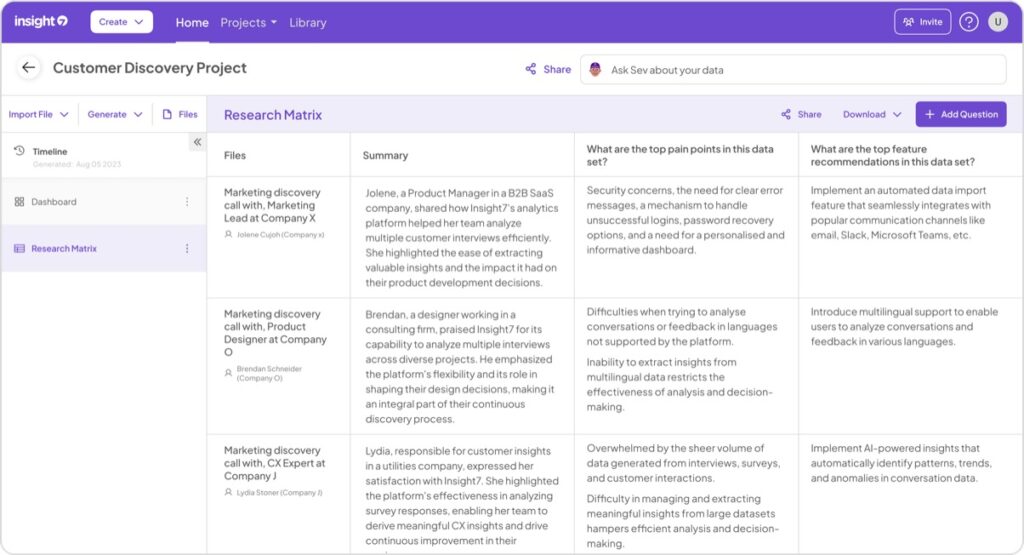
[vc_row type=”in_container” full_screen_row_position=”middle” column_margin=”default” column_direction=”default” column_direction_tablet=”default” column_direction_phone=”default” scene_position=”center” text_color=”dark” text_align=”left” row_border_radius=”none” row_border_radius_applies=”bg” overflow=”visible” overlay_strength=”0.3″ gradient_direction=”left_to_right” shape_divider_position=”bottom” bg_image_animation=”none”][vc_column column_padding=”no-extra-padding” column_padding_tablet=”inherit” column_padding_phone=”inherit” column_padding_position=”all” column_element_direction_desktop=”default” column_element_spacing=”default” desktop_text_alignment=”default” tablet_text_alignment=”default” phone_text_alignment=”default” background_color_opacity=”1″ background_hover_color_opacity=”1″ column_backdrop_filter=”none” column_shadow=”none” column_border_radius=”none” column_link_target=”_self” column_position=”default” gradient_direction=”left_to_right” overlay_strength=”0.3″ width=”1/1″ tablet_width_inherit=”default” animation_type=”default” bg_image_animation=”none” border_type=”simple” column_border_width=”none” column_border_style=”solid”][vc_column_text] Focus group analysis is a crucial component of market research, providing valuable insights into consumer opinions and behaviors. It is essential for result-oriented marketing. Focus groups offer valuable qualitative insights into consumer behaviors, preferences, and perceptions. The introduction of AI tools has transformed this process by offering greater efficiency, accuracy, and depth of insight. This article explores how AI is enhancing focus group analysis and provides a detailed overview of the top AI tools for market researchers in 2024. But before moving on, we should outline the process to give a better understanding of Focus group analysis: Data Collection and Preparation: Begin by collecting and preparing your data. This includes transcribing audio and video recordings and organizing notes accurately. Proper preparation ensures a smooth analysis process. Analysis: This stage involves multiple techniques to extract insights. You start by coding transcripts, assigning labels to relevant text. Then, you identify overarching themes. You might conduct sentiment analysis to gauge emotional responses., or content analysis to quantify specific topics. It is purely dependent on the type of analysis you want to do. Many researchers also do comparative analysis across groups and demographics. Advanced tools can even offer predictive analysis based on patterns in the data. Visualization: Once the analysis is complete, the next step is to visualize the findings. Effective visualization helps in conveying insights clearly and compellingly. Use charts, graphs, and infographics to represent data patterns and themes. Word clouds can highlight frequently mentioned terms, while bar charts or pie charts can illustrate the distribution of coded themes or sentiment scores. The Impact of AI on Focus Group Analysis AI tools address several key challenges in traditional focus group analysis: 1. Enhanced Speed and Efficiency: AI automates transcription, coding, and thematic analysis, allowing researchers to obtain insights more quickly and focus on strategic decisions. 2. Improved Accuracy: AI minimizes human errors in transcription and data coding, ensuring more reliable and consistent results. 3. Deeper Insights: AI algorithms identify patterns and themes that may not be immediately evident, offering richer and more actionable insights. 4. Scalability: AI efficiently handles large datasets, enabling comprehensive analysis without sacrificing quality. Essential AI Tools for Focus Group Analysis Here’s a detailed look at some of the most effective AI tools for focus group analysis, including their features, benefits, and potential drawbacks: 1. Insight7 Insight7 is a no-code SaaS platform designed for qualitative data analysis. It is designed to streamline the analysis of qualitative data with features like automated transcription, sentiment analysis, and theme identification. It offers powerful visualization tools, such as automated charts and graphs, which help in quickly visualizing trends and patterns. The sentiment analysis visuals provide a clear display of sentiment trends across data sets. Insight7’s user-friendly interface ensures that businesses can efficiently extract actionable insights from customer feedback and focus group data, making the analysis process both comprehensive, easy and straightforward. Key Features: Automated Transcription: Converts audio and video recordings into accurate text transcripts. Thematic Analysis: Identifies and extracts key themes and patterns from qualitative data. Customizable Reporting: Generates detailed and tailored reports based on focus group findings. Integration with Other Platforms: Seamlessly integrates with OneDrive, SharePoint, Gong, Google Drive, and more. Multi-Language Support: Analyzes data in various languages by translating it to English for processing and then back to the original language. Pros: User-friendly with a straightforward learning curve. Cost-effective compared to many competitors. Comprehensive end-to-end solution with flexible reporting and multi-language capabilities. Generates insights quickly Cons: Not suited for manual coding. 2. Delve Delve is a user-friendly qualitative data analysis tool that simplifies the process of coding and finding patterns in qualitative data, including focus group transcripts. It offers collaborative features for team analysis, making it easy for multiple researchers to work together. Delve’s intuitive coding process and visualization tools help teams quickly identify and communicate key insights from their data. Key Features: Advanced Coding: Offers dynamic coding and categorization options for detailed analysis. Thematic Visualization: Provides tools for mapping and analyzing themes effectively. Data Integration: Supports the integration of data from multiple sources. Collaborative Features: Enables multiple users to work on projects simultaneously. Pros: Strong coding and visualization features. Effective for team-based research projects. Good for detailed thematic analysis. Cons: Limited advanced analytical tools, Uses manual coding. 3. QuestionPro QuestionPro is a comprehensive survey and research tool that includes capabilities for conducting and analyzing focus groups. It offers features like automated transcription, qualitative data coding, and robust analytics. QuestionPro’s all-in-one platform allows for easy integration of survey and focus group data, and its powerful analytics tools help in generating comprehensive insights. Key Features: AI-Powered Insights: Utilizes advanced analytics to uncover insights from qualitative data. Survey Integration: Combines qualitative and quantitative data through seamless survey integration. Real-Time Reporting: Provides real-time updates and visualizations for immediate analysis. Customizable Dashboards: Tailors dashboards to specific research needs. Pros: Comprehensive tools for both survey and qualitative analysis. Real-time reporting enhances data visibility. AI-driven analytics offer actionable insights. Cons: Can be expensive, Some features may be more suited for survey data than in-depth qualitative analysis and advanced features may require additional training. 4. Taguette Taguette is a free, open-source tool for qualitative research. It allows researchers to code, annotate, and analyze text data, making it suitable for focus group analysis. While it has a basic interface, it is easy to use and provides the essential tools needed for basic qualitative analysis. Taguette’s open-source nature makes it an excellent choice for researchers on a budget or those looking for a customizable solution. Key Features: Tagging and Coding: Intuitive tagging and coding features for qualitative data. Customizable Categories: Allows for the creation of custom coding categories. Data Organization: Manages and organizes large volumes of data efficiently. Open-Source Flexibility: Offers customization options due to its open-source nature. Pros:
How to Analyze Focus Group Discussion with AI Tools

[vc_row type=”in_container” full_screen_row_position=”middle” column_margin=”default” column_direction=”default” column_direction_tablet=”default” column_direction_phone=”default” scene_position=”center” text_color=”dark” text_align=”left” row_border_radius=”none” row_border_radius_applies=”bg” overflow=”visible” overlay_strength=”0.3″ gradient_direction=”left_to_right” shape_divider_position=”bottom” bg_image_animation=”none”][vc_column column_padding=”no-extra-padding” column_padding_tablet=”inherit” column_padding_phone=”inherit” column_padding_position=”all” column_element_direction_desktop=”default” column_element_spacing=”default” desktop_text_alignment=”default” tablet_text_alignment=”default” phone_text_alignment=”default” background_color_opacity=”1″ background_hover_color_opacity=”1″ column_backdrop_filter=”none” column_shadow=”none” column_border_radius=”none” column_link_target=”_self” column_position=”default” gradient_direction=”left_to_right” overlay_strength=”0.3″ width=”1/1″ tablet_width_inherit=”default” animation_type=”default” bg_image_animation=”none” border_type=”simple” column_border_width=”none” column_border_style=”solid”][vc_column_text] Focus group discussions (FGDs) are a powerful way to gather qualitative insights from a group of participants. However, analyzing focus group data manually can be time-consuming and prone to errors. That’s where AI-powered analysis tools come in—automating transcription, identifying key themes, and generating actionable insights in seconds. With the rise of AI in research, analyzing focus group discussions is easier and more efficient than ever before. This article delves into the comprehensive process of FGDs and explores the potential of AI tools used to analyze focus group discussion recordings like Insight7. By the end of this guide, you’ll be able to use AI-powered tools to streamline qualitative research and generate faster, more reliable insights. What is Focus Group Discussion (FGD) Analysis? FGD analysis refers to examining recorded group discussions to extract key insights, opinions, and behavioral patterns. Researchers analyze verbal responses, emotions, and interactions to identify trends and themes. How AI Enhances Focus Group Analysis AI tools eliminate human bias and inefficiency by: Automating transcription to convert audio discussions into text. Extracting key themes & patterns using NLP (Natural Language Processing). Summarizing large datasets quickly for easy reporting. Generating sentiment analysis to understand participant emotions. Visualizing insights through interactive dashboards. These AI-powered capabilities make focus group research faster, more accurate, and scalable. The Focus Group Discussion Process Preparation Phase Defining Objectives: Clearly delineate the research goals to direct discussions effectively toward desired outcomes. Participant Selection: Identify and recruit participants representing the target demographic or possessing relevant expertise to ensure diverse perspectives. Moderator Training: Equip moderators with the necessary skills to facilitate unbiased discussions and maintain focus throughout the session. Designing the Discussion Guide Structured Questioning: Craft a discussion guide comprising open-ended questions and prompts meticulously designed to explore specific aspects of the research topic. Ensuring Relevance: Ensure that questions are pertinent to the research objectives, fostering meaningful dialogue and eliciting valuable insights from participants. Conducting the Focus Group Discussion Establishing Environment: Create a conducive setting conducive to open discourse, free from distractions, and conducive to participant engagement. Introduction and Rapport Building: To cultivate a comfortable atmosphere, kickstart the session with an introduction to the topic, setting ground rules, and fostering rapport among participants. Facilitating Dialogue: Encourage active participation and free-flowing discussions among participants while steering the conversation towards the predefined objectives. Probing for Depth: Judiciously employ probing techniques to delve deeper into responses, unraveling underlying motivations and nuances within participants’ perspectives. Recording Insights: Record the session, with participant consent, using audio or video methods to capture insights accurately for subsequent analysis. Analysis Phase Transcription: Transcribe the recorded discussions verbatim, capturing nuances, emotions, and expressions to preserve the richness of participant input. Thematic Coding: Analyze transcripts meticulously to identify recurring themes, patterns, and divergent viewpoints, facilitating structured data organization. Interpretation and Synthesis: Interpret findings in the context of research objectives, synthesizing diverse perspectives to derive meaningful conclusions and actionable insights. Reporting Findings Comprehensive Documentation: Compile a detailed report encapsulating key findings, supported by illustrative quotes and participant anecdotes to add depth and credibility. Visual Representation: Enhance understanding and retention by supplementing the report with visual aids such as charts, graphs, and diagrams to elucidate trends and insights effectively. Integration of AI Tools in FGDs Streamline Participant Recruitment AI-Driven Targeting: Leverage AI algorithms to sift through vast datasets and identify potential participants matching specific demographic criteria, expediting recruitment. Automated Screening: Implement Natural Language Processing (NLP) algorithms to screen participant responses efficiently, ensuring alignment with research prerequisites. Optimize Discussion Guide Development Sentiment Analysis: Harness AI-powered sentiment analysis to parse through extensive textual data, gauging prevalent sentiments and identifying pertinent discussion topics. Predictive Analytics: Employ machine learning algorithms to anticipate potential discussion avenues based on past FGDs or related research, enriching the discussion guide formulation process. Improve Moderator Support AI-Powered Chatbots: Integrate AI-driven chatbots equipped with NLP capabilities to assist moderators in real-time, suggesting follow-up questions and probing techniques to foster comprehensive discussions. Emotional Analysis: Employ real-time sentiment analysis tools to gauge participants’ emotional states during discussions. This will enable moderators to adapt their approach accordingly and maintain engagement. Facilitate Data Analysis Automated Transcription: Deploy AI-powered transcription tools to automatically convert audio recordings into text format accurately and expeditiously, saving time and resources. NLP-Driven Thematic Analysis: Leverage NLP algorithms to streamline thematic coding processes, identifying and categorizing recurring themes within transcripts swiftly and systematically. Generate Actionable Insights Advanced Analytics: Harness AI-driven analytics platforms to aggregate data from multiple FGDs, uncovering overarching trends and extracting deeper insights beyond human capacity. Pattern Recognition: Employ machine learning algorithms to discern subtle correlations and patterns within data, illuminating nuanced insights and effectively informing strategic decision-making processes. AI Tools for Focus Group Discussion Analysis There are several AI tools available that can assist with analyzing focus group discussions. These tools can help transcribe audio recordings, identify key themes and insights, and provide valuable data analysis. Here are some popular AI-powered tools for focus group analysis: 1. Insight7 Insight7 is a powerful platform for analyzing qualitative data designed to streamline the focus group analysis process. This tool automatically transcribes audio and video recordings in bulk, allowing researchers to handle large datasets efficiently. Its intuitive coding features enable users to identify key themes and patterns within transcripts, providing a deep understanding of participant responses. The platform also generates detailed visualizations and reports, making it easy to explore insights and present findings clearly and compellingly. Automated Transcription: Effortlessly convert bulk audio and video recordings into accurate text transcripts, saving time and reducing manual effort. Thematic Coding: Use advanced coding tools to identify themes, patterns, and trends within your qualitative data, ensuring comprehensive analysis. Visualizations & Reporting: Generate visually engaging reports and dashboards to illustrate insights, making it easier to share results with stakeholders. 2. Dedoose Dedoose is a
