Most compliance leaders think their problem is content.
Not enough training.
Not enough policy refreshers, not enough LMS completion rates.
I don’t buy that.
In the past five years, I’ve watched companies double their compliance training budgets, and still see the same violations, the same audit findings, the same frontline mistakes.
The issue isn’t awareness.
It’s execution decay.
And most AI coaching platforms for regulatory compliance are built around the wrong operating model.
The Myth: “If People Complete the Training, We’re Covered”
This is the most dangerous assumption in compliance today.
Completion rates are treated like a proxy for behavior change. But they’re not.
I’ve seen teams celebrate 98% LMS completion rates – and then fail regulatory audits three months later. The training happened. The knowledge didn’t translate.
Here’s why:
- Training is episodic.
- Risk is continuous.
- Behavior happens in context.
- Policies live in documents.
- Decisions happen in live customer interactions.
The gap between those two worlds is where compliance breaks.
And most AI coaching platforms for regulatory compliance simply automate the old model – they don’t fix it.
Why Traditional Compliance Coaching Fails at a System Level
Let’s diagnose the structural failure.
1. Timing Is Wrong
Compliance training usually happens:
- During onboarding
- Quarterly
- After a violation
But risk surfaces in real time – during sales calls, support escalations, product decisions, pricing conversations.
When coaching is delayed, behavior has already calcified.
The real problem isn’t knowledge gaps. It’s feedback lag.
If a rep mishandles a disclosure today and receives coaching 30 days later, the learning window is gone.
2. Context Is Lost
Most compliance training is scenario-based but generic.
Real-world conversations are messy:
- Customers push back.
- Reps improvise.
- Product features are interpreted creatively.
- Edge cases appear.
Static modules can’t replicate the nuance of live customer interactions.
Without context-specific feedback, employees default to shortcuts.
3. Scale Creates Blind Spots
Enterprise compliance teams simply can’t manually review:
- Every call
- Every support ticket
- Every demo
- Every customer complaint
So they sample.
Sampling creates blind spots.
And blind spots create systemic risk.
The moment you scale, manual oversight collapses.
4. Incentives Compete With Compliance
Let’s be honest.
Sales is rewarded for closing.
Support is rewarded for speed.
Product is rewarded for shipping.
Compliance is rarely tied to frontline performance incentives.
When pressure rises, compliance becomes “interpretive.”
AI coaching platforms that ignore incentive structures fail because behavior follows compensation.
What Actually Works: A Continuous Compliance Execution System
If you want regulatory compliance to hold under pressure, you need to move from training events to execution monitoring.
Here’s the shift:
From:
- Static learning modules
- Completion metrics
- Reactive audits
To:
- Real-time behavioral signals
- Continuous feedback loops
- Execution-level visibility
This is where modern AI coaching platforms for regulatory compliance should operate — not as content distributors, but as operational intelligence systems.
A Framework: The 4-Layer Compliance Coaching Model
Over time, I’ve seen that sustainable compliance requires four coordinated layers.
1. Detection
You cannot coach what you cannot see.
Every regulated interaction – calls, chats, emails – should be monitored for:
- Disclosure language
- Misrepresentation risk
- Required scripts
- Escalation triggers
Without detection, compliance is hope-based.
2. Diagnosis
Flagging issues isn’t enough.
Leaders need to understand:
- Is this an individual performance issue?
- A team pattern?
- A policy ambiguity?
- A product messaging gap?
AI coaching platforms must surface patterns – not just violations.
This is where most systems stop short
3. Directed Coaching
Generic reminders don’t change behavior.
Effective compliance coaching is:
- Role-specific
- Context-aware
- Tied to actual conversations
- Delivered quickly after the behavior
If feedback isn’t anchored to real execution moments, it doesn’t stick.
4. Feedback Loop to Leadership
Compliance isn’t just a frontline issue.
Patterns should inform:
- Product changes
- Messaging updates
- Policy clarification
- Training redesign
When compliance insights don’t flow upward, the organization keeps creating the same risk conditions.
This is the layer most companies completely miss.
What Doesn’t Work (Even If It Feels Modern)
Let me be blunt.
AI-generated quizzes don’t reduce regulatory exposure.
Chatbots that answer policy questions don’t prevent misconduct.
Gamified LMS dashboards don’t change real-world pressure decisions.
These tools optimize knowledge recall, not execution integrity.
And regulators don’t audit quizzes.
They audit behavior.
Leading AI Coaching Platforms for Regulatory Compliance
If you’re evaluating AI coaching platforms for regulatory compliance, here’s the reality:
Most tools fall into one of three categories:
- LMS platforms with light AI features
- Conversation intelligence tools retrofitted for compliance
- Purpose-built execution intelligence systems
They are not the same.
Below is a strategic breakdown, not a feature checklist, of where key platforms sit and what they’re actually built to solve.
1. Insight7
Best for: Continuous compliance execution monitoring across customer-facing teams
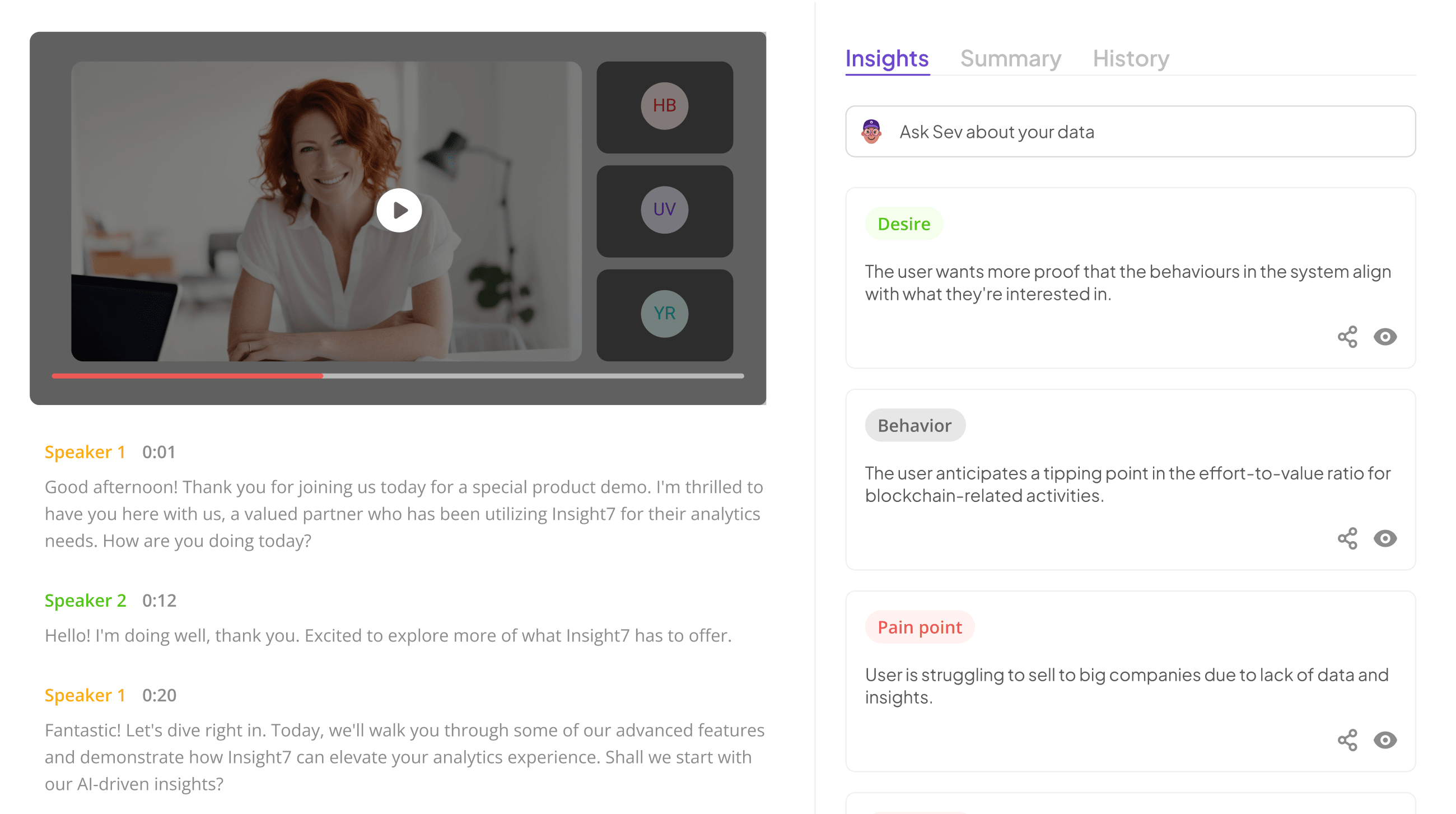
Insight7 analyzes customer conversations at scale – calls, demos, support interactions – to detect behavioral patterns, disclosure gaps, script deviations, and risk signals in real time.
What makes it different isn’t “AI scoring.”
It’s system visibility.
- Monitors 100% of regulated conversations
- Surfaces behavioral drift trends across teams
- Connects compliance insights to product, messaging, and enablement
- Enables fast, contextual coaching tied to real execution
This fits organizations that want compliance embedded into daily operations – not isolated in a quarterly training cycle.
2. Observe.AI
Best for: Contact center compliance monitoring
Observe.AI focuses heavily on QA automation in call centers. It can detect required phrases, script adherence, and policy violations within support interactions.
Strong for:
- High-volume call centers
- Structured scripts
- Financial services and healthcare environments
Limitation:
More QA-centric than cross-functional execution intelligence. Less focused on linking insights upstream to product or revenue leadership.
3. CallMiner
Best for: Enterprise speech analytics and compliance auditing
CallMiner has long been used in regulated industries to monitor calls for risk indicators and compliance triggers.
Strong for:
- Deep speech analytics
- Regulatory monitoring at scale
- Audit support
Limitation:
Often positioned as an analytics layer rather than a continuous coaching engine tied to frontline managers.
4. Second Nature AI
Best for: Scenario-based compliance training simulations
Second Nature AI uses conversational AI to simulate sales conversations, allowing reps to practice responses in controlled environments.
Strong for:
- Pre-production coaching
- Onboarding compliance reinforcement
- Role-play simulations
Limitation:
Simulations are not live behavior monitoring. It improves preparation, not real-time detection.
5. Smarsh
Best for: Archiving and regulatory supervision
Smarsh specializes in capturing and archiving digital communications (email, chat, messaging apps) for compliance review.
Strong for:
- Financial services supervision
- Regulatory archiving mandates
- eDiscovery
Limitation:
Primarily record-keeping and surveillance. Less focused on behavioral coaching loops.
How to Evaluate AI Coaching Platforms for Regulatory Compliance
Instead of asking:
- “Does it have AI?”
- “Does it support our LMS?”
- “Can it generate reports?”
Ask:
- Can it monitor 100% of regulated interactions?
- Does it detect behavioral drift – not just violations?
- Is coaching delivered in context and quickly?
- Can insights influence product, messaging, and policy decisions?
- Does it integrate into frontline workflows?
The real differentiator isn’t automation.
It’s whether the system closes the loop between:
Behavior – Detection – Coaching – Organizational learning.
Most tools stop at detection.
Few complete the system.
The Bigger Point
AI coaching platforms for regulatory compliance are entering a maturity phase.
The first generation digitized training.
The second-generation automated QA.
The next generation embeds compliance into execution itself.
When evaluating tools, the question isn’t:
“Which platform is best?”
It’s:
“Which operating model are we building?”
That’s the strategic decision leaders need to make now – before the next audit forces it.
When we started analyzing real customer conversations at scale, we saw something clear:
Compliance risk isn’t hidden in documents.
It lives in conversations.
Systems like Insight7 make it possible to analyze 100% of customer-facing interactions, detect regulatory risk signals, and surface behavioral patterns across teams — not as a surveillance tool, but as an execution visibility layer.
That visibility changes how leaders operate.
Instead of asking:
“Did everyone complete training?”
They ask:
“Where is behavior drifting?”
That’s a very different management posture.
FAQs: AI Coaching Platforms for Regulatory Compliance
1. Do AI coaching platforms replace compliance teams?
No. They augment them.
AI provides scale and pattern detection. Human leaders provide judgment, escalation decisions, and policy refinement.
2. Can AI actually detect regulatory violations accurately?
Modern language models can identify:
- Missing disclosures
- Misleading claims
- Script deviations
- Escalation failures
But accuracy depends on configuration and governance. The system must be tuned to your regulatory environment.
3. Is this only for highly regulated industries?
No.
Any organization with:
- Customer promises
- Contractual obligations
- Data privacy responsibilities
- Ethical guidelines
…can benefit from continuous execution monitoring.
4. What’s the biggest mistake companies make?
Treating AI coaching platforms for regulatory compliance as content libraries instead of behavioral intelligence systems.
If your platform doesn’t connect training to live execution, it’s incomplete.
The Strategic Shift Ahead
Regulatory environments are not getting simpler.
Product complexity is increasing.
Customer scrutiny is rising.
AI-generated messaging is accelerating communication volume.
The old compliance model – document, train, audit – cannot keep pace.
The organizations that win will treat compliance as a real-time execution system embedded in everyday workflows.
AI coaching platforms for regulatory compliance will either evolve into operational intelligence layers…
Or they will become another checkbox in the LMS.
The choice isn’t technological.
It’s structural.
And the leaders who understand that shift now won’t just pass audits.
They’ll build organizations where compliant behavior is the default – even under pressure.
That’s the real category change.