I dare to say that most AI coaching tools don’t fail because the technology is weak.
They fail because they coach everyone the same way.
I’ve seen this pattern over and over again. A company invests in AI coaching. Leadership rolls it out with enthusiasm. Usage spikes for 30 days. Then engagement drops. Managers quietly go back to their old habits. Reps stop opening the dashboard.
The “AI coach” becomes just another notification stream.
The real problem isn’t AI.
It’s rigidity.
And coaching, at scale, cannot be rigid.
The Myth: Standardized Coaching Scales Better
There’s a common belief that the key to scaling coaching is standardization.
Standard scorecards and Standard feedback loops.
Standard delivery tone and Standard scripts.
It sounds logical. Consistency equals scale, right?
But here’s what we’ve observed across RevOps, Enablement, CX, and Product teams:
Standardization scales processes.
Coaching scales when it adapts.
When AI coaches ignore coaching style preferences – whether someone thrives on direct feedback, reflective questioning, data-driven breakdowns, or collaborative dialogue – adoption collapses. Not immediately. But predictably.
The tension isn’t about AI capability. It’s about human alignment.
Why Traditional Coaching Models Fail
Let’s diagnose the system-level issue.
Most traditional coaching – human or AI – fails for four structural reasons:
1. Context Loss
Coaching often happens outside the moment of execution.
A sales call happens on Monday. Feedback happens on Thursday. The emotional and contextual memory is gone.
Even worse, the feedback is generic: “Ask more open-ended questions.” That’s advice, not coaching.
Without an execution context, coaching becomes abstract.
2. Timing Gaps
Research across enterprise enablement teams shows that behavior change drops by over 50% when feedback is delivered more than 48 hours after an event.
The lag kills momentum.
3. Incentive Misalignment
Managers are measured on revenue. Not coaching hours.
So even when AI surfaces insights, there’s no structural reinforcement to use them consistently.
4. Coaching Style Blindness
This is the quiet killer.
Some leaders respond to blunt performance metrics.
Others need exploratory prompts.
Some prefer tactical “do this instead.”
Others prefer Socratic questioning.
When AI coaching ignores style preference, it creates cognitive friction.
And friction kills adoption.
The Real Shift: From AI Tool to Coaching Operating System
If you’re leading RevOps, Enablement, CX, or Product, this is the mindset shift:
Stop thinking about AI coaches as feedback tools.
Start thinking about them as adaptive execution systems.
The goal isn’t to generate advice.
The goal is to create behavior change loops that match how individuals learn and respond.
That requires a system, not a feature.
The Adaptive Coaching Loop (ACL) Framework
Over the past few years, I’ve come to think about AI coaching through what I call the Adaptive Coaching Loop.
It has five components:
1. Preference Mapping
Before coaching begins, the system needs to understand:
- Does this person respond better to direct feedback or guided reflection?
- Do they prefer data-first insights or conversational nudges?
- Do they want macro themes or micro-level call breakdowns?
Without preference mapping, you’re guessing.
2. Context Capture
Coaching must attach to real execution moments:
- Forecast calls
- Customer escalations
- Product roadmap reviews
- Sales demos
Feedback detached from execution becomes theory.
3. Style-Adaptive Feedback
This is where most AI systems break.
The same performance insight can be delivered in four different ways:
- Directive: “You interrupted the customer 7 times. Pause 2–3 seconds before responding.”
- Analytical: “Your interruption rate is 18% higher than the team average.”
- Reflective: “What patterns do you notice in how you respond during objections?”
- Collaborative: “Let’s test longer pauses on your next call and compare outcomes.”
Same insight. Different psychological entry point.
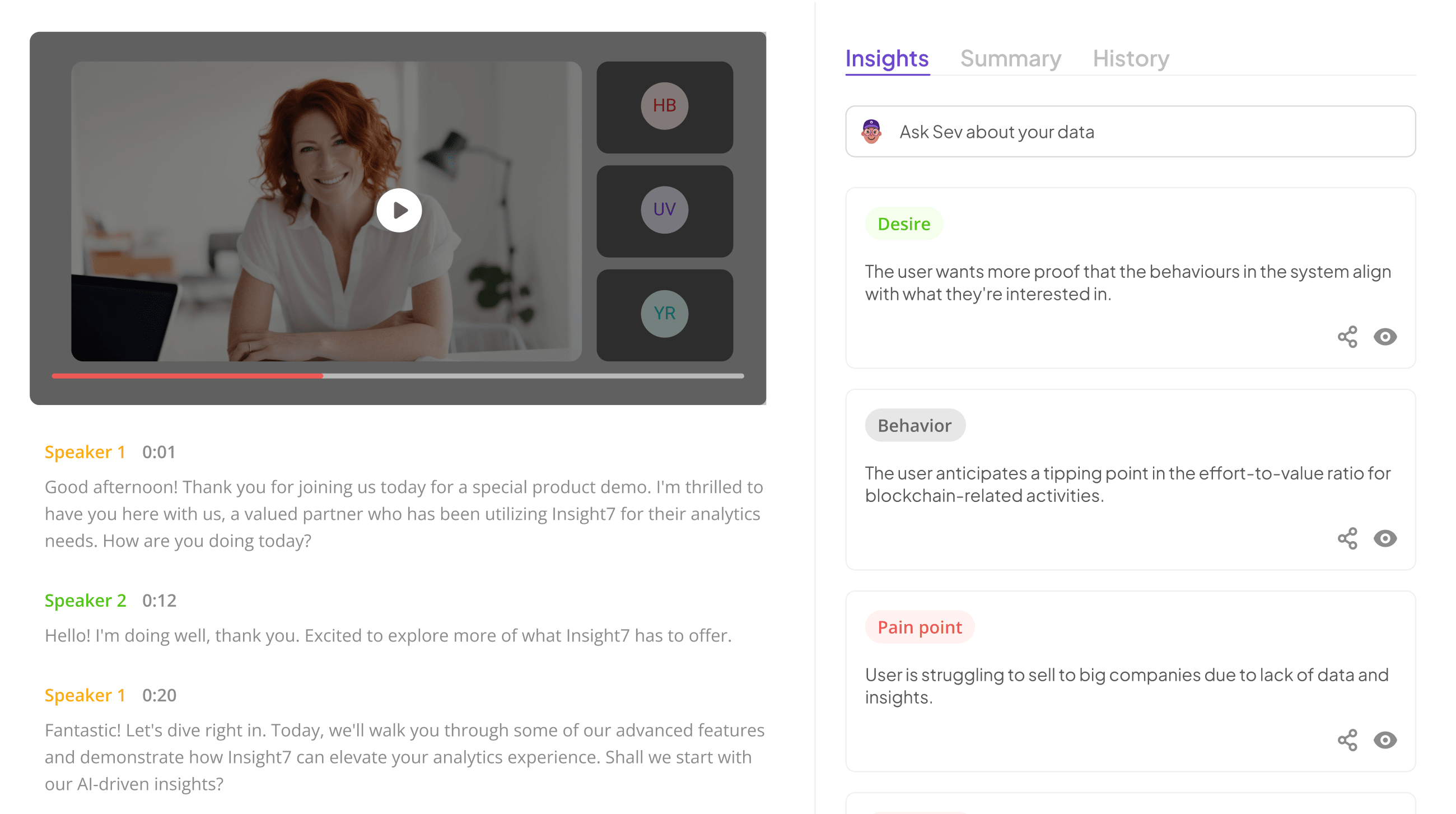
Insight7 Adaptive AI coaching systems choose the delivery based on user preference.
4. Immediate Reinforcement
Coaching should create a next action, not a report.
- One behavior to test.
- One metric to watch.
- One scenario to rehearse.
Small loops outperform massive improvement plans.
5. Feedback-to-Outcome Connection
This is critical.
If coaching doesn’t tie to revenue, retention, product adoption, or customer outcomes, it becomes invisible work.
The loop must close.
What Doesn’t Work
Let’s be honest about what fails.
- AI that floods dashboards with generic tips.
- Coaching systems that treat senior AEs and new hires the same.
- Scorecards without behavioral specificity.
- Insights that don’t connect to deal progression or customer impact.
- “Personalization” that only changes tone but not structure.
I’ve seen organizations adopt AI coaching platforms and see 60–70% user drop-off within a quarter. Not because the AI was wrong. But because it wasn’t relevant to how individuals think.
Relevance drives repetition.
Repetition drives change.
What Actually Works in AI Coaches That Adapt to Coaching Style Preferences
Across high-performing teams, the pattern looks different.
1. Coaching Anchored to Execution Moments
Instead of generic skill modules, coaching attaches to real calls, real tickets, and real roadmap debates.
That changes everything.
It moves from theory to lived behavior.
2. Behavioral Micro-Adjustments
Top teams focus on:
- One behavior per week
- One measurable shift
- One reinforcement loop
Not ten improvement goals.
3. Coaching Style as a System Variable
Here’s the insight most teams miss:
Coaching style isn’t a personality detail. It’s a performance lever.
When leaders can choose – or the AI can infer whether feedback should be directive, reflective, or analytical, engagement increases dramatically.
We’ve observed teams double-sustained usage when feedback tone and structure align with preference.
Not because the insight changed.
Because the delivery matched the cognitive model.
What Next? The Decision Path
This is exactly why execution intelligence matters.
At Insight7, we’ve seen that the real breakthrough isn’t just analyzing calls or conversations. It’s connecting behavior patterns to outcomes in a way that adapts to how teams operate.
Instead of static reports, the system surfaces execution insights tied directly to revenue, retention, or product impact, and can present those insights in ways that align with how different leaders consume feedback.
Some want score-driven clarity.
Others want contextual breakdowns.
Some also want patterns across dozens of conversations.
The point isn’t the interface.
It’s the adaptive loop.
When coaching intelligence connects behavior to business results – and respects style preference – it stops feeling like surveillance and starts feeling like leverage.
Micro-Use Cases Across Functions
Let’s make this practical.
CX
A CX leader values reflective coaching. The AI surfaces escalation themes and prompts team leads with guided debrief questions instead of directives.
That preserves team morale while improving retention.
Product
A Product leader wants pattern recognition. The AI highlights recurring friction themes across sales calls – delivered as aggregated insight, not isolated anecdotes.
Feedback influences roadmap decisions.
Same engine. Different coaching expression
FAQs about AI Coaches That Adapt to Coaching Style Preferences
1. Do AI coaches really need to adapt to style?
Yes. Behavior change is psychological. If delivery style clashes with how someone processes feedback, the insight won’t stick.
2. Isn’t standardization important for scale?
Yes, but standardize the system, not the tone. The framework should be consistent. The expression should adapt.
3. Can style preferences be inferred automatically?
Increasingly, yes. Engagement patterns, feedback response rates, and interaction behavior provide strong signals.
4. What’s the biggest mistake leaders make with AI coaching?
Treating it as a reporting layer instead of a behavior change engine.
The Bigger Category Shift
We’re moving from:
AI as a feedback generator
to
AI as an adaptive execution partner.
That’s not a small upgrade. It’s a category shift.
In the next 3-5 years, the competitive advantage won’t belong to teams that simply “use AI coaching.”
It will belong to teams whose AI understands how their people learn, decide, and respond.
Because coaching isn’t about information.
It’s about transformation.
And transformation only happens when insight meets preference, at the right moment, inside real work.
The companies that understand this won’t just deploy AI coaches.
They’ll build adaptive coaching systems that compound performance over time.
And once that loop is in place, it’s very hard for competitors to catch up.