Using agent assist analytics to prepare for agent coaching sessions
-
 Bella Williams
 - 10 min read

Using agent assist analytics can significantly enhance the effectiveness of coaching sessions for contact center agents. By leveraging real-time data and insights, supervisors can prepare more targeted and impactful coaching sessions, ultimately improving agent performance and customer satisfaction. This blog post will explore the challenges of traditional coaching methods, the benefits of using agent assist analytics, and practical steps for implementation.
The Coaching Scalability Crisis
The traditional coaching model in contact centers often struggles with scalability and effectiveness. Supervisors face significant challenges, including limited capacity to coach a large number of agents, inconsistent coaching quality, and the inability to provide timely feedback. These issues can lead to a plateau in agent performance, inconsistencies in service quality, and increased supervisor burnout.
Traditional Coaching Model Breakdown:
Standard Process:
- Listen to recorded calls (20-30 min per call)
- Manual quality scoring and documentation
- Schedule 1-on-1 session (30-60 min)
- Review calls with agent
- Follow up next cycle
Time Investment: 1-2 hours per agent per week
Result: Supervisor can coach 8-10 agents maximum
The scalability math problem becomes evident when considering a 100-agent center, which would require 10-12 supervisors. This model results in coaching occurring days or weeks after calls, leaving 95%+ of performance invisible to supervisors.
Why Traditional Coaching Fails:
- Delayed Feedback: Coaching on Monday about Friday's call lacks context.
- Sampling Bias: Only 2-5% of calls are reviewed.
- Capacity Ceiling: Supervisors can't be hired quickly enough to meet demand.
- Inconsistent Quality: Different supervisors have varying coaching styles.
- Agent Passivity: Agents wait for coaching instead of actively seeking improvement.
- Remote Invisibility: Work-from-home agents often lack oversight.
The cost of these inefficiencies includes performance plateaus, quality inconsistencies, agent disengagement, and customer experience variance.
Understanding Real-Time Coaching
Real-time coaching, facilitated by agent assist analytics, offers a transformative approach compared to traditional methods. Instead of reviewing past performance, real-time coaching provides in-the-moment guidance during actual calls, allowing supervisors to correct errors before they happen and empowering agents to become active learners.
How It Works:
During the Call:
- Agent assist monitors conversations.
- Detects coaching opportunities (missed upsells, poor empathy, incorrect information).
- Real-time prompts appear on the agent's screen.
- Agents apply coaching immediately, improving customer experience in real-time.
Supervisor Monitoring:
- A dashboard shows all agents simultaneously.
- Alerts signal moments requiring intervention.
- Performance data is captured automatically, allowing for better-prepared coaching sessions.
The Multiplication Effect:
With real-time assist, one supervisor can effectively coach 20-30+ agents, compared to just 8-10 without it. This scalability is crucial in meeting the demands of larger contact centers.
Supervisor Capacity Transformation
The integration of agent assist analytics transforms the supervisor's workflow, allowing them to focus on strategic coaching rather than manual tasks.
Workflow Shift:
Old Workflow:
- 60% Listening to calls and manual scoring
- 20% Documentation and reporting
- 15% Scheduled coaching sessions
- 5% Real-time floor support
New Workflow with Agent Assist:
- 10% Exception review (automation handles routine)
- 30% Strategic coaching on patterns
- 40% Real-time intervention on high-impact moments
- 20% Performance analysis and team development
Dashboard Capabilities:
- Real-Time View:
- All agents visible simultaneously
- Live quality scores updating
- Alert notifications for intervention
- Team performance trends
- Individual progress tracking
Alert-Based Intervention Types:
- Critical Error Prevention: Immediate correction when an agent is about to provide incorrect information.
- Coaching Opportunity: Guidance provided if the agent struggles with objections or upselling.
- Performance Pattern: Noting consistent skill gaps for future coaching sessions.
- Positive Reinforcement: Immediate praise for successfully applied coached behavior.
Coaching Prep Automation:
The system provides:
- Pre-selected call examples with timestamps
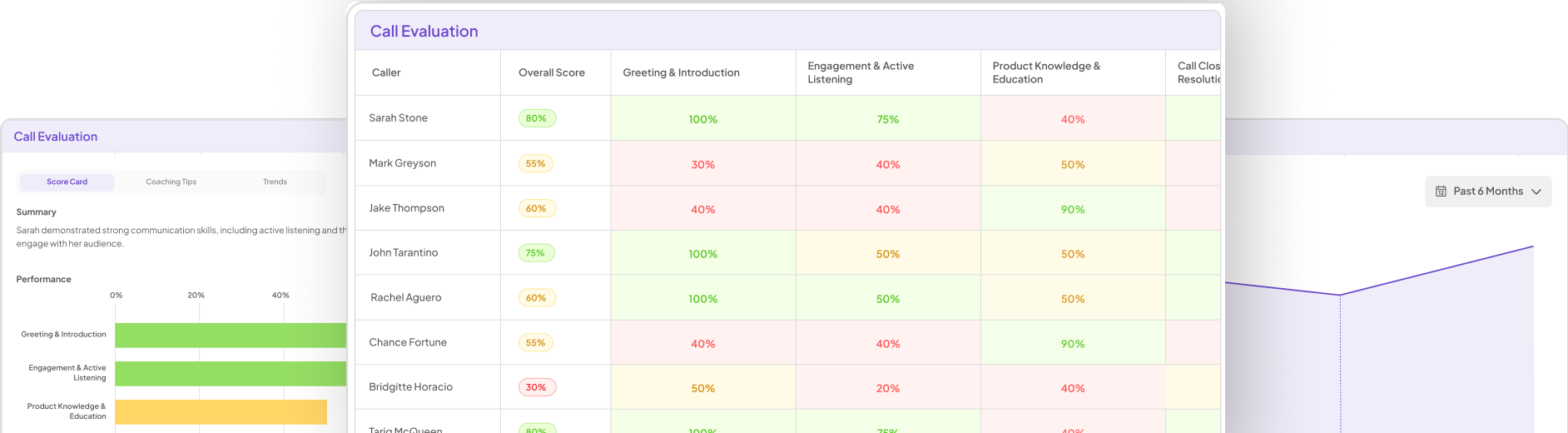
- Performance trend visualizations
- Skill gap identification
- Team comparison data
- Suggested coaching focus areas
This automation reduces coaching preparation time from 60 minutes to just 10 minutes, allowing supervisors to focus on high-impact coaching.
Self-Coaching & Agent Development
One of the key benefits of agent assist analytics is the promotion of self-sufficient agents. By encouraging agents to take ownership of their development, organizations can foster a culture of continuous improvement.
Building Self-Sufficient Agents:
Phase 1: Guided Learning (Weeks 1-4)
- Heavy real-time prompting and active supervisor monitoring.
- Post-call automated feedback and weekly coaching sessions.
- Goal: Learn what good performance looks like.
Phase 2: Supported Independence (Weeks 5-12)
- Reduced prompting, with agents reviewing their own analytics.
- Bi-weekly coaching sessions focus on self-directed improvement.
- Goal: Apply learning independently with a safety net.
Phase 3: Self-Directed Improvement (Week 13+)
- Minimal prompting, with agents driving their own analysis.
- Monthly strategic coaching sessions to refine skills.
- Goal: Own performance and continuously improve.
Self-Coaching Tools:
- Agent Performance Dashboard:
- Personal quality scores and trends.
- Skill-specific performance metrics.
- Anonymized team comparison for motivation.
- Improvement trajectory tracking.
By implementing agent assist analytics, organizations can not only enhance the effectiveness of coaching sessions but also empower agents to take charge of their development, leading to improved performance and customer satisfaction.
In conclusion, the integration of agent assist analytics into coaching processes represents a significant leap forward in how contact centers can develop their agents. By addressing traditional coaching challenges and leveraging real-time data, organizations can create a more efficient, effective, and engaging coaching environment.