


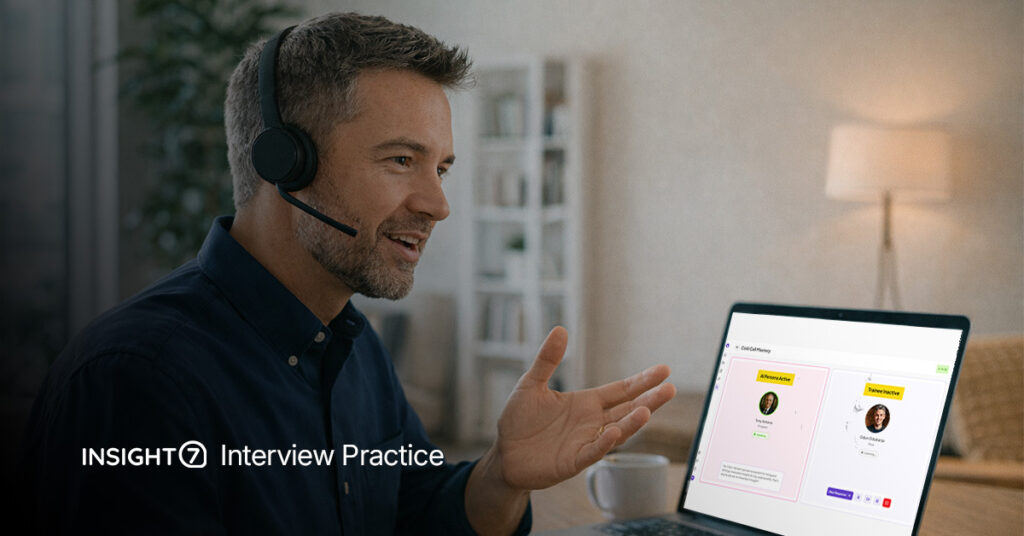
Meta's People & HR interviews are designed to find candidates who can scale culture and talent practices inside one of the most complex organizations in tech. Interviewers probe whether you default to systemic, data-informed decisions or rely on intuition and precedent. Every question is filtered through Meta's values: move fast, be direct, and build for long-term impact.
Start your free Meta People & HR practice session.
What interviewers actually evaluate
People systems thinking and cultural alignment
Meta HR interviewers are not looking for HR generalists who execute policy. They want builders who can design talent systems at scale, communicate hard truths directly, and balance individual advocacy with business outcomes. Evaluation signals include: data-driven org decisions, comfort with ambiguity in fast-moving environments, demonstrated ability to influence without authority, and alignment with Meta's direct feedback culture.
What gets scored in every session
Specific, sentence-level feedback.
| Dimension | What it measures | How to answer |
|---|---|---|
| Structured reasoning | Whether you diagnose talent problems before proposing solutions | State the problem clearly, name the data or signals you used, then describe the intervention |
| Move Fast alignment | Whether you bias toward action or wait for full consensus | Show a time you made a defensible HR call with incomplete information and owned the outcome |
| Direct communication | Whether you deliver honest feedback clearly, even upward | Give an example where you named a hard truth to a senior leader and describe how you framed it |
| Long-term impact focus | Whether your people programs optimize for retention and growth, not just short-term metrics | Connect a program you built to a business outcome measured at least six months later |
How a session works
Step 1: Get your Meta People & HR question
The session opens with a behavioral or situational question drawn from real Meta HR interview patterns. Questions cover workforce planning, performance management, change management, and cross-functional influence.
Step 2: Answer by voice
Speak your answer as you would in the actual interview. The AI captures your full response including pacing, structure, and the specific language you choose to describe HR challenges and solutions.
Step 3: Get scored dimension by dimension
You receive a score and written feedback on each dimension: how clearly you structured your reasoning, whether your answer demonstrated Meta value alignment, and where your response was vague or generic.
Step 4: Re-answer and track improvement
Retry the same question with the feedback in front of you. Most users close two to three scoring gaps in a single session by tightening their examples and removing filler language.
Frequently Asked Questions
What are the 5 C's of interviewing?
The 5 C's are Competency, Character, Communication, Culture fit, and Commitment. In a Meta People & HR interview, culture fit and communication carry the most weight because HR practitioners at Meta are expected to model the behaviors they build programs around, including directness and long-term thinking.
What are common Meta interview questions?
Common Meta interview questions for HR roles include: "Tell me about a time you changed how a team operated," "How have you used data to make a people decision," "Describe a situation where you had to push back on a business leader," and "What is a talent program you built from scratch and what did you measure?" Questions always include a follow-up on impact.
What are the top 10 HR interview questions?
The most frequently asked HR interview questions cover: handling underperformance, designing onboarding programs, managing change resistance, building diverse pipelines, resolving conflict between managers, measuring employee engagement, scaling culture in hypergrowth, partnering with finance on headcount, navigating legal risk in terminations, and designing compensation frameworks. Meta's version of each adds a bias toward speed and data.
What is the 30-60-90 question in an interview?
The 30-60-90 question asks you to describe what you would prioritize and accomplish in your first 30, 60, and 90 days in the role. For a Meta People & HR role, a strong answer names specific listening activities in the first 30 days, a prioritized problem statement by day 60, and one measurable program or process improvement by day 90.
How does Meta evaluate HR candidates differently from other tech companies?
Meta explicitly tests for directness and speed of decision-making more than most tech companies. HR candidates are expected to cite metrics when discussing programs, demonstrate comfort recommending unpopular decisions to senior leaders, and show evidence of building systems rather than managing exceptions. Meta also looks for candidates who have operated in ambiguous, fast-scaling environments where policy lagged organizational growth.
Also practice
All nine Meta role interview practice pages.
- Sales
- Customer Service
- Product Management
- Marketing
- Finance
- Operations
- Leadership
- Legal & Compliance
One full session free. No account required. Real, specific feedback.








