
Best Practices for a Successful B2B Product Development Process with Chris Long

In this episode, Chris Long, VP of Product at Axonify joins Odun Odubanjo, CEO at Insight7 to discuss strategies for building successful B2B products from his experience leading B2B product development processes at high-growth tech companies like Shopify and Booking.com. Odun Odubanjo Hi everyone. Uh, welcome to this episode of The Seventh Sense. Uh, this week I have Chris Long, who is the VP of product at Axonify, and, uh, Chris has also led product teams at companies like Shopify, booking.com and Super slide. Uh, Chris, I’m super excited to have you here. Thank you for joining us. Chris Long Yeah, my pleasure. It’s, uh, awesome to be here. Really excited for today’s conversation. Odun Odubanjo Yeah, absolutely. Uh, on today’s episode, we’ll be discussing strategies for building successful B2B products. And, and Chris, you have a ton of experience there. Um, but before we dive in, you know, I’d love to, to learn a little bit about how you go into B2B product development. So you, you know, you started your career writing software and now you are leading product team. So why, why did you make that transition ? Chris Long Yeah, it’s, uh, so I started off in software development. I went to school for computer science, but my first job outta university, I was actually the third employee. Um, and when you’re the third employee, you’re doing a lot of, a bit of everything. Um, like I was answering phone calls, I was doing all sorts of things. Yeah. Uh, and through that process I kind of figured out, I actually like the what are we doing and why are we doing, rather than necessarily the how don’t get me. I still love the how, like I’m coding on the side. I’m like having a lot of fun with, uh, chat GPD and stuff. But the one, the why is what really got me interested. So I lucked out. I ended up in a product management role at a company that was rebooting how they approach product management. And they actually, in my first month or second month, they sent the entire product team to a Marty Kagan workshop. Odun Odubanjo Okay. Chris Long Um, and, uh, that kind of set my tone for being a product manager and being a product leader. Um, I like Marty Kagan is great. I love him. Um, I love a lot of his writings around. It’s a little bit too perfect world, um, some cases, but, uh, that the fundamental ideas of how he views product management has kind of been the baseline for me and has really helped driven my growth and my career as, uh, yeah. Coming off that foundation of, uh, I always wonder if like when I joined an organization that was all about, uh, more scrum product owner or other things along those lines, would my career have been very different? And I think it would’ve been in a lot of ways. Odun Odubanjo Yeah. Interesting. So the shout out Marty, uh, for inspiring a lot of us in product today. Uh, so, so let’s get into the, the topic for the day a B2B product development and really making that successful. Mm-Hmm. be that you could easily tell, you know, a B2B product from a B2C product. Um, but today, you know, users, consumers, they, they want consumer grade products and even in a B2B settings. Um, what remains unique about building B2B products, um, today? Chris Long Yeah, I think like one of the key things with B2B products that always comes up is who’s buying your product isn’t who’s using your product. Like I think we’ve all been in that where it’s, uh, it’s B two B2C or variations of that, and you have layers there too. So it’s not just one user who’s using it. Um, you actually have like the executive buyer, you have the champion, you have an administrator. In our case, like with Exonify, we work with frontline teams, retail teams. So you then have a manager at a location and they finally have the end user of our product in a lot of those cases. So those layers just adds a lot of complication to things as well. And it sort of adds those complications from both the sales side of things all the way to how your product’s being used. Chris Long And you consider all those different elements as well there. Um, so for the executive buyer, it needs to be how are you presenting the value that they’re getting from your product? Yeah. Uh, for your champion or administrator, how do you make it easy for them as well? Um, and then the other thing too with uh, B2B products is those users, all the people in that stack are not using the product because they want to. So all those different users are generally the expectation from their company is like, Hey, you need to use it. Um, so like Google meets, it’s the expectation within your company that you use Google meets, you might much prefer Zoom or something else along those lines, but that’s what matters there as well. Um, and the last like B2B side of things too is like, there’s very, you can’t take as many shortcuts on that side of things too. Chris Long Like there’s security, scalability requirements, those layers I was talking about apply to releases as well. Um, when you release something, you have to go first to the administrator. They have to think about how does it impact their organization. You can’t just flip a flag and turn it on for everyone. But there is really, like, to your point, the consumerization like that is happening. The expectation within the market now is like, you look and interact and act like a Facebook, like a Gmail, like all these products that people are used to using, that’s becoming an expectation
How to Develop Product Sense as a B2B Product Manager
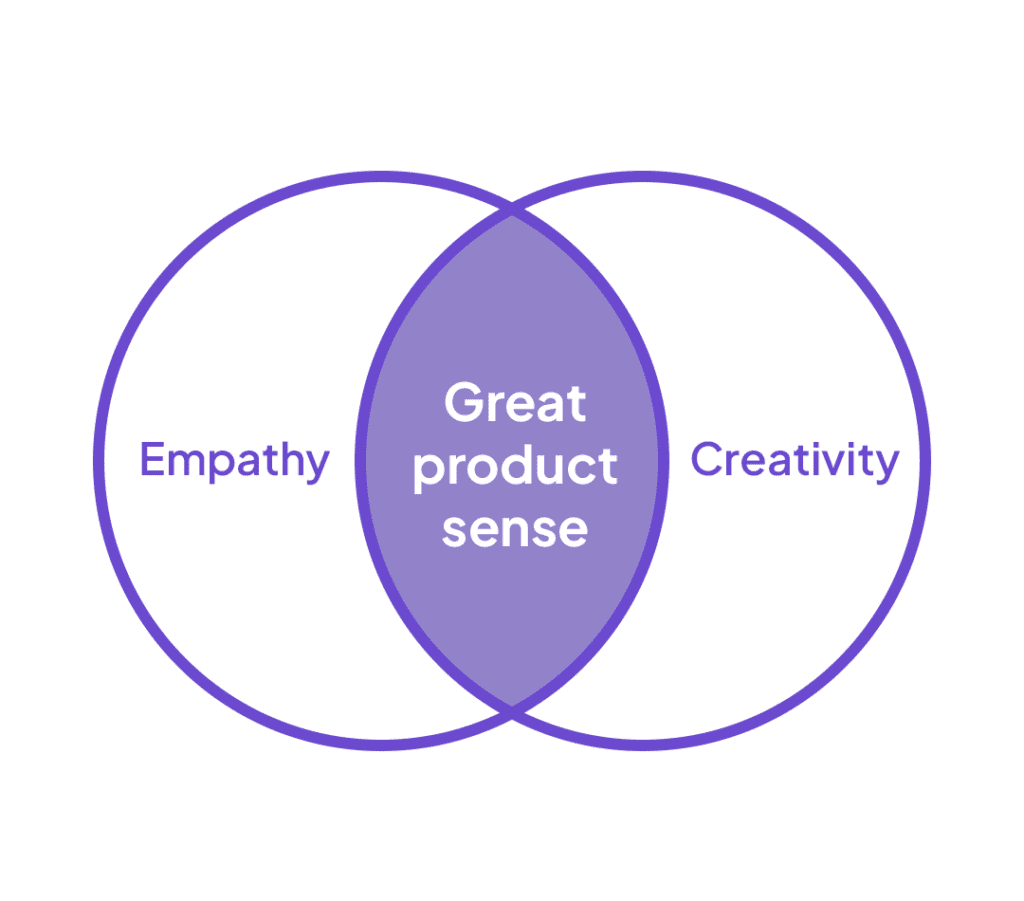
Product sense is a crucial skill for anyone involved in B2B product development. It involves understanding the products you’re working on and having a deep insight into the needs of your target customers. It is the intertwine between customer empathy and product creativity. Developing this skill takes time and effort, but with dedication, you can become a valuable asset to your team and contribute significantly to your company’s success. In this blog post, we will explore how to develop product sense as a B2B PM, the challenges that come with it, and how to overcome them. What is Product Sense? Product sense, a.k.a. the PM’s sixth sense, is their intuitive understanding of what drives a product’s success from a user’s perspective. PMs with strong product sense can anticipate user needs, identify problems, and come up with innovative solutions to improve a product. Product Sense needs development; it’s not a natural talent PMs develop this intuition over time with practice and experience. You’re not born with it. You work on so many problems and get used to complex situations that you advance yourself to make better decisions out of thin air. Difficulty in Developing Product Sense Product Sense isn’t necessarily an innate talent – it’s a skill that can be shaped, built, and improved over time. It is one of the core hard skills that successful product managers should master. A good product manager with this skill set will understand what product features make sense to a user, and which don’t. They will understand the challenges faced by users and create effective solutions to address them. Possessing a keen product sense is a fundamental aspect of product development and plays a vital role in shaping any product roadmap. This skill is indispensable for crafting impactful products that prioritize the needs of users. However, developing product sense can be challenging. The difficulty of the various aspects of developing product sense can vary depending on an individual’s background, experience, and natural inclinations. What one person finds challenging, another might excel at. However, some aspects are generally considered more challenging due to their complexity or the skills and mindset they require. Let’s break down these aspects: Solution Discovery: This phase can often be the most challenging. It involves not only identifying problems but also devising innovative and effective solutions. Creativity, critical thinking, and the ability to balance user needs with technical feasibility and business goals are crucial here. Generating truly valuable and feasible solutions can be a complex task. User Discovery: While understanding user needs is fundamental, it can be challenging because it requires empathy and the ability to put yourself in the user’s shoes. It also involves interpreting user feedback and behavior, which can be nuanced and multifaceted. Problem Discovery: Identifying the right problems to solve can also be difficult. Sometimes, what seems like a problem on the surface may not be the root issue. It requires digging deep, asking the right questions, and being able to differentiate between symptoms and causes. As mentioned earlier in this article, it is important to note that the level of difficulty can vary from person to person. Some individuals naturally excel at one aspect while finding another more challenging. However, developing a well-rounded product sense typically involves continuous learning and improvement in all three areas. Collaboration and a diverse team can also help mitigate individual challenges by bringing together complementary skills and perspectives. Practical tips for developing Product Sense 1. Practice product teardown Product teardown does not imply selecting and criticizing a product. Rather, reverse engineering a product to gain a better understanding of it. Asking questions like, what works for this product? Is it achieving the business goals? and so on. And then taking inspiration from that product. The inspiration can come from anything – from interactive UI to broader concepts like user onboarding and re-engagement. You can begin practicing product teardown by selecting a variety of products and focusing on what makes them unique. These products can be new or old, and they can solve specific to broader problems. If you’ve chosen several apps, the best way to proceed is to install them, sign in, and use the app. You can begin by evaluating user onboarding – how the app’s UI makes the process simple. Then you can begin experimenting with the app’s functionality and UX. When you’ve thoroughly examined the app, you should be able to answer the following key questions: -What did I love the most about the app? -What didn’t I understand about it? -What other broader observation did I make? -What goals did the creators target? -What goals does the app actually fulfill? -What inspiration can I take from this product? 2. Define your goals Establishing clear product goals is essential for developing a strong product sense. By defining SMART goals that are Specific, Measurable, Achievable, Relevant, and Time-bound, you can ensure your product remains focused on user needs. For instance, consider a software company developing a project management tool. By setting SMART goals such as improving collaboration features to increase user engagement among project teams by 20% within three months, they not only maintain alignment with their business clients’ needs but also enhance their product development skills. Continuously gathering user feedback and adapting goals as needed, such as improving the feature’s user-friendliness based on feedback, not only keeps your product in alignment with users but also enhances your product development skills as you work toward meaningful objectives. 3. Identify all available possibilities Pproduct sense shouldn’t hinge on a PM’s ability to pinpoint a mythical “correct answer” (since it doesn’t exist). Instead, it should be gauged by their capacity to perform the following tasks when confronted with limited information: Identifying key issues with logical hypotheses. Crafting high-level solutions supported by solid justifications. Grasping the potential advantages and disadvantages of each solution. Knowing which questions to pose next. The capability to chart all potential paths and obstacles propels a product closer to its objectives, even in situations of extreme
