


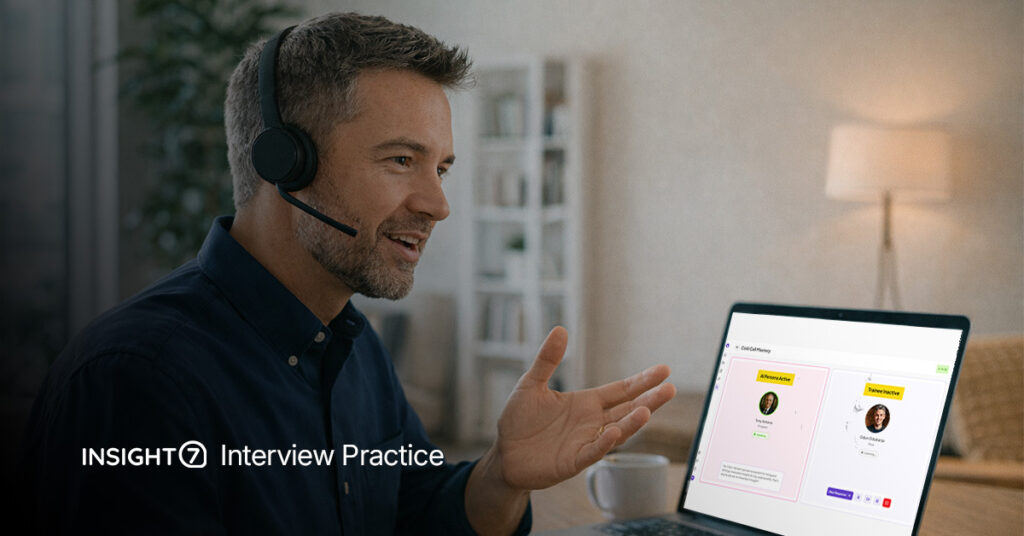
US Foods People and HR interviews evaluate your judgment in talent and organizational decisions across a large, publicly traded foodservice distribution company with a diverse workforce spanning warehouse associates, drivers, field sales teams, and corporate functions. Interviewers focus on whether your assessments are grounded in observable behavioral evidence, whether your talent decisions balance empathy with accountability, and whether your outcomes are specific enough to evaluate. Expect behavioral questions about performance management, hiring decisions, employee relations, and workforce development in a high-turnover hourly and field sales environment.
Start your free US Foods People & HR practice session.
What interviewers actually evaluate
Behavioral Judgment, Talent Decisions, and Empathy with Rigor
US Foods People and HR interviews assess whether you can make consequential talent decisions, including performance exits, promotion choices, and development investments, with both compassion and a defensible, documented rationale. Interviewers want to see that your judgments are based on observable behavior rather than impression, that you maintain standards while treating people with dignity, and that your outcomes are specific and traceable. Candidates who describe HR programs or processes without linking them to talent or organizational results consistently underperform.
Behavioral judgment, talent decision quality, empathy plus rigor balance, outcome specificity, distribution workforce context
What gets scored in every session
Specific, sentence-level feedback.
| Dimension | What it measures | How to answer |
|---|---|---|
| Behavioral Judgment | Were your assessments grounded in documented, observable behavior rather than perception or pattern-matching? We score for specific incidents cited, documentation referenced, and criteria applied consistently across individuals. | Observable behavior, documentation, consistency |
| Talent Decision Quality | Was the talent decision sound and did it hold up over time? We score for decision rationale, stakeholder alignment, and post-decision outcomes including retention, performance change, or organizational health improvement. | Decision rationale, alignment, post-decision outcome |
| Empathy + Rigor Balance | Did you maintain standards while treating the individual with dignity? We flag answers that sacrifice one for the other: pure empathy without accountability, or rigid process without human consideration. | Standards maintained, dignity preserved, both elements present |
| Outcome Specificity | What measurably changed in the team or organization? We look for specific outcomes: retention rate improvement, engagement score change, time-to-fill reduction, or performance uplift tied to your HR intervention. | Specific outcome, measurable delta, timeframe |
How a session works
Step 1: Get your US Foods People & HR question
Questions target where HR candidates most often fall short in US Foods interviews: outcome specificity and the empathy-rigor balance in high-turnover, operationally diverse workforce environments. Each session starts with a new question focused on a different evaluation dimension.
Step 2: Answer by voice
Speak your answer as you would in a real interview. The AI listens for STAR structure with emphasis on behavioral evidence in your Action section and a specific organizational or talent outcome in your Result.
Step 3: Get scored dimension by dimension
Instant scores across all four rubric dimensions with a flagged weakness and a sentence-level fix for each. US Foods interviewers expect HR candidates to demonstrate both human judgment and commercial accountability, and this session applies the same standard.
Step 4: Re-answer and track improvement
Revise based on feedback and answer again. See the before/after score change across Behavioral Judgment, Talent Decision Quality, Empathy + Rigor Balance, and Outcome Specificity. Your gap profile updates so recurring weaknesses shape your next question assignment.
Frequently Asked Questions
What questions does US Foods ask in People and HR interviews?
US Foods People and HR interviews are behavioral and often set in high-volume, multi-site distribution workforce contexts. Common questions include: "Tell me about a performance management situation you owned from diagnosis to resolution," "Describe a hiring decision you are proud of and the outcome it produced," "Walk me through a time you had to hold an employee or manager to a standard they resisted," and "Tell me about a time you improved retention or engagement at a location or within a team." Interviewers probe for behavioral evidence and measurable results.
How does US Foods handle HR for hourly distribution workers versus salaried corporate employees?
US Foods has distinct HR structures for its distribution center and driver workforce versus its corporate and field sales populations. HRBP roles supporting operations deal heavily with labor relations, attendance management, safety compliance, and frontline leadership development. Corporate HR roles deal more with talent acquisition, succession planning, and organizational effectiveness. Interviewers in both tracks expect outcome specificity, but the context and metrics differ significantly.
Does US Foods have union labor considerations in HR interviews?
US Foods has both union and non-union facilities across its distribution network. If you are interviewing for an operations HR role, be prepared to discuss labor relations experience, grievance handling, and how you navigate a unionized workforce environment. Candidates who have managed labor agreements or led contract negotiations can differentiate themselves, but knowledge of the principles of constructive labor relations is sufficient for most HR generalist roles.
What are the most common failure modes in US Foods People and HR interviews?
The most consistent failures are: describing HR processes rather than the talent decisions and their outcomes, providing results that are vague rather than specific and measured, demonstrating pure empathy without showing that standards were enforced, failing to establish personal ownership of the outcome, and citing program or initiative credit without explaining your individual contribution.
How do I prepare if my HR experience is in a professional services or technology environment?
Focus on the universality of the core HR competencies: behavioral assessment, talent decisions, and organizational outcomes. Research US Foods' workforce profile, including the mix of CDL drivers, warehouse associates, field sales representatives, and corporate employees. Show that you can adapt your HR approach to a high-turnover, safety-critical, hourly workforce context. If you have experience with large hourly workforces, frontline management development, or multi-site HR, lead with those stories.
Also practice
All nine US Foods role interview practice pages.
- Sales
- Customer Service
- Product Management
- Marketing
- Finance
- Operations
- Leadership
- Legal & Compliance
One full session free. No account required. Real, specific feedback.








