


In high-ticket, one call close sales, every call is the only call.
There is no follow-up sequence. No second meeting. No recovery email. You either close on that call or the opportunity is gone.
This reality changes everything about how performance must be measured, coached, and optimized.
This buyer guide is written for high-ticket sales leaders evaluating revenue intelligence platforms built specifically for one-call-close environments. It covers:
-
What revenue intelligence means in a one-call-close model
-
Whether your team is ready
-
What to look for in a platform
-
What it actually costs
-
How to evaluate vendors
-
How to implement successfully
-
How to measure ROI
So you can make a confident, informed decision before signing a contract.
Why One Call Close High-Ticket Sales Is Structurally Different
In traditional sales teams, deals unfold over weeks or months. There are multiple touchpoints, pipeline stages, and opportunities to recover from mistakes.
In one-call-close sales, the margin for error is effectively zero.
The moment a rep hangs up without a commitment, the lead goes cold.
There is no nurture sequence. No second shot.
This model is common in high-ticket industries such as:
-
Insurance
-
Healthcare services
-
Financial services
-
Manufacturing and equipment sales
Because revenue is won or lost inside a single conversation, performance visibility must operate at the call level – and it must be fast.
Most revenue intelligence platforms were built for multi-touch B2B environments. They focus on pipeline tracking, deal stages, and long sales cycles.
One-call-close teams operate under completely different constraints:
-
Same-day coaching matters
-
Script execution precision matters
-
Objection handling quality matters
-
First-call conversion rate is the core KPI
This guide helps you evaluate platforms designed for that reality
What Is Revenue Intelligence for One Call Close Sales?
Revenue intelligence for high-ticket, one-call-close sales is the use of AI to analyze 100% of sales conversations, identify the exact moments where revenue is won or lost, and turn those insights into actionable coaching before the next live call.
In high-ticket environments, a single lost call can represent thousands – sometimes tens of thousands – in revenue. There is no second meeting to recover it.
Because the entire sales cycle happens inside one conversation, performance visibility must operate at the call level – and it must move fast.
Revenue intelligence in this context must answer operationally critical questions like:
-
What do top closers do in the first 60 seconds that average reps don’t?
-
Which objections are consistently ending high-ticket calls before the close?
-
At what exact point in the conversation are deals being lost?
-
What behaviors correlate with post-sale cancellations?
-
How do we replicate our best rep’s performance across the entire team?
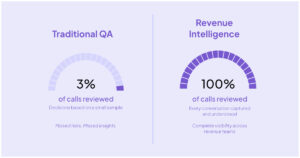
Traditional QA processes review 1–3% of calls manually. Revenue intelligence analyzes 100% of conversations using AI.
Instead of anecdotal feedback, you get:
-
Pattern recognition across thousands of high-ticket calls
-
Call-level conversion diagnostics
-
Behavior-level performance data
-
Structured practice environments that improve reps before they are live again
For high-ticket, one-call-close teams, delayed coaching equals lost revenue. Insights must translate into same-day improvement.
Why Most Revenue Intelligence Platforms Aren’t Built for One Call Close Sales
Most dominant revenue intelligence tools – including Gong, Chorus.ai, and Clari – were designed for multi-touch B2B sales cycles and long pipeline management.
Their architecture prioritizes:
-
Deal progression tracking
-
Forecasting accuracy
-
Pipeline visibility across weeks or months
-
Executive reporting at the opportunity level
High-ticket, one-call-close sales operate under different economic constraints:
-
The entire revenue opportunity lives inside a single call
-
First-call conversion rate is the primary KPI
-
Objection handling precision directly impacts revenue
-
Coaching must be immediate to prevent repeat losses
When revenue is decided in 30–60 minutes, the platform must treat that call as the complete sales cycle – not as one stage in a longer journey.
Is Your High-Ticket Sales Team Ready?
Revenue intelligence creates the greatest impact when sufficient call volume and coaching discipline exist.
Strong Fit
-
25+ reps and 1,000+ calls per week
-
High-ticket, close-or-lose model on the first call
-
Top reps outperform average reps by 2x or more
-
Scaling faster than new hires can be trained
-
Post-sale cancellations are eroding booked revenue
-
Call recordings, CRM data, and dialer API access available
These conditions generate enough data for AI to identify meaningful patterns in high-ticket conversion performance.
Not Ready Yet
-
Fewer than 25 reps or under 500 calls per week
-
No call recordings
-
Managers do not currently coach
-
Leadership expects a “set it and forget it” solution
Revenue intelligence amplifies a coaching culture — it does not replace one.
What Does Revenue Intelligence for High-Ticket Sales Actually Cost?

Most vendors quote per-seat pricing.
For a high-ticket sales team with ~100 users, the fully loaded Year 1 cost typically looks like this:
| Cost Category | Typical Range |
|---|---|
| Platform fees | $80K–$150K / year |
| Implementation & integration | $10K–$50K |
| IT and RevOps time | $20K–$40K |
| Manager time | $20K–$40K |
| Change management | $15K–$40K |
| Year 1 Total | $150K–$320K |
A practical budgeting rule:
Plan for 2–2.5x the quoted platform fee in Year 1.
This reflects internal time, rollout effort, and change management — not just software.
The Hidden Cost: Failed Implementation
The largest financial risk is not the platform fee. It is a stalled rollout.
Low adoption, minimal behavior change, no measurable ROI — followed by migration to another platform 12–18 months later — can easily double the original investment when you factor:
-
Lost optimization gains
-
Internal rework
-
Management distraction
-
Contract overlap
Getting vendor selection and rollout right matters more than negotiating a 10% discount.
Benefits and Drawbacks
Benefits
1. More Closed Deals at the Same Call Volume
In high-ticket, one-call-close sales, a 1–2% lift in first-call conversion rate generates incremental revenue without:
-
More leads
-
More headcount
-
More marketing spend
It compounds across thousands of calls.
2. Precision Diagnosis of Call Breakdown
AI identifies where deals fall apart:
-
Weak opening
-
Poor objection handling
-
Missed buying signals
-
Mistimed close
Coaching becomes targeted instead of anecdotal.
3. 100% Call Coverage
Traditional QA reviews 1–3% of calls.
Revenue intelligence analyzes all of them.
Managers move from sample-based coaching to pattern-based coaching.
4. Faster Ramp Time
New hires practice real objections before facing live customers.
Best-in-class teams report 20–30% faster time-to-quota when structured coaching workflows are consistently applied.
5. Lower Cancellation Rates
Behavioral signals in the original sales call often predict cancellations.
Platforms that identify hesitation patterns early can trigger intervention before revenue is lost.
For teams with high cancellation rates, even a 10–15% reduction can materially impact revenue — sometimes matching the impact of conversion improvement.
Drawbacks
1. Year 1 Costs More Than Expected
Under-budgeting implementation is the most common mistake.
Plan for internal time and change management from the start.
2. Results Take 3–6 Months
Behavior change takes time.
Teams that expect measurable ROI in 30 days often abandon initiatives prematurely. Align leadership expectations before launch.
3. It Requires Active Coaching
The platform surfaces insights.
Managers must act on them.
Revenue intelligence amplifies a coaching culture — it does not replace one.
4. Most Failures Are Execution Failures
Industry-wide, stalled rollouts are usually caused by:
-
Weak executive sponsorship
-
Inconsistent manager cadence
-
Poor change management
Technology is rarely the root cause.
How to Evaluate Revenue Intelligence Vendors
The Scorecard
Score each vendor from 1-10.
Identify your top 5 non-negotiables first – a low score on a critical criterion outweighs a high total score.
| Criterion | What to Verify |
|---|---|
| Built for one-call-close | 3 customer references in your industry |
| First-call conversion analysis | Does it analyze the call itself — or just log it? |
| Same-day insights | How quickly after a call ends does it appear? |
| Dialer + CRM integration | Live demo with your stack |
| AI coaching + objection practice | Observe a real roleplay workflow |
| Cancel rate prediction | Measured accuracy and methodology |
| Manager workflow | Have a manager demo daily usage |
| Verified references | 9+ months live, similar volume |
| Transparent pricing | Fully loaded Year 1 cost |
| Pilot before commitment | 60–90 day evaluation period |
80+: Strong fit
60–79: Proceed carefully
Under 60: Continue evaluating
Questions to Ask Vendors
-
“What does your platform not do well for one-call-close environments?”
-
“Show me first-call conversion analysis — not pipeline analytics.”
-
“What percentage of implementations stall in the first six months?”
-
“Connect me with a customer 9+ months into rollout in consumer sales.”
-
“How is cancel prediction accuracy measured?”
Vendors that answer precisely tend to have operational depth.
Red Flags
-
No pilot before annual commitment
-
“On the roadmap” for core features
-
Integration requires custom internal development
-
References are all < 6 months live
-
Support is documentation-only
How to Implement Successfully
Why Rollouts Fail
Approximate breakdown across implementations:
-
40% — Weak executive sponsorship
-
35% — Poor change management
-
15% — Wrong vendor selection
-
10% — Unrealistic expectations
The strongest predictor of success is sustained weekly cadence for 6+ months.
Teams that maintain weekly manager reviews, structured coaching assignments, and visible wins consistently outperform those that treat rollout as a one-time launch event.
The Four Phases
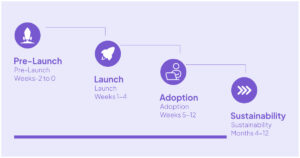
1. Pre-Launch (Weeks −2 to 0)
-
Train managers first
-
Frame as performance development, not surveillance
-
Align on metrics and cadence
2. Launch (Weeks 1–4)
-
Hands-on rep usage from Day 1
-
First coaching assignment within 24 hours
-
Tie platform activity to real call outcomes
3. Adoption (Weeks 5–12)
Maintain cadence:
-
Weekly coaching focus
-
Public wins
-
One team-level metric
Consistency matters more than intensity.
4. Sustainability (Months 4–12)
-
Integrate into promotion criteria
-
Introduce advanced features gradually
-
Make it “how we work,” not an initiative
How to Measure ROI
Ignore vanity metrics:
-
Calls analyzed
-
Scenarios completed
-
Accounts created
-
Platform uptime
Track leading indicators:
-
Daily active users (target: 70%+)
-
Coaching completion rate (target: 80%+)
-
Weekly manager dashboard reviews
-
Rep NPS (target: 50+ by Month 3)
These support outcome metrics:
-
First-call conversion rate
-
Post-sale cancellation rate
-
New rep ramp time
-
Rep retention
ROI Formula
Incremental Revenue
= Reps × Calls per day × Working days × Conversion lift % × Average deal value
ROI
= (Incremental revenue − Total cost) ÷ Total cost × 100
Do not exclude cancellation reduction from the model.
For teams with elevated cancel rates, retention gains often materialize faster than conversion lift.
Typical ROI Ranges (When Properly Implemented)
-
Conservative (1.5–2% lift): 300–600%
-
Realistic (2–3% lift): 800–1,500%
-
Best-in-class (3–5% + cancel reduction + faster ramp): 2,000%+
Results depend heavily on coaching consistency and call volume.
Frequently Asked Questions
How is revenue intelligence different from call recording software?
Call recording stores conversations. Revenue intelligence analyzes them – scoring every call, identifying what top performers do differently, and generating coaching.
How is Insight7 different from Gong or Chorus.ai?
Gong and Chorus focus on multi-touch B2B pipelines. Insight7 is built for high-volume, one call close teams – first call conversion analysis and objection-focused coaching.
How long before we see results?
Behavior changes typically appear in 6-12 weeks. Conversion lift usually follows in 3- 6 months. Evaluating at 30 days is too early.
What’s the minimum team size to see ROI?
Generally 25+ reps and 1,000+ calls per week. Below that, data volume and economics become harder to justify.
What happens to our data if we cancel?
It should be fully exportable (CSV or JSON) and accessible for at least 90 days post-cancellation. Get this in writing before signing.
Why Consider Insight7?
There’s no shortage of revenue intelligence tools on the market. Most were built for long sales cycles – multiple touchpoints, extended pipelines, teams with dedicated analysts. If that’s not your world, you’ve probably felt the mismatch.
Insight7 was built differently. It’s designed specifically for teams where the entire revenue opportunity lives inside a single conversation. Here’s what that looks like in practice.
“It’s a great tool, and I am using it more everyday. The time to insight is impressive – it enables me to take customer interactions and turn them into insights I can act on.” — Ryan Levander, Head of Analytics, Rednavel Consulting
Revenue Intelligence
Funnel stage tracking shows how calls move through Opening, Discovery, Proposal, and Close in real time. Drop-off analysis pinpoints exactly where deals stall – with evidence pulled directly from the conversation. Winning behaviors surface what top closers do differently so you can replicate it team-wide. For one-call-close teams, this is the difference between guessing why conversion is flat and knowing exactly which moment to fix.
AI Coaching
Reps practice with realistic AI scenarios, receive personalized scorecards with specific coaching tips, and track skill development over time – without requiring a manager to be present for every session. In a one-call-close environment, reps need to have handled every objection before it appears on a live call. Insight7 makes that possible, on demand.
Automated QA & Scoring
Every call is evaluated automatically – talk time, words per minute, filler words, speaker balance, sentiment, and custom quality criteria, all scored the moment a call ends. Strengths and weaknesses are identified per rep, with coaching points backed by evidence. Managers stop reviewing a handful of calls and hoping they caught the right ones. Every rep gets feedback, every time – fast enough to use before the next call.
Security and compliance
SOC 2 certified · HIPAA compliant · GDPR compliant · Data encrypted at rest and in transit · Role-based access controls · Multilingual support
The Call Ends In minutes. The revenue Impact Lasts All Year.
Every call is the only call. No recovery email, no follow-up meeting, no second chance. The teams winning in one-call-close aren’t working harder — they’re learning faster. They know what their best reps do differently, they practice the moments that matter before going live, and they catch at-risk deals before they cancel.








