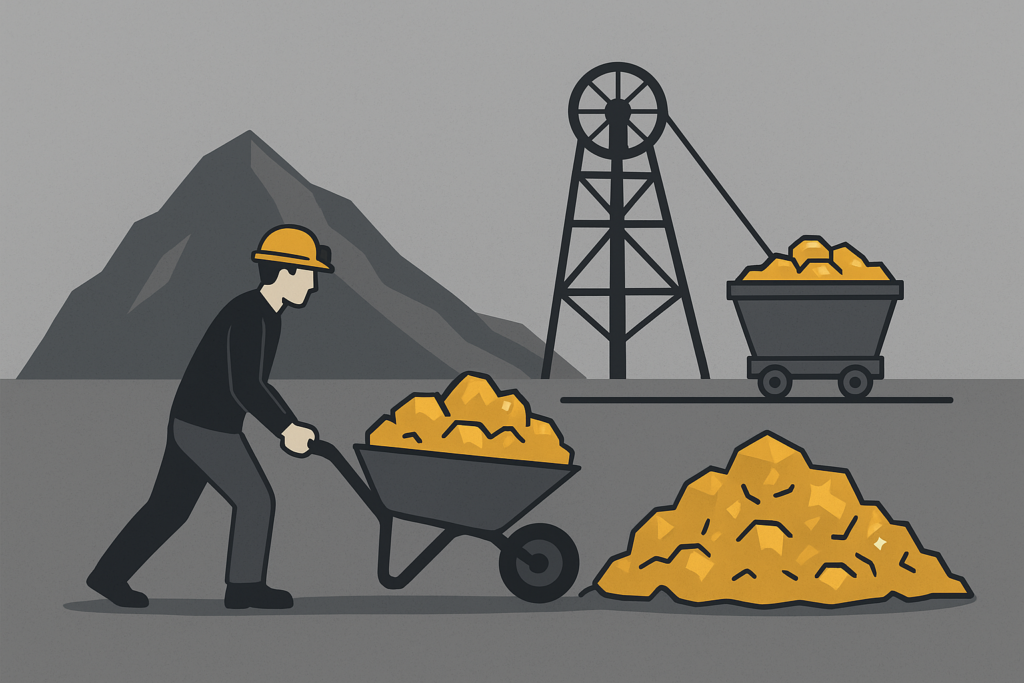

Did you know that analyzing a transcript conversation isn’t straightforward? Well, neither did I! 🤷🏽♂️ When I first started building analysis and evaluation products at Insight7, I quickly realized that working with conversational data presented a plethora of challenges that required more than just technical know-how. So grab your favorite cup of coffee, and let’s dive into the gold mine that is transcript analysis!
Why Transcript Analysis Is Harder Than It Looks
Conversational data is rich with insights but is often messy and unstructured. It may seem like a straightforward process—record a conversation, get a transcript, and voilà! But the reality is far more complicated. Here are some of the hidden challenges:
- Compartmentalization: There’s no one-size-fits-all approach to transcripts. Different types require different handling.
- Lack of Numerical Data: Conversations are text-heavy, and extracting quantifiable data is no small feat.
- Disjointed Transcripts: Sometimes, you’ll encounter transcripts where the information is scattered, making it difficult to analyze.
Common Misconceptions About Transcript Analysis
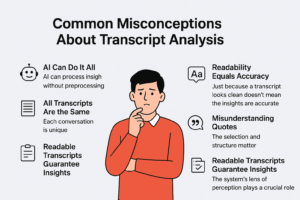
Many sales and customer service teams harbor misconceptions about transcript analysis that can lead to missed opportunities. Here are a few:
- AI Can Do It All: A prevalent belief is that AI can process insights without preprocessing. However, no model performs well with disjointed and unstructured data.
- All Transcripts Are the Same: Each conversation is unique. For instance, internal calls differ significantly from client calls, requiring separate handling.
- Readability Equals Accuracy: Just because a transcript looks clean doesn’t mean the insights derived from it are accurate. The system’s interpretation can differ from human understanding.
- Misunderstanding Quotes: Users often assume that any given quote can represent the data accurately, but the selection and structure matter greatly.
- Readable Transcripts Guarantee Insights: The assumption that a readable transcript guarantees accurate insights is misleading; the system’s lens of perception plays a crucial role.
The Nature of Conversational Data
Conversational data is inherently complex. Unlike structured data, which fits neatly into rows and columns, conversations are fluid and often contain nuances that can be easily overlooked. Here are some common problems with raw transcripts:
- Ambiguity: Names can be misidentified or coded as letters (e.g., ‘A’ for ‘InsightLeader’), complicating analysis.
- Disorganized Format: From PDFs to voice recordings, the format can vary greatly, impacting how you extract valuable insights.
The Core Pipeline: Clean → Process → Identify
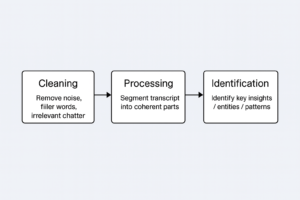
To tackle the messiness of conversational data, we often follow a core pipeline:
Cleaning
This is the first step where standard data cleaning procedures come into play. You need to ensure that the text is free from noise—think filler words, background chatter, or irrelevant comments.
Processing
Once cleaned, the next step is to preprocess the data. This involves segmenting the transcript into coherent parts, making it easier to manage. For instance, separating comments by users allows for clearer analysis.
Identification
This step involves identifying the speakers and the context of the conversation. Are you dealing with a focus group, a tutorial, or a one-on-one interview? The answer shapes how you approach the analysis.
Solving Transcript Problems With Practical Techniques
Now that we’ve laid the groundwork, let’s explore some practical techniques for overcoming common transcript challenges:
Detecting Conversation Types
Identifying call types helps in processing different transcripts effectively. For example, insights gleaned from a focus group can differ significantly from those derived from a tutorial.
Using AI + Analysis Models for Metadata Extraction
Leveraging AI models allows us to glean essential metadata from conversations—like identifying customers, their company size, or even specific sentiments expressed during the call.
Structuring Transcripts With Index Parsing
I developed an index parsing approach that manipulates text to create a structured format, making it easier to analyze and retrieve information.
Hybrid Named Entity Recognition (NER)
A mix of LLMs (Large Language Models) and rule-based methods can tackle the challenge of identifying speakers—even when names are outliers or coded.
Handling Disjointed Transcripts
Disjointed conversations can be tricky. The best technique I’ve found involves using an LLM to process the entire conversation. While it’s a costly approach, it tends to yield the most accurate results.
Real-World Impact of Transcript Analysis
In dozens of real-world cases working with Insight7, transcript analysis didn’t just save time — it revealed patterns and opportunities that teams acted on immediately. For example, sales teams discovered that customers were dropping off not because of price, but due to integration and implementation concerns, prompting demos and onboarding changes that boosted close rates. Customer-service operations exposed frustration not with response speed but with repeated handoffs and conflicting answers — leading to the adoption of an owner-agent model and higher CSAT scores. On the coaching front, managers used transcript-driven metrics (like talk ratio, missed value-recaps, failure to “ask next step”) to give precise feedback, resulting in improved call quality and more predictable follow-ups. Product teams even used recurring customer complaints to drive roadmap changes, showcasing how Insight7 makes analyzing interviews faster and more impactful.
Can You Extract Goals From Transcripts? Absolutely.
With a refined system that adequately identifies various conversation types, we can effectively analyze and evaluate transcripts. This capability empowers CEOs and project managers to make insightful decisions based on their data.
How Insight7 Makes This Entire Process Automatic
At Insight7, we’ve developed cutting-edge tools that automate the transcription and analysis of conversations in over 60 languages. Here’s how we deliver value:
- Clear Actionable Insights: We surface recurring themes, sentiment, pain points, and meaningful quotes.
- Visualization: Our dashboards, journey maps, and scorecards help visualize findings for easy interpretation.
- Collaboration and Reporting: Designed for product, sales, CX, and research teams, our platform supports collaboration and evidence-based decision-making—all while ensuring enterprise-grade security.
Conclusion
In sales and customer service, understanding conversations isn’t just about transcripts; it’s about transforming unstructured data into actionable insights. By embracing the challenges of transcript analysis, we can extract the gold nuggets that lie within conversations and drive informed decision-making.
Ready to unlock the potential of your conversational data? Join the ranks of successful sales and customer service teams by leveraging Insight7’s powerful tools. Let’s turn your conversations into actionable insights today!